

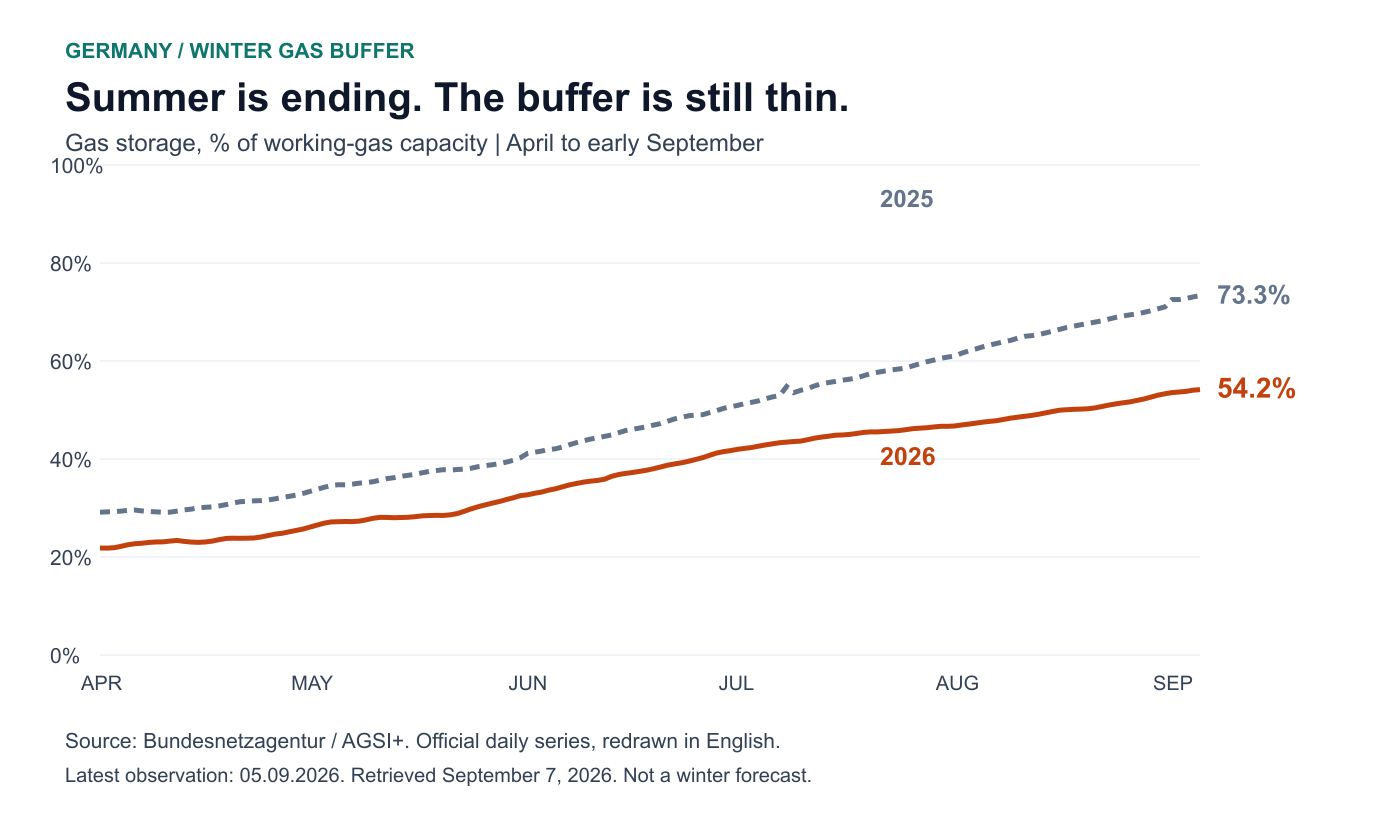
Gas was expensive, so filling the storage sites looked unattractive. Now the heating season is approaching, and Germany still has almost half its storage space empty.
The latest official storage series, updated September 7, puts the September 5 reading at 54.16%. On the same date last year, it was 73.33%. That is a gap of roughly 19 percentage points before the first sustained cold spell.
This does not mean Germany is about to run out of gas. It means the country has less room for something to go wrong. And for investors, there is an important difference between owning gas, owning an export terminal, and owning a company that has to buy gas to stay open.
Waiting Has a Cost That Does Not Show Up on the Quote Screen
Buying gas for storage means paying for the fuel now, financing it, and paying to hold it. If the expected winter selling price does not cover those costs, waiting can make commercial sense.
But what makes sense for an individual buyer can leave the whole market short of a cushion.
In its August warning, Germany's transmission operators said high prices were discouraging injections. The reported seven-day pace was about 0.5 terawatt-hours a day. As temperatures fall, more incoming gas goes straight to customers, leaving less available to put underground.
Paying more later can attract a cargo. It cannot give back a lost summer.
That is the risk worth following: buyers trying to rebuild reserves at the same time households start using them. It is a conditional squeeze, not a forecast that prices must rise every week.
A Terminal Is Not a Full Storage Site
The obvious response is that Germany can import more liquefied natural gas. It can. But a receiving terminal is an entry point, not a stockpile.
The operators estimate that domestic LNG terminals can meet just under 10% of demand on a typical winter day. That does not count all gas arriving through neighboring countries; it shows why Germany's own terminals cannot replace the combination of pipeline imports and stored gas.
Storage provides something a ship at sea does not: fuel already inside the system, available when demand jumps. A cold spell, a delayed cargo or a pipeline outage becomes more expensive when that buffer is thin.
The regulator also stresses that security depends on imports, infrastructure, storage and demand together. A low fill percentage alone is not evidence of imminent rationing.
The Ticker Is LNG. The Business Is More Complicated.
Cheniere Energy looks like an obvious place to start. It has operating export facilities, not just plans for them. On August 31, it announced substantial completion of its Corpus Christi Stage 3 project.
Its second-quarter exports rose from 550 to 672 trillion British thermal units, about 22%. It also raised full-year adjusted EBITDA guidance to $7.9 billion-$8.4 billion.
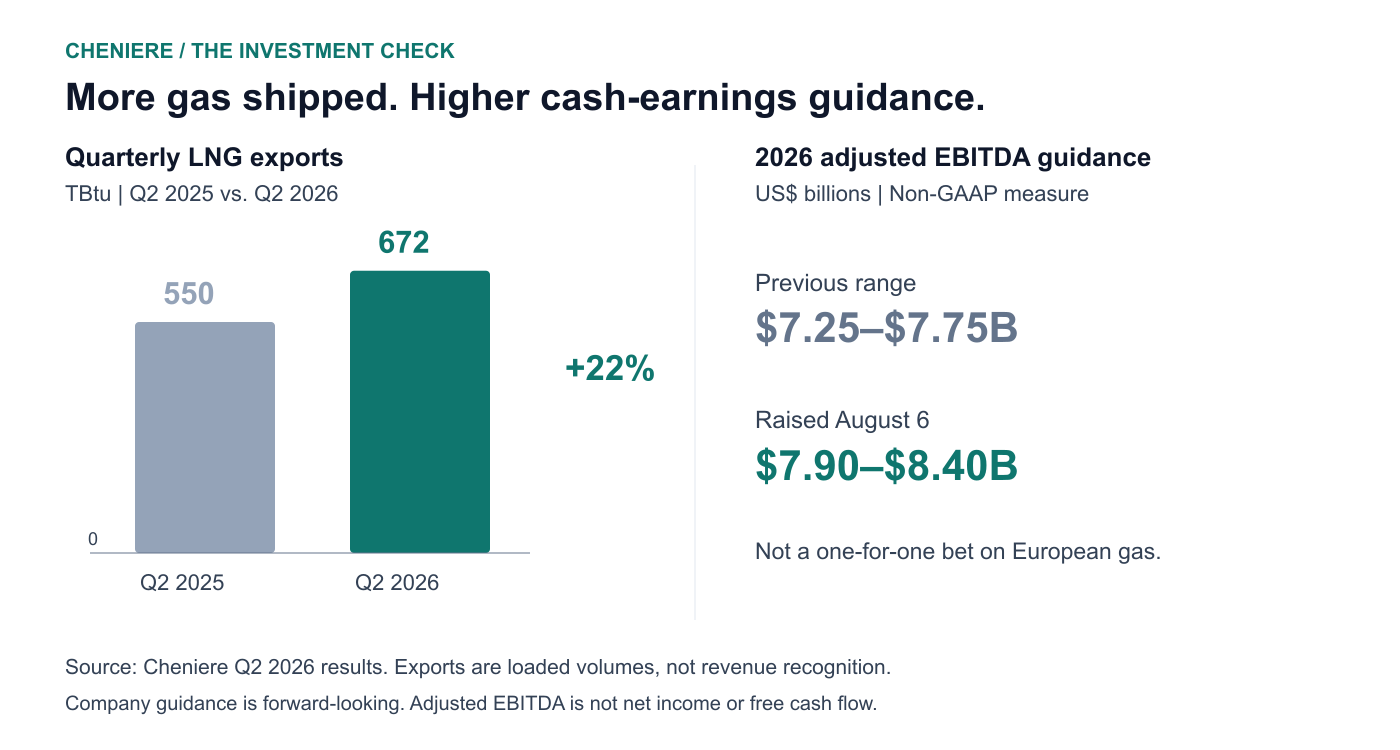
But Europe's gas price is not Cheniere's profit margin. Long-term contracts often separate a fixed liquefaction fee from the cost of the feedstock. At its listed subsidiary Cheniere Energy Partners, many contracts generally charge a fixed fee plus 115% of Henry Hub, the U.S. gas benchmark. The variable portion is intended to cover gas supply, transport and fuel, not become pure profit.
That leaves two different things to investigate: dependable contracted earnings, and the additional margin from flexible cargoes and trading. Do not apply Europe's spot-price surge to every tonne the company exports.
Three Ways to Buy the Story. Three Different Risks.
Cheniere (LNG): study additional production, marketing margins, capital spending and valuation. Its improved guidance is public information, not a hidden catalyst. A useful test is whether the shares still make sense with less dramatic gas prices.
EQT: a U.S. producer is a different exposure. Check domestic realized prices, transport constraints and hedges. Its first-quarter discussion put the start of its LNG-contract cash-flow opportunity in 2030. A future international pricing story should not be mistaken for a direct windfall this winter.
UNG: the fund tracks a Henry Hub futures benchmark, not European TTF gas. Export demand can connect the markets, but export capacity limits that connection. Futures rolling and expenses add another source of difference. Being right about Germany does not guarantee being right about UNG.
On the other side are European manufacturers using gas as fuel or feedstock. Their vulnerability depends on hedges and their ability to raise selling prices. A headline about expensive gas is a reason to inspect those details, not to short every chemical company.
What Would Make This Trade Disappear?
Start with the weekly storage change, not the next frightening headline. Faster injections and a narrowing year-on-year gap would weaken the squeeze. So would mild weather, reliable pipeline flows, or more LNG actually arriving.
Then watch TTF against U.S. Henry Hub and Asian LNG prices, after allowing for freight and processing costs. Europe's need matters to exporters only when the contracts and available capacity let them capture the economics.
Finally, separate a tightening physical market from an already expensive stock. A real shortage can still be a bad investment if the purchase price assumes a worse winter than the one that arrives.
Germany does not need to run out of gas for this to matter. It only needs to have fewer alternatives when the next shipment gets expensive.
As of September 7, 2026. The latest storage observation used is September 5; official data can be revised. Charts reproduce cited data, not forecasts. Company and fund examples distinguish exposures and are not buy or sell recommendations. No share-price target or expected return is implied.








Comments
No comments yet