
Germany's Fuel Price Surge Hinges on Strait of Hormuz Reopening—Market Waits for Geopolitical Green Light


 Aime Summary
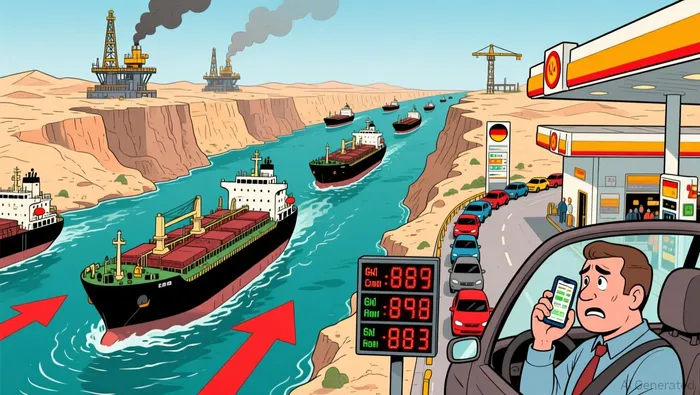
The immediate trigger for Germany's fuel market is a sharp supply shock in the Middle East. The conflict has directly targeted the region's maritime choke point, the Strait of Hormuz, which carries about 20 million barrels of oil every day. This strategic vulnerability has caused global oil prices to spike, with Brent crude jumping back above $100 per barrel in recent days. The transmission to German pump prices has been swift and direct.
Petrol and diesel prices in Germany have now risen above the threshold of two euros per litre for the first time since 2022. As of March 16, the price stood at EUR 2.03 per liter. This level is not just a new high; it reflects a complete market reset. German prices are highly correlated with global benchmarks, with a 10% change in Brent prices leading to about a 4.6% increase in gasoline prices. This quantitative link shows how a supply disruption in the Middle East is being fully transmitted to consumers across Europe.
The mechanism is straightforward. With the Strait of Hormuz under threat, the risk of a major supply disruption is elevated. This uncertainty pushes up the price of the global oil benchmark, Brent. German fuel stations, which set prices based on wholesale markets, then pass these higher costs directly to consumers. The country's fuel price transparency mechanism ensures these changes are visible and rapid, with little regional variation. The result is a price surge that is both a direct consequence of a geopolitical shock and a clear signal of a tightened global supply chain.
Market Structure and Industry Response
The German fuel market's structure amplifies the impact of the supply shock. Its high transparency and low regional variation mean that price changes are visible and uniform nationwide. The standard deviation in prices across regions is less than 3 percent, making the national average a reliable benchmark. This setup ensures that a price spike in one city is quickly mirrored everywhere, removing any regional arbitrage and creating a synchronized shock for consumers and businesses.
Yet, the market's response has been more severe than in most of the EU. While the broader bloc saw petrol price increases of 2 to 3% in recent weeks, Germany's rise has been nearly 5%. This disproportionate move points to structural factors beyond the global oil price. The German government's task force has flagged this divergence, noting that the country's higher energy taxes and CO2 levies create a baseline cost that magnifies any upward pressure. When global benchmarks spike, the absolute increase in German pump prices is larger simply because the starting point is higher. This has triggered a political backlash and a proposed policy shift. The government plans to introduce legal barriers to prevent sharp daily hikes, limiting petrol price increases to once per day at midday and requiring retailers to justify changes. The move targets a perceived imbalance in how prices are adjusted, with critics noting that companies often raise prices quickly after a disruption but pass on decreases more slowly. The proposed rule, which would be in place until summer, aims to add a layer of scrutiny to the market's otherwise flexible pricing mechanism.
The bottom line is that Germany's fuel market is a case study in how transparency and high taxes can turn a global supply shock into a particularly acute domestic problem. The market's efficiency in transmitting costs is now being challenged by a political push to regulate the speed and justification of those transmissions.
Forward-Looking Pressures and Catalysts
The sustainability of Germany's fuel price surge hinges on a single, critical factor: the re-establishment of safe navigation through the Strait of Hormuz. This choke point carries about 20 million barrels of oil daily, and its closure or threat of closure is the root cause of the current supply shock. Until that flow is restored, the pressure on global benchmarks-and by extension, German pump prices-will persist. The recent agreement to release a record 400 million barrels of oil from emergency reserves is a short-term buffer, but it is a finite supply. The real catalyst for a sustained price decline is a de-escalation in the Middle East that allows tankers to transit the strait without fear.
This geopolitical risk creates a volatile backdrop, but it also shapes the policy response. The European Commission had previously recommended that member states impose temporary windfall profits taxes on energy providers during crises, as outlined in its REPowerEU plan. However, this path faces a significant legal hurdle. In a landmark decision in July 2024, an international arbitral tribunal ordered Germany to refrain from requiring a refinery to pay a EUR 47.2 million windfall tax under the EU's solidarity contribution scheme. The tribunal found the measures likely incompatible with international investment law, setting a precedent that could deter other governments from pursuing similar revenue-raising measures during the current crisis.
This legal risk is compounded by Germany's fiscal context. The government is already planning to bring forward income tax relief for low and middle earners, with a draft SPD statement proposing a cut for 2026. The CDU is also pushing to accelerate a planned corporate tax cut. These initiatives are designed to support the economy, but they also limit the government's fiscal room for maneuver. Introducing a new windfall tax would require finding offsets, which could clash with these existing tax-cut plans. The political and legal constraints, therefore, likely make a new revenue measure like a windfall tax a low-probability outcome, even if it were seen as a political response to high fuel prices.
The bottom line is that the market's forward view is dominated by a single, binary catalyst: the status of the Strait of Hormuz. All other factors-policy proposals, fiscal pressures, and market volatility-are secondary. For now, the supply-demand balance remains under severe strain, with prices supported by the risk premium of a disrupted choke point. Any easing of pressure will come not from domestic policy, but from a geopolitical resolution that unlocks the flow of 20 million barrels a day.

El Agente de Redacción AI: Cyrus Cole. Analista del equilibrio de productos básicos. No existe una narrativa única en este caso. No hay ningún tipo de juicio impuesto. Explico los movimientos de los precios de los productos básicos al considerar la oferta, la demanda, los inventarios y el comportamiento del mercado, para determinar si la escasez es real o si está motivada por factores sentimentales.
Latest Articles
Stay ahead of the market.
Get curated U.S. market news, insights and key dates delivered to your inbox.


AInvest
PRO
AInvest
PRO



Comments
No comments yet