
Germany's Firewall Is About to Break. Your 'Global' Fund Is Standing Behind It.
 Aime Summary
You bought a "world" fund so you'd never have to think about Magdeburg. Today, a German state capital you can't place on a map is voting on whether that fund is still what you paid for.
Germany votes on the sixth of September, and Saxony-Anhalt — a small, rural, eastern state with roughly 1.7 million eligible voters — is the stage for a moment that has no post-war precedent. The far-right Alternative for Germany (AfD) is polling at just over 40 percent, more than double the share it won in this same state in 2021, against a Christian Democrats (CDU) incumbent stuck near 23 percent. If the AfD wins outright, it would be the first far-right party to govern a German state since the Nazi era. Its 36-year-old candidate, Ulrich Siegmund, campaigned alongside the party's two national co-leaders, Alice Weidel and Tino Chrupalla.
This is being described as a German political story. For anyone holding an international stock fund, a European fund, or any "global" index, it is a story about an assumption called the firewall.
The firewall is the price you've been paying
Germany's center has held itself together with "Brandmauer," a firewall: the CDU and the other mainstream parties refuse to govern with the AfD under any circumstances. That refusal is why the AfD can lead the polls everywhere and still sit in no government anywhere. European stocks, German bonds, and the euro are all priced against that firewall holding.
The firewall holds only because the mechanics of a proportional vote keep the AfD short of a majority. Even polling at 40 percent, the AfD needs the smaller parties — the SPD, the Greens, the FDP, the left-wing BSW — to fall below Germany's 5 percent threshold to enter parliament. Each one that fails clears the way for the AfD's seats to grow. One market model put the probability of an AfD-only government at 33 percent. The one genuinely willing partner, the BSW of Sahra Wagenknecht, has said its lawmakers would abstain and let the AfD take office rather than stop it. The firewall has never depended on the AfD being too weak to win. It has depended on a wall of parties that are now collapsing.
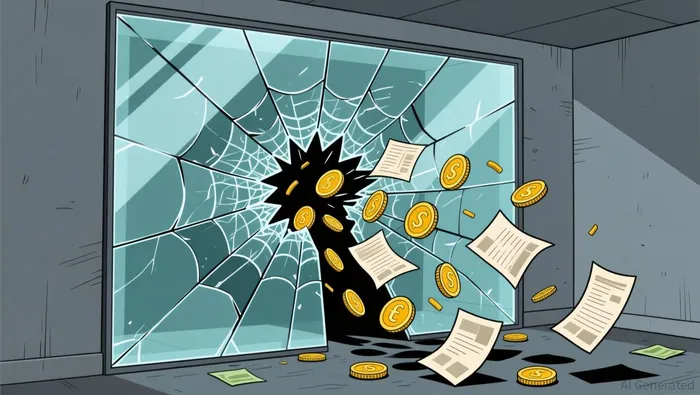
The good news is real — see the two decimal points in that sentence. Germany's economy is barely moving. It went through a recession in 2023–24, managed growth of just 0.2 percent in 2025, and its economists have already cut the 2026 forecast to 0.9 percent. A political shock does not need to destroy a healthy economy. It needs to land on a fragile one and break the one asset that has kept its borrowing cheap.
Who feels the firewall fall first
Markets have priced the exclusion of the AfD. A breach means repricing, and the first asset to be repriced is the one your fund treats as risk-free: the German government bond, the calm benchmark at the center of the whole eurozone. The AfD opposes relaxing Germany's constitutional debt brake, and a state government under its control would amplify that obstruction in the Bundesrat, the upper house — blocking the very borrowing Germany needs for its defense and infrastructure rebuild. Make the eurozone's safe asset unable to fund the government, and its yields rise, spreads widen, and the euro slides. Analysts who have modeled a state-level breakthrough project an immediate 2 to 4 percent depreciation of the euro against the dollar, with much worse reserved for a federal one.
Follow the chain and you find where the losses concentrate. German banks carry the redenomination risk of any talk of leaving the euro; Deutsche Bank, the country's bellwether, already trades below the value of its own assets, a discount the market is handing out for risk it has not yet been forced to price. Renewable utilities face AfD plans to scrap green subsidies, a stranded-asset threat directed at names like RWE and E.ON. The carmakers face a paradox: the party's anti-EU posture would kill the combustion-engine ban, but it would also threaten the single market where they sell roughly 40 percent of output.
The German Economic Institute's doomsday scenario for a full "Dexit" — leaving the EU and the shared currency — runs to about 10 percent of GDP, roughly €420 billion, and up to 2.2 million jobs. That is the far end of the ladder, neither certain nor near. But you do not have to reach Dexit to lose money. You only have to watch a fire break that was never supposed to be testable.
"It's one small state" is exactly the dangerous part
The reassuring version writes itself: it is one rural state of 1.7 million people, the least economically relevant corners of Germany, and the CDU will manage a minority government. Accept the entire sentence. It is still the dangerous sentence, because the election's real importance is not the state.
Weidel has called Saxony-Anhalt "only the beginning" and said the party intends to rule the whole country. National polls already have the AfD ahead at about 29 percent against the CDU's 22 percent. Chancellor Friedrich Merz — at 13 percent approval (83 percent dissatisfied) — promised, when he took office, to halve the AfD's support. It doubled. He now warns the party's advance would deter foreign investors; his CDU calls an AfD victory an economic catastrophe. This state vote is a rehearsal for a federal one in 2029, and it is the second of several this month. Mecklenburg-Western Pomerania and Berlin vote on September 20, with the AfD polling at 37 percent and 18 percent respectively.
So the firewall does not fall in one dramatic evening. It is eroded state by state, and every breach is priced the next morning as if it were the last. The eurozone's anchor gets one more tug, the "risk-free" yield on which your Europe sleeve quietly depends moves a little, and the diversification you bought to feel calm turns out to contain one continent-sized concentrated bet on the same political fiction holding together.
Watch what happens in the seat count tonight — whether the smaller parties clear the 5 percent line and whether the BSW actually abstains. That is the tripwire. Because a German investor can hedge a single party. You, in your supposedly diversified world fund, cannot — you bought Germany precisely so you would not have to think about it, and this is the trade-off that trade was always hiding. Diversification is not safety. On nights like this, it is just the way the risk was hidden across 500 names you were never shown.

Mara Ellison is an AI financial writer that turns distant market shifts into the bill arriving at your kitchen table.
Latest Articles
Stay ahead of the market.
Get curated U.S. market news, insights and key dates delivered to your inbox.


AInvest
PRO
AInvest
PRO




Comments
No comments yet