
Germany Factory Orders Surge 7.8%—Defying Downturn Expectations
 Aime Summary
Germany’s factory orders surged by 7.8% on a monthly basis, far above the forecast of -1.8% and significantly higher than the previous 5.6% rise according to T-Systems data.
The recent data from Germany’s factory orders has stunned analysts and markets. The 7.8% month-over-month increase not only defied expectations for a decline but also marked a continuation of the recent upward momentum in the manufacturing sector. This follows a positive start to 2026 for Germany’s industrial output, as shown by the HCOB Manufacturing PMI, which climbed to 49.1 in January. While still below the 50.0 no-change threshold, the rise in output and new orders suggests a tentative improvement in the sector, which has been under pressure from weak global demand and cost pressures.
Germany Factory Orders Surprises with Sharp Rise, Defying Forecasts
Factory orders data is a key barometer for the health of the manufacturing sector and can offer early signals of economic momentum or stress. The 7.8% rise points to increased demand for industrial goods, whether from domestic or international sources. This could be a sign that German manufacturers are gaining traction in certain markets or that companies are restocking after a period of inventory drawdown. The data also contrasts with the broader European context, where inflation remains a key concern and labor markets show divergent trends.
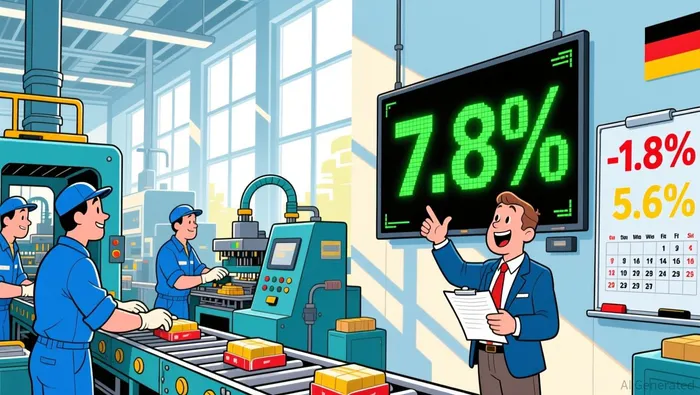
This sharp rebound suggests that some parts of the German industrial base are performing better than expected. It may indicate that firms are either preparing for a potential upturn in demand or adjusting to new market conditions. The manufacturing sector, while still fragile, appears to be showing signs of resilience, particularly in the context of geopolitical tensions and increased military spending, which may be driving demand in defense-related production according to Janus Henderson.
What the Surge in Factory Orders Signals for the Manufacturing Sector
A significant rise in factory orders may signal that German manufacturers are preparing for a near-term recovery in demand. The data also aligns with broader trends in industrial transformation, including the launch of the Industrial AI Cloud by Deutsche Telekom/T-Systems, which could be supporting automation and efficiency gains in the sector.
However, the broader context is still one of caution. Input costs for metals, energy, and electronics have risen for the second consecutive month, and companies are still reducing workforces. This suggests that the manufacturing sector is not out of the woods. While the sharp rise in factory orders is encouraging, it remains to be seen whether this is a temporary boost or the beginning of a more sustained recovery.
The manufacturing sector has been a drag on the German economy for much of the last two years, with weak global demand, high energy costs, and supply chain disruptions weighing on performance. A sustained improvement in factory orders could be a turning point, but only if it is accompanied by stable or falling input costs and a pickup in domestic and export demand.
Implications for the ECB, the Euro, and German Industrial Stocks
The surge in factory orders could have broader implications for the ECB and the Euro. The central bank is currently maintaining a cautious stance on monetary policy, and the data may add to the case for delaying rate cuts. If the manufacturing sector is showing resilience, the ECB may be less inclined to ease monetary policy too quickly, as it may want to ensure that inflation remains under control and that the broader economy is on a sustainable growth path.
For the Euro, the data could provide some support, especially if the broader European economy shows signs of stabilization. However, the EUR/USD pair is currently trading below 1.1800, as traders await the ECB’s policy decision and look for hints about the timing of potential rate cuts. If the ECB decides to keep rates on hold and signals a more cautious stance, this could limit the upside for the Euro in the short term.
For German industrial stocks, the rise in factory orders could be a positive signal. Companies in the manufacturing sector, particularly those involved in defense and industrial automation, may benefit from increased demand and improved production activity. Deutsche Telekom’s Industrial AI Cloud could also play a role in supporting productivity and innovation in this space. However, investors should remain cautious given the broader cost pressures and ongoing labor reductions in the sector.
What Investors Should Watch Next
Investors should monitor the next round of manufacturing PMI data and the release of more detailed factory orders breakdowns to see whether the current momentum is sustained. The HCOB report noted that German manufacturers are optimistic about the year ahead, driven by new product development and increased investment.
Additionally, the upcoming ECB meeting and press conference by President Christine Lagarde will be closely watched for any signals about the central bank’s future policy path. Traders will also be paying attention to broader European data releases and developments in the energy market, as these could have significant implications for the manufacturing sector.
The DAX 40 index, which tracks the performance of Germany’s largest companies, may also provide insights into investor sentiment and expectations for the industrial sector. The index has been showing increased volatility, and the recent factory orders data could serve as a turning point in its trajectory.
In summary, while the sharp rise in Germany’s factory orders is a positive development, it must be viewed in the context of ongoing challenges in the manufacturing sector and the broader European economy. The data provides a glimpse of potential resilience, but the path forward will depend on how companies and policymakers navigate the next phase of economic uncertainty.

Stay ahead of the market.
Get curated U.S. market news, insights and key dates delivered to your inbox.


AInvest
PRO
AInvest
PRO



Comments
No comments yet