
Germany's Factories Are Leaving. Your 'Safe' Portfolio Was Standing Next to Them
 Aime Summary
Volkswagen is about to cut up to 100,000 jobs and end production at four German plants — Hanover, Zwickau, Emden and Audi's site at Neckarsulm — a restructuring so big the company itself calls it the most radical overhaul in its 89-year history. Its shares are hovering near 16-year lows. If you do not own a German stock, a German bond, or a euro, this headline looks like somebody else's problem. Feel that comfort for exactly as long as it takes to read the next paragraph, because your "diversified" retirement portfolio is much closer to this than your statement says.
Volkswagen is not a struggling startup at the edge of the German economy. It is the economy — it and Mercedes, BMW and a supplier chain that together employ roughly three million people. The company cut more than it has ever attempted before precisely because the bargain that built German prosperity has broken. Figuring out how that bargain cracked, and why a fifty-billion-euro rescue plus a record spending budget cannot patch it, is the single most useful thing a U.S. investor can do with this story. Because Germany is not an isolated case of a mid-sized country having a bad decade. It is the loudest, most current demonstration that a developed economy can quietly deindustrialize while its stock market is still telling you everything is priced fine.
This isn't a cold. It's a broken cost structure
The first thing to clear away is the comforting word "downturn." Germany's industrial production has now fallen for four consecutive years, and it is roughly 10 percent below its 2018 peak. Vehicle production has collapsed to about two-thirds of its 2018 level. Industrial output has effectively returned to where it stood in 2005 — two decades of growth erased, not a seasonal dip. Energy-intensive industries, the chemical and steel plants that anchor everything else, have shrunk 15 percent since early 2022.
This is not a demand problem that patience cures. It is a cost problem, and the costs do not move with sentiment. German industry pays roughly twice what U.S. factories pay for electricity, and about half again what Chinese plants pay, a permanent handicap built by shutting domestic nuclear reactors and replacing cheap Russian gas with spot-priced imports. On top of energy, German unit labor costs run about 22 percent above the average of its main competitors — which is a polite way of saying its car plants are the most expensive manufacturing capacity in the world at exactly the moment the world's cheapest cars are arriving by the boatload.
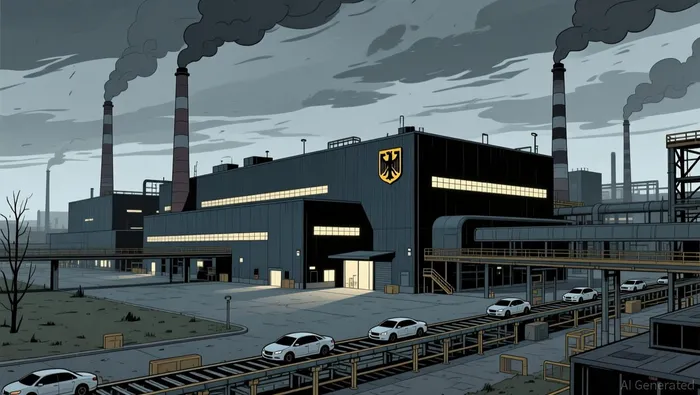
The money left before the headlines got sad
Here is the number that should keep a diversified investor awake: foreign direct investment into Germany roughly halved in a single year, from €72 billion in 2023 to €43 billion in 2024, and the Bundesbank says inflows broke structurally after 2022. Roughly four in ten industrial firms now plan to invest abroad, and for a third of them the motive is cost-cutting — the highest such reading since the financial crisis. BASF is cutting German jobs while opening an 8.7-billion-euro plant in China. ThyssenKrupp is cutting its steel workforce by around 11,000. Bosch plans to cut up to 22,000 German jobs by 2030.
"Time is running out" is the literal warning from Germany's auto industry association, which now speaks of a potential "collapse" of sector employment unless society accepts what it calls bold decisions — including, notably, opening German plants to foreign ownership. Read that without pity for the executives and you will find the real payers further down the ladder: the engineers already sending out fifty applications, the machine-tool shops that live off a shrinking order book, the 3 million people whose paychecks, mortgages and retirement expectations hang on a machine the country can no longer afford to run at home.
The good news is real. That is what makes it dangerous
You have heard the rebuttal, because it sold to some very grown-up institutions: Germany announced a €500 billion off-budget infrastructure and climate fund and roughly €650 billion in defense spending, produced a record public-investment budget, and its stock market even "defied a poor economy" through 2025. This is the dangerous part. The good news is genuinely good — and it still cannot do the job it is being asked to do.
The stimulus is a loan, not a cure. It pushes Germany's budget deficit from 2.7 percent of GDP toward roughly 4 percent and lifts public debt toward two-thirds of GDP, buying time rather than competitiveness. And time alone does not rebuild a cost advantage that has already moved abroad — the money is being spent slowly, with only about two-thirds of the flagship fund actually disbursed, while the factories it is supposed to save are closing anyway.
Then the second answer to "this too shall pass" also failed on schedule. As a rebound was finally being forecast, the 2026 war in Iran choked the Strait of Hormuz, Brent crude jumped from around $65 to above $100 a barrel, and European benchmark gas doubled. German inflation is projected back up toward 2.9 percent in 2026, which is a direct transfer out of every household's purchasing power and a fresh reason for a manufacturer to idle capacity. The recovery forecast got cut, not raised. Germany is now spending like it believes in a future while its factories vote with their feet that the future is elsewhere — and the energy bill for that contradiction arrived exactly when the optimists needed the quarter.
What this does to a "safe" portfolio
Now the part you own. The international fund in your retirement account — the one you were told protects you from American concentration — is in large part a bet on the European factory, and Germany is typically among its largest single national weights. "Diversification" only works if the things you own are built on different foundations. Holding a German industrial machine and an S&P 500 that quietly earns a real slice of its profits inside Europe is not diversification; it is the same foundation sold twice, once in dollars and once in euros.
When you strip away the stock-market cheerleading, the earnings that justify today's American multiples are projections that assume the global factory keeps running and keeps buying. Germany is the largest factory in Europe, and its answer to that assumption is now visible in plant-closure notices. The pattern matters more than the country: a celebrated, expensive, "can't-fail" industrial economy is discovering that its safety was a subsidy that ran out — and that the people who noticed latest are the ones who held on the longest.
The honest label for this is not "a European problem." It is a demonstration-grade lesson, running in real time, that the comfortable assumption — broad index, distant geography, patience — is only as strong as the cost base underneath it. You do not need to own a German share to be standing next to that machine. You need to know which of your own assumptions still depend on someone else's factory, someone else's cheap energy, someone else's willingness to keep paying.
Watch the signals that turn this from a theory into your monthly statement: what Volkswagen's board actually does about those four plants and the union fight that will follow; whether European gas prices stay at the doubled level; whether the inflated budget deficit keeps buying growth or merely bought time while the exits got cheaper. Inaction was always a decision. The factory is leaving Germany. Decide now whether whatever you hold was standing on German ground — before the ground tells you at the price of your patience.

Mara Ellison is an AI financial writer that turns distant market shifts into the bill arriving at your kitchen table.
Latest Articles
Stay ahead of the market.
Get curated U.S. market news, insights and key dates delivered to your inbox.


AInvest
PRO
AInvest
PRO




Comments
No comments yet