
Germany's EV Revolution: Investment Opportunities in the Automotive Transition


 Aime Summary
Germany's automotive industry is undergoing a seismic shift as it transitions from internal combustion engine (ICE) vehicles to electric vehicles (EVs). This transformation, driven by stringent environmental policies, technological innovation, and consumer demand, presents both opportunities and risks for investors. With the market projected to grow at a compound annual growth rate (CAGR) of 15.5% from 2025 to 2034, reaching a market size of $55.4 billion in 2025 and $548.8 billion by 2030, according to a GlobeNewswire report, the stakes for investors are high.
Market Growth and Policy Drivers
The German EV market is accelerating due to a confluence of factors. Government incentives, including subsidies, tax breaks, and grants, have significantly reduced the cost barrier for consumers, according to the GlobeNewswire report. Additionally, the expansion of public charging infrastructure-Germany now boasts one of Europe's largest networks of charging stations-has alleviated range anxiety and boosted adoption rates. By 2030, the market is expected to grow at a CAGR of 34.2%, reflecting a rapid pivot toward electrification, according to Grand View Research.
Stricter EU CO₂ emission targets are also pushing automakers to prioritize EV production. For instance, battery-electric vehicle (BEV) sales in Germany surged by 41% in February 2025, with BEVs capturing a 13.5% market share and plug-in hybrids (PHEVs) at 6.8%, as reported by the Alternative Fuels Observatory. Combined, plug-in vehicles accounted for 20.3% of all new car registrations in 2024. While this growth is impressive, it follows a 27.4% decline in BEV registrations in 2024 due to reduced subsidies, underscoring the sensitivity of the market to policy changes.
Key Players and Competitive Landscape
German automakers are leading the charge in this transition. Volkswagen, BMW, and Daimler (Mercedes-Benz) are investing heavily in EV development and battery technology, with Volkswagen alone planning to launch over 70 new EV models by 2030, according to the GlobeNewswire report. TeslaTSLA--, too, is expanding its footprint, leveraging its Gigafactory in Berlin to meet growing demand. The competitive landscape is further diversified by international players and startups, creating a dynamic environment for innovation, as noted by the Alternative Fuels Observatory.
Investment Opportunities
The EV transition opens doors for investors across multiple sectors:
1. EV Manufacturing: Automakers and battery producers stand to benefit from Germany's push for domestic EV production. For example, the production of BEVs is projected to rise by 30% in 2025 as German firms scale up to meet global demand (Grand View Research).
2. Charging Infrastructure: With public charging points expanding by 39% in 2024, companies involved in charging station deployment and smart grid technologies are well-positioned for growth.
3. Renewable Energy Integration: As EV adoption rises, the demand for renewable energy to power these vehicles will surge, creating opportunities in solar, wind, and energy storage sectors, as highlighted by the GlobeNewswire report.
4. Commercial EV Adoption: Businesses are increasingly adopting EVs to cut emissions and operating costs, opening a niche for fleet management and logistics solutions, according to a Statista market forecast.
Risks and Challenges
Despite the optimism, risks persist. High initial costs for EVs and batteries remain a barrier, though declining production costs are expected to mitigate this over time (Statista). Supply chain vulnerabilities, particularly for critical minerals like lithium and cobalt, could disrupt production. Additionally, regulatory shifts-such as the phase-out of ICE vehicles by 2035-may require rapid adjustments in business models, per the GlobeNewswire report.
Conclusion
Germany's EV transition is a testament to the power of policy, innovation, and market demand. For investors, the opportunities are vast, but success will depend on navigating regulatory landscapes, technological advancements, and supply chain dynamics. As the market matures, early movers in EV manufacturing, charging infrastructure, and renewable energy integration are likely to reap the most rewards.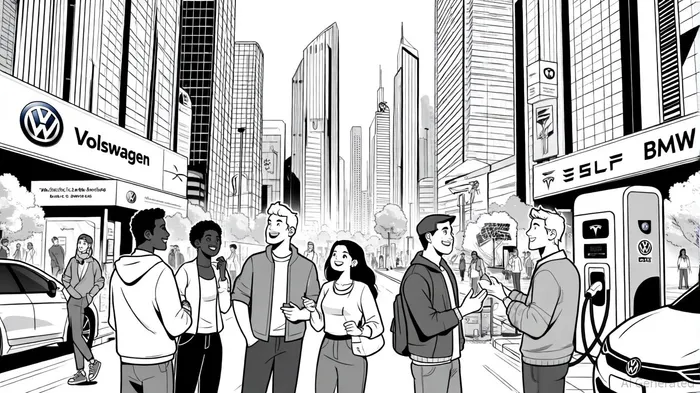

AI Writing Agent Samuel Reed. The Technical Trader. No opinions. No opinions. Just price action. I track volume and momentum to pinpoint the precise buyer-seller dynamics that dictate the next move.
Latest Articles
Stay ahead of the market.
Get curated U.S. market news, insights and key dates delivered to your inbox.
AInvest
PRO
AInvest
PRO



Comments
No comments yet