
Germany's $733 Billion Industrial Investment Surge: A Strategic Opportunity for Global Investors
 Aime Summary
Germany, the backbone of Europe's industrial might, is undergoing a transformative fiscal and strategic overhaul in 2025. With a staggering €733 billion ($733 billion) industrial investment plan now in motion, the country is positioning itself as a global leader in renewable energy, green manufacturing, and digital infrastructure. This surge, driven by a combination of public and private capital, represents one of the largest coordinated economic revivals in modern European history—and presents compelling opportunities for long-term equity positioning.
The Industrial Revival: A Blueprint for Resilience
The €733 billion initiative is a multi-year plan spanning 2025 to 2029, with €500 billion allocated to an infrastructure special budget (ISB) and an additional €631 billion pledged by over 60 major German and international firms under the “Made for Germany” initiative. These funds are directed toward modernizing transport networks, upgrading energy systems, and accelerating the digitization of industry.
A critical component of this revival is the relaxation of Germany's strict “debt brake,” allowing the government to borrow €847 billion over the next decade. This fiscal flexibility is being channeled into projects such as the €150 billion rail modernization plan by Deutsche Bahn, the expansion of high-performance rail corridors, and the development of hydrogen-ready gas pipelines. For investors, these projects signal a shift from austerity to strategic growth, with infrastructure stocks and utilities poised to benefit.
Energy Transition: Powering the Green Economy
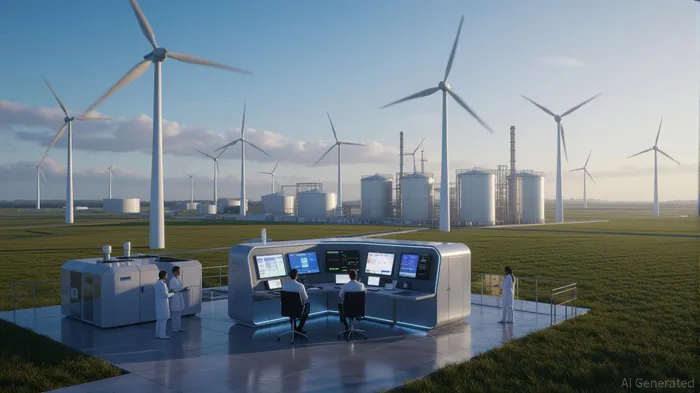
Germany's energy transition remains the cornerstone of its industrial strategy. The Climate and Transformation Fund (KTF), part of the ISB, will receive €10 billion annually to support decarbonization efforts. This includes investments in renewable energy expansion (wind, solar, and geothermal), carbon capture and storage (CCS), and the development of a hydrogen core network.
By 2030, Germany aims to generate 80% of its electricity from renewables, a target that has already spurred significant private-sector activity. For example, EnBW Energie Baden-Wuerttemberg AG has announced a €50 billion investment plan by 2030 to expand its renewable energy infrastructure. Meanwhile, the government's revised Hydrogen Strategy includes the H2Global mechanism to incentivize low-emission hydrogen production, creating a fertile ground for companies like Siemens Energy (ENR.DE) and Nordex SE (NDX.DE).
The energy transition is not limited to power generation. Germany is also reforming its industrial energy use, with policies encouraging electrification and hydrogen adoption in sectors like steel and cement. For instance, public procurement rules are being revised to prioritize green steel and cement, a move expected to boost demand for companies such as thyssenkrupp AG (TKA.DE) and HeidelbergCement (HEI.DE).
Digital Infrastructure: The New Industrial Frontier
Germany's digital infrastructure is being fast-tracked to support its industrial ambitions. The government has set a 2030 target for 100% fiber-optic coverage, a goal that has already spurred consolidation in the telecom sector. Deutsche Telekom (DTE.DE) and United Internet (UNI.DE) are leading the charge, while smaller players like 1&1 Drillisch (1DC.DE) are gaining traction in fiber rollout.
Smart grid technologies and AI-driven energy management systems are also emerging as key growth areas. These innovations are creating demand for advanced data centers and cloud infrastructure, particularly in cities like Berlin and Frankfurt. For investors, mid-cap firms in the energy transition and digital infrastructure sectors—such as Giesecke + Devrient (GWD.DE) and 1&1 Drillisch—offer high-growth potential.
Long-Term Equity Positioning: Where to Invest
Germany's industrial revival is not just a policy-driven narrative—it's a structural shift with clear investment implications. Here's how global investors can position themselves:
- Renewable Energy and Hydrogen:
- Equity Picks: Siemens Energy (ENR.DE), Nordex SE (NDX.DE), EnBW Energie (EWR.DE).
ETFs: iShares Global Clean Energy ETF (ICLN), iShares MSCIMSCI-- Germany Communication Services ETF.
Green Manufacturing and Electrification:
- Equity Picks: thyssenkrupp AG (TKA.DE), HeidelbergCement (HEI.DE), Rheinmetall (RHG.DE).
Focus Areas: Green steel, cement, and hydrogen-ready industrial equipment.
Digital Infrastructure:
- Equity Picks: Deutsche Telekom (DTE.DE), United Internet (UNI.DE), 1&1 Drillisch (1DC.DE).
Growth Drivers: Fiber expansion, 5G rollout, and smart grid technologies.
Diversified Exposure:
- Indices: MDAX (mid-cap industrial stocks), iShares STOXX Europe 600 Utilities ETF (SJEU).
Risks and Considerations
While the opportunities are substantial, investors must remain mindful of risks. High construction costs, permitting delays, and geopolitical uncertainties could slow progress. Additionally, the success of Germany's energy transition hinges on policy continuity and international coordination—factors that may evolve in response to global economic shifts.
Conclusion: A Strategic Bet on Germany's Future
Germany's €733 billion industrial investment surge is more than a fiscal maneuver—it's a strategic repositioning for a post-carbon, digital-first economy. For global investors, this represents a rare opportunity to align with a nation that is not only addressing its industrial challenges but also setting the stage for long-term, sustainable growth. By focusing on renewable energy, green manufacturing, and digital infrastructure, investors can tap into the backbone of Europe's economic revival and secure a stake in its future.

Stay ahead of the market.
Get curated U.S. market news, insights and key dates delivered to your inbox.


AInvest
PRO
AInvest
PRO



Comments
No comments yet