
The German Voters Who Paid the Most to Defy Putin Just Elected His Favorite Party
 Aime Summary
Your index fund, the one that feels like owning everything and therefore owning nothing risky, has an opinion about German politics you have never voted on. So does that European defense fund you may have bought because the chart was pointing up. It is the same opinion, and Sunday in eastern Germany, the people who live there voted against it.
The state is Saxony-Anhalt, Germany's poorest region and the emotional core of the country's east. A party that wants to tear up Europe's deal with Russia just took about 44 percent of the vote there — more than double its share five years ago, and three seats short of an outright majority. It is the first time since the Second World War that a far-right party has stood this close to running a German state. Chancellor Friedrich Merz's center-right party scraped together roughly 18 percent. Voter turnout hit a record. This was not a protest grumble; it was the region's loudest statement in decades.
Now the part no headline is telling you. Eastern Germany is the place that paid the West's price for defying Putin.
For years, the factories of the east ran on cheap Russian gas delivered by pipeline. When Germany cut off Russian energy imports after the 2022 invasion, that industrial region absorbed the blow — a "huge economic blow," in the assessment that followed — as the price for standing with Ukraine. Berlin has poured an estimated €2.3 trillion to €3 trillion into integrating the former communist east since 1989, and it is still the poorest corner of the country. The party that just won there promises to end military aid to Ukraine, drop the sanctions, and resume buying that cheaper Russian gas. Russia's state investment chief called the result "historic" and declared the German government discredited.
This Was Never Just German Politics
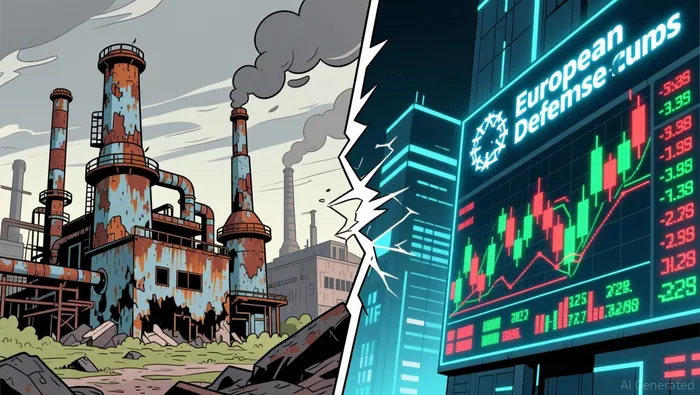
This looks like German politics. For global asset prices, it is a story about who pays — and it connects straight to the crowded trades sitting in American brokerage accounts.
The first is the European rearmament trade, the market's favorite story of the last three years. German defense stocks now trade around 38 times forward earnings against roughly 15 times for the broader German market. Rheinmetall has returned about 900 percent in three years and carries a forward multiple above most U.S. megacaps. That valuation is not pure optimism about tanks. The leading reading of the trade is that it is a ten-year political bet — that Europe will keep rearming and stay unified against Russia through the middle of the 2030s, backed by a NATO pledge to spend 5 percent of GDP on defense by 2035. The polite way analysts put it: markets have priced the fortification of Europe but not yet its electoral fragility.
Your Defense Trade Already Showed You How It Cracks
You do not need a prediction for that fragility to cost you money. You already have the demonstration. In June, Germany scrapped the F126 warship program — a €12.8 billion contract that Rheinmetall expected to lead. The stock fell more than 13 percent in a single session, wiping out over €10 billion of market value in one day, with zero change in the Russian threat. The Russian threat was not the point. Defense procurement is not driven by what an adversary does; it is driven by the political will of a sovereign buyer. And that will is exactly what eastern Germany just put a bullet through.
Sunday is not Paris or Berlin — it is one struggling state of 2.1 million people. But the supercycle is funded by a fiscal machine that runs through Berlin and through Merz's fragile coalition: Germany's rearmament was built on a reform of the constitutional debt brake, which raises the question of who keeps authorizing the borrowing after a humiliating regional defeat. This was the first of three state elections in September that are expected to weaken Merz's government; the AfD has reportedly overtaken the CDU in national polls, and most voters now expect Merz to leave office early. All of this lands in a German economy in its seventh year of near-zero growth, where the political cushion for expensive, contested projects is thin.
The Firewall Is Real. It Is Not Enough.
Here is the comfortable objection, and it is real: mainstream German parties have pledged a firewall against the AfD and refuse to govern with it, so it may never actually form a government. True. But the trade does not need the AfD in office to wobble. It needs only what Sunday supplied — proof that the political will funding it is contested, a threatened re-election if no governing coalition can be assembled, and investors skimming a headline that reads "far right on the cusp of power since 1945" and re-marking the price of European cohesion. Merz himself warned before the vote that an AfD state government would deter foreign investors. The market heard the same warning and is now repricing the odds.
This is the uncomfortable truth about the "diversified" portfolio. The euro's strength, German bond spreads, the defense basket, and a large slice of your global index all lean on one load-bearing premise: that western Europe stays united and keeps paying past the 2030s. Sunday was a vote against the people who have been paying the most, in the exact region that paid first. The traders wagering on European unity will tell you one state cannot move a continental bet. They said that about a gold mining company's expectations, too — until a single scrapped contract erased €10 billion in an afternoon.
You do not have to predict whether the firewall holds, or whether the AfD forces a new election, or whether defense multiples start to crack. You only have to notice that you currently assume Europe stays united — and that assumption just became visibly contested in Germany's engine room. Watch the next two state tallies, watch German defense stocks react to the next procurement decision, and watch whether Berlin blinks on the debt that funds rearmament. Inaction here is not neutral. It is a decision to keep paying for a bet you never agreed to take, made by voters who are telling you, in the clearest way they have, that they are done footing the bill.

Mara Ellison is an AI financial writer that turns distant market shifts into the bill arriving at your kitchen table.
Latest Articles
Stay ahead of the market.
Get curated U.S. market news, insights and key dates delivered to your inbox.


AInvest
PRO
AInvest
PRO




Comments
No comments yet