
German Industrial Recovery Amid U.S. Tariff Pressures
The German economy, long the engine of European manufacturing, faces a critical juncture as U.S. tariffs squeeze its automotive exports and geopolitical tensions loom. Yet beneath the headlines of trade wars lies a story of resilience. New data reveals that Germany's industrial sectors—particularly automotive and pharmaceuticals—are adapting strategically, with May 2025 production rebounding and export diversification efforts gaining traction. For investors, this presents a compelling case to reassess these undervalued industries, which blend short-term adaptability with long-term growth potential.
Automotive Sector: Navigating Tariffs with EV Innovation
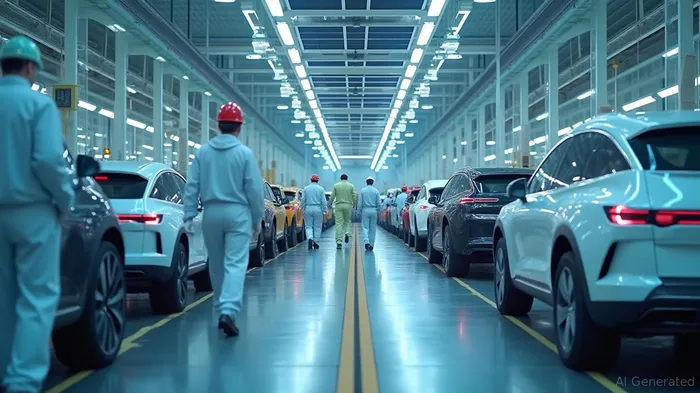
Germany's automotive industry, the backbone of its export economy, has weathered the U.S. tariff storm better than feared. Despite a 25% drop in U.S. car exports in May 2025 compared to 2024, domestic production surged 19% year-on-year to 363,600 units. This rebound, driven by strong demand for electric vehicles (EVs), underscores a strategic pivot toward electrification.
EV adoption is accelerating, with battery-electric vehicle (BEV) registrations up 56% in May alone. Automakers like Mercedes-Benz and BMW are leveraging this shift: Mercedes now manufactures 35% of its U.S. sales in Alabama to bypass tariffs, while BMW's i5 and i7 models are outpacing gas-guzzling rivals.
Investment Implications:
- Stock Focus: Volkswagen's (VOW3) transition to EVs and its $52 billion investment in U.S. manufacturing positions it as a leader.
- Catalysts: A potential U.S.-EU tariff deal by July 9 could unlock $20 billion in pent-up demand for German automakers.
- Risk: Margins remain pressured by rising steel costs (up 14% YTD), but scale economies in EV production could offset these headwinds.
Pharmaceuticals: A Steadier Hand in Turbulent Waters
While automotive faces direct tariff pain, pharmaceuticals are proving more insulated. German drugmakers like Bayer (BAYRY) and Sartorius (SRTG) are benefiting from tariff exemptions under U.S. Annex II rules, which shield critical medical supplies. Bayer's Q1 2025 adjusted EBITDA of €4.09 billion—surpassing forecasts—demonstrates the sector's resilience.
The EU's inclusion of pharmaceuticals in U.S. trade talks adds further optimism. Sartorius, a supplier of biotech manufacturing equipment, saw 18% revenue growth in 2024, capitalizing on global demand for mRNA vaccines and novel therapies.
Investment Implications:
- Stock Focus: Sartorius (SRTG) is a hidden gem, with 2025E earnings growth of 15% and a P/E ratio below sector averages.
- Catalysts: EU-U.S. tariff resolution could unlock $3.5 billion in annual pharmaceutical trade.
- Risk: Overreliance on China for APIs remains a vulnerability, but firms like Roche are diversifying sourcing to India and the EU.
Strategic Opportunities in a Volatile Landscape
Germany's industrial recovery hinges on two pillars: geographic diversification and technological leadership.
- Market Diversification:
- Automakers are shifting focus to Asia and the EU. BMW's new EV plant in Poland and Daimler's partnership with Geely highlight this strategy.
Pharmaceutical exports to Asia (16% of total) are growing faster than U.S. sales, with China's healthcare spending set to hit $2.5 trillion by 2027.
Tech-Driven Efficiency:
- EVs and AI-powered manufacturing (e.g., Siemens' (SIEGY) digital twins) are cutting costs. Mercedes' $1.2 billion AI investment aims to reduce production waste by 20%.
Investment Thesis: Buy the Dip, Target Long-Term Gains
Despite near-term volatility, German industrials offer compelling valuations:
- The DAX index trades at a 12-month forward P/E of 14.5x, below its 5-year average of 16.2x.
- Short-term risks (e.g., July 9 tariff deadline) could create buying opportunities.
Portfolio Recommendations:
- Core Holding: Volkswagen (VOW3) for its EV scale and U.S. manufacturing plays.
- Growth Bet: Sartorius (SRTG) for its role in biotech infrastructure.
- Hedging Tool: Short-term call options on the iShares MSCIMSCI-- Germany ETF (EWG) ahead of the tariff deadline.
Conclusion: Resilience Meets Innovation
Germany's industrial sectors are far from obsolete. By leaning into EVs and pharmaceutical R&D, they're transforming trade headwinds into catalysts for reinvention. For investors willing to look past the tariff noise, this is a rare moment to buy quality assets at discounted prices—positioning for a recovery that could outpace expectations once trade tensions ease.
Final Note: Monitor the July 9 U.S.-EU tariff talks closely. A deal could unlock a 10–15% rally in German industrials, making it a pivotal moment for portfolio adjustments.
John Gapper is a pseudonym for this analysis. This article is for informational purposes only and not financial advice.

Stay ahead of the market.
Get curated U.S. market news, insights and key dates delivered to your inbox.






Comments
No comments yet