
German Ifo Index Surges, But Demographics Loom
 Aime Summary
- Germany's Ifo Business Climate Index rose to 88.8 in August, surpassing forecasts and the prior month's 86.6 reading.
- The rebound signals a notable improvement in corporate sentiment, driven by forward-looking expectations despite current flat performance.
- Structural demographic challenges continue to strain the economy, with social spending reaching a record 32% of GDP.
- Investors are closely watching how this cyclical recovery interacts with Eurozone political risks and currency volatility.
Germany's premier business sentiment indicator posted a stronger-than-expected result this week, offering a brief respite from the prolonged stagnation that has weighed on the eurozone's largest economy. The Ifo Business Climate Index climbed to 88.8 in August, eclipsing market expectations of 87.2 and marking a significant acceleration from the 86.6 reading recorded in July. This upward trajectory suggests that corporate confidence is stabilizing, even as underlying structural pressures from an aging population and rising fiscal burdens continue to loom over the economic landscape. The divergence between the improving cyclical data and the deepening structural deficits highlights the complex dual challenges facing German policymakers and global investors alike.
What Does the August Ifo Reading Signal About Economic Momentum?
The August release of the Ifo Business Climate Index serves as a critical barometer for the health of the German economy, aggregating survey responses from approximately 9,000 firms across manufacturing, construction, trade, and services sectors. The index is calculated by balancing positive and negative assessments of current business situations against six-month expectations, providing a comprehensive view of economic momentum. In August, the 88.8 reading represented a clear improvement, fueled primarily by a significant uptick in forward-looking expectations among corporate managers. This shift indicates that businesses are growing more optimistic about the near-term outlook, a sentiment that has historically preceded actual economic expansion when sustained over multiple months.
However, the underlying composition of the data reveals a nuanced picture. While expectations improved markedly, current business performance remained relatively flat, with companies reporting only moderate satisfaction with their immediate operational conditions. This discrepancy between current reality and future optimism suggests that while the worst of the stagnation may be behind them, a robust recovery is not yet fully realized in day-to-day operations. The improvement comes after a period of sharp drops in March and April, suggesting a stabilization trend rather than a sudden boom. Furthermore, geopolitical uncertainties, particularly in the Persian Gulf, have seen a slight decrease in their perceived impact on corporate pessimism, allowing businesses to focus more on domestic economic fundamentals.
Why Are Investors Watching German Business Sentiment Now?
For global markets, the Ifo index is more than a domestic metric; it is a key leading indicator for the broader Eurozone economy and a primary driver of European Central Bank (ECB) policy expectations. A reading that exceeds market forecasts, such as the August 88.8 print, is typically interpreted as bullish for the Euro (EUR), as it suggests robust economic activity and potential pressure on the ECB to maintain tighter monetary policy or delay rate cuts. Conversely, weaker readings have historically signaled bearish sentiment, reflecting weakening business conditions that could necessitate more accommodative policy. The recent rebound provides a counter-narrative to the persistent fears of a deep German recession, potentially supporting the Euro against the US Dollar in the near term.
Market analysts are currently weighing this positive data against a backdrop of rising political and technical risks within the Eurozone. Despite the bullish signal from the Ifo index, the Euro has faced defensive pressure following a recent 3% rally against the Dollar. Strategists at Scotiabank note that the currency is vulnerable to reversal as US Treasury yields climb and intra-eurozone political risks, such as the widening Bund-BTP spread and French budget uncertainties, intensify. Additionally, ING strategists point to speculative positioning, noting that asset managers are currently underweight on the Euro, which could support gradual gains unless broader risk assets suffer. The August Ifo data, therefore, acts as a crucial fundamental catalyst that could either reinforce the Euro's bullish structure or expose it to technical corrections depending on how it interacts with these broader market dynamics.
How Do Structural Demographic Challenges Impact Long-Term Outlook?
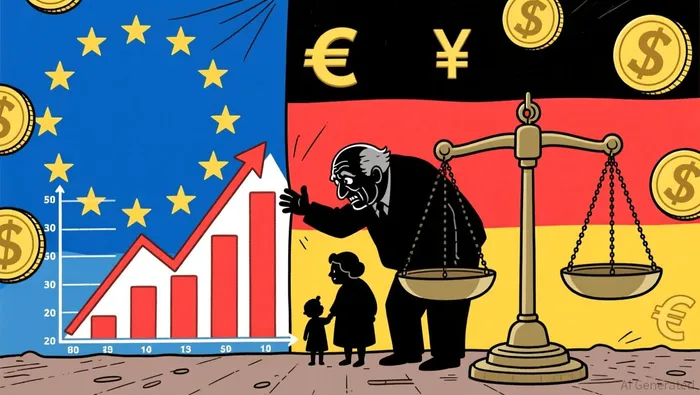
While the cyclical business sentiment is improving, the long-term economic outlook for Germany is increasingly defined by deep-seated structural challenges, particularly demographic shifts. According to a recent analysis by the Ifo Institute, Germany's social budget reached a record high of 32% of GDP in 2025, driven largely by an aging population and rising costs for elderly care and pensions. Combined spending related to old age and illness accounted for approximately 70% of total social spending, pushing the social budget to unprecedented levels. This trend is not merely a fiscal issue but a fundamental constraint on economic growth, as social spending is now rising faster than GDP.
The key structural cost driver behind this trend is demographic change, which is exacerbating the shift in the welfare state burden between generations. Between 2019 and 2025, social spending rose by 11.5% (€104 billion) even after adjusting for price effects, with over 80% of the real increase in spending since 1992 attributed to costs associated with the elderly population. Ifo researcher Emilie Hoeslinger noted that the social budget is growing faster than GDP, meaning that the weak economy inadvertently contributes to a higher relative share of social spending. This creates a challenging environment for fiscal policy, as rising demographic costs compete with other public investment priorities and limit the government's ability to stimulate growth through spending. Investors must therefore consider that while the Ifo index provides a positive short-term signal, the long-term economic trajectory is constrained by these irreversible demographic headwinds.
What Should Investors Monitor in the Coming Months?
Moving forward, investors should monitor the sustainability of the improvement in business sentiment and how it translates into actual GDP growth. The August Ifo data is a positive data point, but it must be viewed in the context of the broader macroeconomic environment, including inflation trends, wage growth, and energy prices. Additionally, the political landscape within the Eurozone will play a crucial role in determining the Euro's direction. Upcoming French budget negotiations and polling data regarding far-right candidates could introduce volatility that overshadows fundamental economic data. The divergence between the improving German business climate and the structural fiscal pressures outlined by the Ifo Institute suggests a complex economic environment where short-term gains may be offset by long-term liabilities.
Furthermore, global liquidity conditions and US monetary policy will continue to influence the Euro's performance. As US Treasury yields climb, the attractiveness of the Dollar may rise, potentially capping the upside for the Euro despite positive European data. Investors should watch for subsequent releases of Eurozone PMI data and ECB policy statements to gauge whether the central bank views the German recovery as durable enough to support a tighter policy stance. The interplay between cyclical business optimism and structural demographic reality will likely define the investment narrative for the Eurozone in the coming quarters, requiring a nuanced approach that balances short-term trading opportunities with long-term fundamental risks.

Stay ahead of the market.
Get curated U.S. market news, insights and key dates delivered to your inbox.


AInvest
PRO
AInvest
PRO




Comments
No comments yet