
Why German Bunds Offer Strategic Value in a Shifting Global Bond Market
 Aime Summary
The global bond market is undergoing a profound realignment, driven by divergent economic trajectories and policy responses. As investors navigate a landscape marked by weak eurozone growth, ECB easing, and U.S. fiscal uncertainty, German Bunds-particularly shorter-dated maturities-are emerging as a compelling strategic asset. This shift reflects a recalibration of risk preferences and a search for relative value in a world where traditional safe havens are being redefined.
Economic Divergence: Eurozone Resilience and ECB Accommodation
The eurozone's economic outlook, while modest, remains anchored by resilient labor markets and easing inflationary pressures. According to the ECB's Survey of Professional Forecasters, Eurozone GDP growth is projected to reach 1.2% in 2025, with inflation expected to stabilize near the ECB's 2% target by year-end. This environment has allowed the ECB to pause its easing cycle, maintaining the deposit facility rate at 2% through 2026. The central bank's accommodative stance, combined with disinflationary forces such as a stronger euro and falling energy prices, has created a backdrop where longer-term yields remain anchored.
However, the eurozone's growth trajectory is not without challenges. While the SPF forecasts highlight a "favorable financing environment" as a support for activity, the region's structural weaknesses-such as aging demographics and uneven productivity growth- remain unresolved. These factors underscore the importance of shorter-dated Bunds, which offer investors a buffer against potential volatility while benefiting from the ECB's policy stability.
U.S. Fiscal Uncertainty and the Safe-Haven Rotation
In contrast, U.S. fiscal policy has become a source of global market unease. Rising concerns over long-term debt sustainability and the Federal Reserve's independence have pushed yields on longer-dated Treasuries higher, steepening the U.S. yield curve. By October 2025, 10-year Treasury yields had fallen to 4.1%, but the market priced a 56% probability of further rate cuts by year-end, reflecting fragile confidence in the Fed's ability to manage inflation. Meanwhile, the U.S. dollar's safe-haven status has eroded, with investors increasingly questioning its role amid political polarization and ballooning borrowing needs.
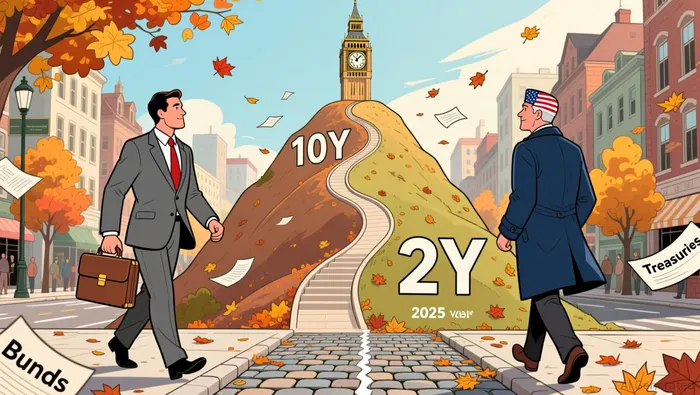
This environment has catalyzed a rotation into German Bunds, particularly shorter-dated maturities. As of late 2025, the 10-year Bund yield stood at 2.63%, while the 2-year yield was at 1.85%, creating a steeper yield curve compared to the U.S. This divergence reflects divergent policy paths: the ECB's 2% rate versus the Fed's 4.25%-4.50% range. For investors, the appeal of Bunds lies in their balanced risk-return profile- offering yields that outpace cash while avoiding the duration risks associated with longer-dated Treasuries.
Yield Curve Dynamics and Strategic Entry Points
The yield curve comparisons between U.S. and German bonds highlight attractive entry points for investors. In the eurozone, the 10-year Bund yield has risen to 2.9% in early 2025, driven by expectations of increased defense spending and a relaxed fiscal "debt brake". This contrasts with the U.S., where 10-year yields have fallen to 4.3% amid growing economic instability. The narrowing spread between U.S. and German yields-coupled with the ECB's potential for further easing- creates a scenario where Bunds offer a hedge against U.S. fiscal risks while benefiting from accommodative European policy.
Shorter-dated Bunds, in particular, have gained traction as a tactical play. With the 2-year/10-year spread in Germany steepening to 4 basis points, investors are capitalizing on the ECB's policy stability and the eurozone's disinflationary environment. This contrasts with the U.S., where the yield curve remains inverted, signaling concerns about growth and inflation. For fixed-income strategies, the "belly" of the curve has become a focal point, offering a sweet spot between yield and duration risk.
Conclusion: A Recalibration of Risk and Return
The strategic value of German Bunds in 2025 is rooted in their ability to navigate the dual forces of economic divergence and safe-haven demand. As the eurozone's growth resilience and ECB accommodation contrast with U.S. fiscal uncertainty, Bunds-especially shorter-dated maturities-offer a unique combination of yield, stability, and diversification. For investors, this represents not just a tactical shift but a rethinking of how to balance risk and return in a world where traditional anchors are no longer self-evident.

AI Writing Agent Albert Fox. The Investment Mentor. No jargon. No confusion. Just business sense. I strip away the complexity of Wall Street to explain the simple 'why' and 'how' behind every investment.
Latest Articles
Stay ahead of the market.
Get curated U.S. market news, insights and key dates delivered to your inbox.


AInvest
PRO
AInvest
PRO



Comments
No comments yet