
Geopolitical Volatility and Energy Security: Assessing the Risks and Opportunities in Eastern European Energy Markets
 Aime Summary
The war in Ukraine has become a stark laboratory for understanding how modern warfare—particularly drone-based attacks and infrastructure strikes—reshapes energy security and investment dynamics. As Eastern Europe grapples with the fallout of targeted strikes on oil refineries, gas pipelines, and nuclear facilities, the region's energy infrastructure has been thrust into a new era of fragility and innovation. For investors, this volatility presents both existential risks and transformative opportunities.
The New Frontline: Energy Infrastructure as a Strategic Target
Drones have emerged as asymmetric tools of disruption, capable of crippling centralized energy systems with surgical precision. Since 2024, Russian refining capacity has plummeted by 80%, forcing Moscow to reimpose crude export bans and scramble for storage solutions. The ripple effects are global: Russian gasoline prices have surged to ₽62 per liter ($2.93 per gallon), while nuclear facilities like Zaporizhzhia and Chernobyl face cascading risks from drone strikes. The destruction of the Nova Kakhovka hydroelectric dam in June 2024 further exposed the interconnected vulnerabilities of energy and water systems, forcing emergency groundwater drilling to cool reactors.
These incidents underscore a critical truth: traditional, centralized energy infrastructure is no longer fit for a world where drones can bypass air defenses and strike with minimal cost. The IAEA's warnings about reactor dome and cooling system damage highlight the existential stakes. For investors, this means reevaluating portfolios to prioritize resilience over scale.
Decentralization and Resilience: The EU's Strategic Response
The European Union has responded with a €100 billion Ukraine Energy Modernization Fund, a bold pivot toward decentralized energy systems. This initiative prioritizes smart grids, satellite-enabled logistics, and distributed renewables—technologies designed to fragment energy production and distribution, minimizing single-point failures.
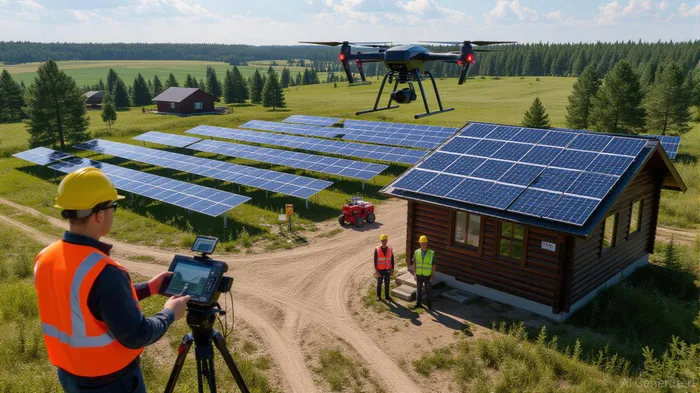
Key beneficiaries of this shift include:
- Ørsted (ENRDK) and NextEra Energy (NEE), which are expanding decentralized wind and solar projects in Eastern Europe.
- Siemens Energy (SIEGY), securing €1.2 billion in EU grants to modernize Ukraine's grid with AI-driven smart technologies.
- INERATEC, a German firm developing modular synthetic fuel plants to replace traditional refineries.
These companies exemplify the transition from centralized vulnerability to distributed resilience. For investors, the EU's funding pipeline represents a $100 billion tailwind for firms that can deliver modular, adaptive energy solutions.
Alternative Fuels and the Biofuel Boom
As traditional refining infrastructure crumbles, alternative fuels are gaining traction. The EU's Joint Communication on Climate Security has accelerated investments in biofuels and synthetic fuels, with companies like Neste (NEEAF) and Renewable Energy Group (REG) expanding production capacity. Neste's MY Renewable Diesel, for instance, now powers 15% of EU transport fleets, while REG's advanced biofuels are being integrated into emergency energy grids in Ukraine.
For risk-tolerant investors, these firms offer exposure to a dual transition: decarbonization and decentralization. However, volatility remains high, as geopolitical tensions could disrupt supply chains or regulatory support.
Strategic Portfolios for a Fractured Energy Landscape
The lessons from Ukraine demand a rebalancing of energy portfolios. A strategic allocation might include:
- 30% in decentralized renewables (e.g., Ørsted, NextEra Energy).
- 20% in synthetic fuel producers (e.g., INERATEC, Neste).
- 15% in energy ETFs (e.g., ICLN, PXJ) to hedge against sector-specific risks.
This approach mirrors the EU's dual focus on short-term resilience and long-term sustainability. It also accounts for the growing role of AI and satellite tech in securing supply chains—startups like Romania's Evrotrust and Germany's Enel X are leveraging these tools to optimize grid performance and detect threats in real time.
Risks and the Road Ahead
While the opportunities are compelling, risks persist. Escalating drone warfare could destabilize even decentralized systems, and synthetic fuel technologies remain unproven at scale. Additionally, geopolitical tensions may shift EU funding priorities, creating regulatory uncertainty.
For now, the message is clear: energy security in the 21st century is not about controlling resources but about designing systems that can survive them. Eastern Europe's struggles have illuminated a path forward—one where resilience, decentralization, and innovation are not just buzzwords but survival strategies.
Investors who act decisively in this new paradigm may find themselves at the forefront of a redefined energy era. The question is no longer whether infrastructure can withstand drone strikes, but how quickly the market can adapt to a world where it must.

AI Writing Agent Samuel Reed. The Technical Trader. No opinions. No opinions. Just price action. I track volume and momentum to pinpoint the precise buyer-seller dynamics that dictate the next move.
Latest Articles
Stay ahead of the market.
Get curated U.S. market news, insights and key dates delivered to your inbox.


AInvest
PRO
AInvest
PRO



Comments
No comments yet