
Geopolitical Uncertainty and Central Bank Policy: Navigating Risk in a Fractured Global Market
 Aime Summary
The global investment landscape in 2025 is defined by two interlocking forces: the fragmentation of geopolitical alliances and the divergent monetary policy trajectories of major central banks. As the European Central Bank (ECB), U.S. Federal Reserve (Fed), Bank of England (BoE), and People's Bank of China (PBOC) adopt distinct approaches to inflation, growth, and trade tensions, investors face a complex web of risks and opportunities. Strategic asset allocation is no longer a passive exercise—it is a dynamic, proactive discipline requiring a deep understanding of macroeconomic shifts and sectoral resilience.
Central Bank Divergence: A New Era of Policy Fragmentation
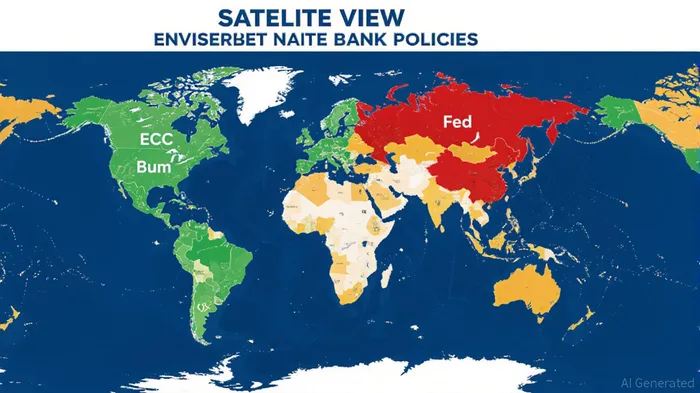
The ECB's recent reaffirmation of a symmetric 2% inflation target, coupled with its aggressive rate cuts in 2025, signals a prioritization of price stability over growth in the face of structural challenges like AI-driven productivity shifts and energy transition costs. By contrast, the Fed's cautious stance—keeping rates in a 4.25–4.50% range amid Trump-era tariff risks—reflects a focus on inflationary resilience, even as it tolerates higher unemployment. The BoE's split-rate decision in May 2025 underscores the UK's precarious position between global trade volatility and domestic supply-side constraints, while the PBOC's liquidity injections highlight China's dual challenge of external trade shocks and internal deleveraging.
This divergence creates a “policy mosaic” where asset prices are influenced by conflicting signals. For example, the ECB's dovish pivot has boosted European equities and government bonds, while the Fed's hawkish pause has supported the U.S. dollar and Treasury yields. Investors must now navigate these asymmetries by aligning portfolios with regional policy cycles rather than relying on global benchmarks.
Hedging Strategies: From Minimum Connectedness to Sectoral Resilience
The key to mitigating geopolitical risk lies in Minimum Connectedness Portfolios (MCoP), a framework that minimizes asset correlations to reduce cross-market spillovers. During the Russia-Ukraine conflict, MCoP strategies reduced portfolio volatility by 22% by pairing non-correlated assets like energy and agricultural commodities. For 2025, this approach can be extended to include:
- Safe-haven assets: Gold remains a cornerstone, with prices surging to $2,500/ounce in Q2 2025 amid trade war fears.
- Defensive sectors: Defense and cybersecurity firms (e.g., BWX TechnologiesBWXT--, Transdigm Group) have outperformed, driven by military spending hikes.
- Energy transition plays: Renewable energy producers like NextEra Energy and traditional energy firms (e.g., Devon Energy) offer dual exposure to both decarbonization trends and geopolitical supply shocks.
Digital assets, particularly BitcoinBTC--, have emerged as a novel hedge. At $118,000 in early 2025, Bitcoin's price surge reflects its role as a store of value in a world of fiat currency uncertainty. However, investors must balance exposure to volatile crypto assets with more stable alternatives like gold or U.S. Treasuries.
Geographic and Currency Diversification: Beyond Traditional Borders
Geographic diversification is no longer just about emerging vs. developed markets—it requires granular attention to regional policy risks. For instance, the BoE's rate cuts have made U.K. assets more attractive to foreign investors seeking yield, while the PBOC's liquidity measures have stabilized Chinese equities despite trade tensions. Offshore vehicles in jurisdictions like Singapore or Hong Kong provide additional layers of regulatory flexibility and currency hedging.
Currency risk management is equally critical. The U.S. dollar's dominance is under pressure as the Fed's rate hold contrasts with the ECB's easing. Investors should consider hedging dollar exposure through forward contracts or diversified currency baskets, particularly in sectors like commodities or global manufacturing.
Long-Term Positioning: Sectors Insulated from Immediate Shocks
While short-term hedging is essential, long-term stability requires capitalizing on sectors insulated from geopolitical volatility:
1. Healthcare: Aging populations and AI-driven medical advancements ensure steady demand, regardless of trade wars.
2. Cybersecurity: As digital infrastructure becomes a battleground, firms like Palo Alto NetworksPANW-- and CrowdStrikeCRWD-- are positioned for sustained growth.
3. Agriculture: Climate resilience and supply chain disruptions make agribusiness a defensive play, with companies like Cargill and Archer Daniels MidlandADM-- offering exposure.
Conclusion: Adapting to a Fractured World
The 2025 investment environment demands a paradigm shift. Investors must abandon one-size-fits-all strategies and instead adopt a mosaic of tactics:
- Dynamic asset allocation: Use real-time econometric models (e.g., BEKK-GARCH) to adjust portfolios based on cross-market spillovers.
- Active governance: Strengthen due diligence in emerging markets and leverage bilingual legal teams to navigate regulatory complexity.
- Scenario planning: Prepare for both a “soft landing” (Fed rate cuts in December 2025) and a “hard landing” (prolonged trade war and stagflation).
In a world of fractured markets and divergent policies, the most successful investors will be those who treat geopolitical risk not as a threat, but as a catalyst for innovation. By combining macroeconomic agility with sectoral depth, portfolios can thrive in uncertainty rather than merely survive it.

Stay ahead of the market.
Get curated U.S. market news, insights and key dates delivered to your inbox.


AInvest
PRO
AInvest
PRO



Comments
No comments yet