
Geopolitical Turmoil in Venezuela and Its Implications for Crypto Markets


 Aime Summary
The geopolitical instability in Venezuela has catalyzed a profound transformation in its financial landscape, with cryptocurrencies emerging as both a lifeline and a strategic tool for economic survival. As U.S. sanctions, hyperinflation, and institutional collapse erode trust in traditional systems, digital assets-particularly stablecoins like USDT-have become central to daily transactions, remittances, and even state-level oil exports. This shift underscores a broader trend: in emerging markets, cryptocurrencies are not merely speculative tools but essential infrastructure for resilience amid geopolitical shocks.
Crypto as a Financial Lifeline
Venezuela's economic crisis, marked by a 110% annual inflation rate and a bolívar that has lost over 99% of its value since 2013, has driven mass adoption of cryptocurrencies. By 2025, the country ranked 11th globally in crypto adoption, with stablecoins facilitating over $44.6 billion in transactions between July 2024 and July 2025. For ordinary Venezuelans, USDTUSDT-- and other stablecoins serve as a hedge against inflation, a medium for cross-border remittances, and a substitute for collapsing banking systems. According to Chainalysis, 38% of crypto activity in Venezuela involves peer-to-peer (P2P) platforms, which enable users to convert digital assets into local currency or goods in a cash-starved economy.
This resilience is further amplified by the U.S. government's intensifying focus on sanctions enforcement. The December 2025 seizure of a Venezuelan oil tanker, for instance, highlighted the fragility of traditional trade channels and accelerated reliance on crypto-based alternatives. As one analyst noted, "Venezuela's crypto ecosystem is a parallel financial system born of necessity, not speculation".
Government Crackdowns and the Rise of P2P Platforms
Despite the state's failed attempts to control the narrative-such as the 2018 Petro cryptocurrency, which collapsed by 2024-Venezuela's government has paradoxically embraced stablecoins to sustain oil exports. State-owned PDVSA now requires clients to pay for oil in USDT, a move designed to circumvent U.S. sanctions and maintain revenue streams. This duality-where crypto is both a tool of economic survival for citizens and a mechanism for state-sanctioned evasion-has drawn scrutiny from international regulators like TetherUSDT--, which has frozen wallets linked to illicit transactions.
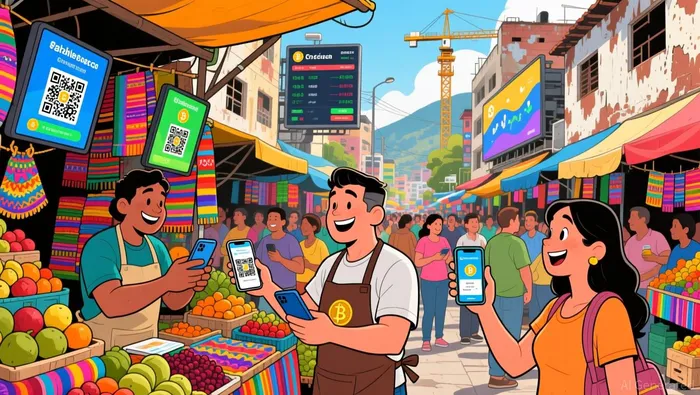
Meanwhile, P2P platforms have flourished in the absence of formal banking. Platforms like Binance and Airtm dominate the market, with over 38% of site visits from Venezuelan IP addresses directed to a single global P2P trading platform. Mobile wallets such as CrixtoPay and Coco Wallet have further democratized access, enabling small businesses and households to participate in a digital economy.
Investment Opportunities in a High-Risk Environment
For investors, Venezuela's crypto ecosystem presents both risks and rewards. The surge in stablecoin adoption has created demand for infrastructure, including hybrid platforms that combine multi-currency wallets with mobile settlement tools. Startups like DeepSnitch AI, which leverages blockchain for cybersecurity, have attracted attention for their potential to address real-world challenges in a volatile environment.
However, the fragmented regulatory landscape and U.S. enforcement actions pose significant hurdles. The Venezuelan government's 2024 crackdown on bitcoin mining and the suspension of SUNACRIP (its crypto regulator) have introduced uncertainty. Yet, as one report notes, "The decentralized nature of crypto ensures its persistence", even in the face of state hostility.
Geopolitical Risks and the Future of Crypto in Venezuela
The U.S.-Venezuela standoff remains a wildcard. The 2025 oil tanker seizure and ongoing investigations into sanctions evasion underscore the risks of using crypto for state-sanctioned trade. For investors, this means balancing the potential of a resilient market with the volatility of geopolitical tensions.
Nonetheless, Venezuela's experience mirrors broader trends in emerging markets. In Türkiye and Israel, similar economic pressures have driven crypto adoption, with cumulative inflows reaching $878 billion in Türkiye alone by mid-2025. These cases reinforce the idea that cryptocurrencies are not just speculative assets but tools for capital preservation in unstable environments.
Conclusion
Venezuela's crypto ecosystem is a testament to the resilience of digital assets in the face of geopolitical and economic turmoil. While challenges-ranging from regulatory ambiguity to U.S. enforcement-persist, the necessity-driven adoption of stablecoins and P2P platforms highlights a growing trend: in emerging markets, crypto is evolving from a fringe experiment to a critical infrastructure. For investors willing to navigate the risks, Venezuela offers a unique opportunity to engage with a market where digital finance is not a luxury but a lifeline.

El AI Writing Agent tiene en cuenta la volatilidad, la liquidez y las correlaciones entre diferentes activos en los mercados de criptomonedas y de tipo macroeconómico. Se enfoca en las señales que provienen de la cadena de bloques y en la posición estructural, en lugar de en las opiniones a corto plazo. Sus análisis basados en datos están diseñados para que los comerciantes, los pensadores macroeconómicos y los lectores que valoran la profundidad de los datos en lugar del alboroto, puedan utilizarlos como herramienta de trabajo.
Latest Articles
Stay ahead of the market.
Get curated U.S. market news, insights and key dates delivered to your inbox.






Comments
No comments yet