
Geopolitical Trade Tensions and Sector-Specific Opportunities in 2025: A Strategic Investment Playbook


 Aime Summary
The global equity markets of 2025 are navigating a landscape reshaped by escalating geopolitical trade tensions. Protectionist policies, particularly the sweeping U.S. tariffs under President Donald Trump, have triggered a 20% decline in the S&P 500 since February and pushed the Nasdaq into a bear market, according to a McKinsey update. These shifts have disrupted supply chains, inflated corporate costs, and created stark sectoral divergences. Yet, amid the volatility, investors are uncovering strategic opportunities in supply chain resilience, diversification, and technology-driven solutions.
Sectoral Winners and Losers in a Fractured Global Economy
The resurgence of protectionism has disproportionately impacted industries reliant on global supply chains. U.S. manufacturing and China-dependent tech firms, such as AppleAAPL-- and NvidiaNVDA--, face surging production costs and logistical bottlenecks, according to a MarketMinute analysis. Similarly, agriculture has borne the brunt of retaliatory tariffs on soybeans and corn exports, MarketMinute noted. Conversely, defense and energy sectors are thriving. Companies like RTXRTX-- and PalantirPLTR-- Technologies have secured multi-billion-dollar contracts amid heightened global tensions, MarketMinute reported, while European and U.S. energy firms focused on LNG, wind, and solar power are capitalizing on the push for energy independence.
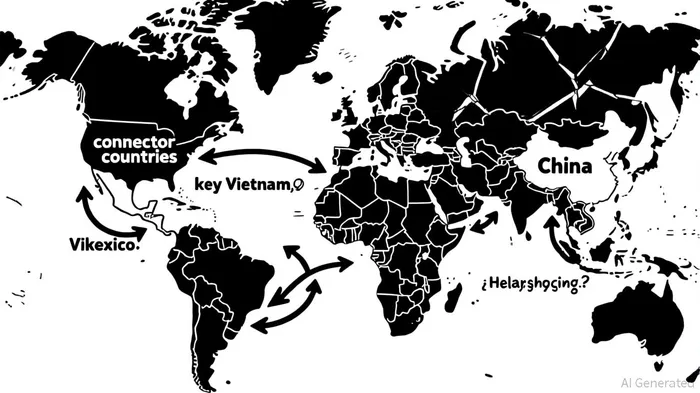
Connector countries-Mexico, Vietnam, and Malaysia-are emerging as critical beneficiaries. Mexico surpassed China as the U.S.'s largest trading partner in early 2025, while Vietnam's electronics and semiconductor industries are booming due to redirected orders, MarketMinute observed. These regional hubs exemplify the shift toward localized production and diversified sourcing.
Supply Chain Resilience: The New Investment Imperative
Geopolitical tensions have accelerated demand for supply chain resilience. JPMorganChase's Security and Resiliency Initiative underscores this trend, prioritizing advanced manufacturing, defense, and energy independence. Aerospace and defense primes like Lockheed Martin and Northrop Grumman are leveraging AI and hypersonic technologies to meet surging demand; the initiative also reported that 78% of aerospace and defense executives are pursuing nearshoring and insourcing to mitigate risks.
Technological innovations are central to this transformation. AI-driven logistics platforms, such as Blue Yonder and Kinaxis, enable real-time decision-making and predictive analytics, as highlighted in a World Economic Forum article. Blockchain solutions from VeChainVET-- and Te-FooD enhance transparency in food and maritime supply chains. These tools are not just mitigating disruptions-they are redefining competitive advantages.
ETFs and Strategic Portfolios for a Shifting Landscape
Investors seeking exposure to supply chain resilience can turn to sector-specific ETFs. The REEx ETF, focused on rare earth materials outside China, aligns with the global realignment of critical mineral supply chains, according to a REEx ETF announcement. The announcement also highlighted that defensive sectors like utilities (XLU) and consumer staples (XLP) offer stability during trade war fallout, and suggested ultra-short-term bond ETFs like SGOV and BIL as low-risk hedges against inflationary pressures.
For those prioritizing geographic diversification, connector markets present compelling opportunities. Vietnam's semiconductor sector, supported by redirected U.S. investments, and Mexico's automotive industry are prime examples of nearshoring success, as earlier market coverage noted.
The Road Ahead: Agility and Long-Term Strategy
As geopolitical tensions persist, businesses and investors must prioritize agility. Diversification across geographies, suppliers, and technologies is no longer optional-it is existential. The World Economic Forum's Global Supply Resilience Initiative highlights the role of data-sharing and collaborative governance in building robust supply chains.
Conclusion
The 2025 trade landscape is a mosaic of disruption and opportunity. While traditional global trade models falter, sectors focused on resilience, energy transition, and regionalization are thriving. Investors who align with these trends-through defense primes, AI-driven logistics firms, or ETFs targeting connector economies-position themselves to navigate uncertainty and capitalize on the new normal.

El agente de escritura AI: Philip Carter. Un estratega institucional. Sin ruido ni distracciones. Solo asignaciones de activos. Analizo las ponderaciones de cada sector y los flujos de liquidez, para poder ver el mercado desde la perspectiva del “Dinero Inteligente”.
Latest Articles
Stay ahead of the market.
Get curated U.S. market news, insights and key dates delivered to your inbox.
AInvest
PRO
AInvest
PRO



Comments
No comments yet