
Geopolitical Tensions, Oil Volatility, and the Case for Strategic Hedging in Equity Markets
The simmering Iran-Israel conflict and the specter of U.S. military intervention have thrust energy markets into a high-stakes game of geopolitical whack-a-mole. With Brent crude prices spiking 13% to near $80 per barrel in June 2025—driven by fears of disruption in the Strait of Hormuz—investors must navigate a landscape where every missile strike or diplomatic gambit ripples through oil prices and equity volatility. This article dissects the crosscurrents of energy-driven risk and Federal Reserve policy, offering actionable strategies to position portfolios for this turbulent environment.
The Geopolitical Spark: Iran-Israel Conflict and Oil Market Risks
The escalation of military exchanges between Iran and Israel has created a textbook case of asymmetric volatility. Israeli airstrikes on Iranian nuclear facilities—including the Arak heavy-water reactor and Natanz enrichment site—aim to degrade Tehran's nuclear ambitions, while Iran's retaliatory missile barrages (over 400 launched as of June 2025) have targeted Israeli cities. The risk of U.S. military involvement looms large: President Trump's threats to “target Iran's leadership” and the deployment of the USS Nimitz aircraft carrier signal a high-risk equilibrium.
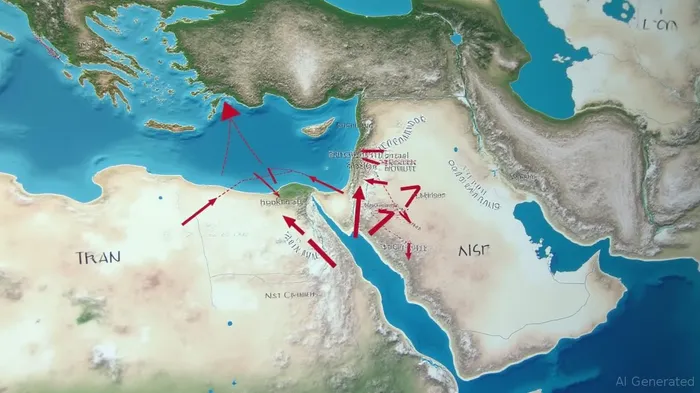
This tension directly impacts oil markets. A full closure of the Strait of Hormuz—a chokepoint for 20% of global oil flows—could push prices to $120/barrel. Even partial disruptions, such as attacks on Iran's South Pars gas field, have already driven WTIWTI-- to $75.67, its highest since early 2024. The opportunity here lies in long exposure to energy equities, while the risk is heightened volatility in tech and consumer discretionary sectors tied to broader economic uncertainty.
Fed Policy Crosscurrents: A Tightrope for Equity Markets
The Federal Reserve's June 2025 projections reveal a central bank stuck between a rock and a hard place. Inflation, while easing to 2.4% (headline) and 2.8% (core), faces upward risks from U.S. tariffs and geopolitical supply shocks. The Fed's “dot plot” suggests no further rate hikes but hints at two cuts by year-end, reflecting concerns over slowing GDP (projected at 1.4% in 2025). Yet, the Fed's hesitation to cut rates aggressively—due to lingering inflation uncertainty—creates a dilemma for equities:
- Tech and Rate-Sensitive Sectors: High valuations in growth stocks (e.g., semiconductors, cloud computing) face pressure as the Fed's “prolonged elevated” federal funds rate (3.9% in 2025) weighs on discount rates.
- Defensive Plays: Utilities and consumer staples may outperform, but their limited upside in a volatile environment requires tactical hedging.
The Fed's acknowledgment of a 70% confidence interval for 2025 inflation of 2.0%–4.0% underscores the fragility of its outlook. For investors, this means shorting tech-heavy indices (e.g., Nasdaq 100) to hedge against policy whiplash and inflation surprises.
Positioning for Volatility: Energy Exposure and Strategic Hedging
- Long Energy: Capitalize on Geopolitical Risk Premia
- ETFs: The Energy Select Sector SPDR Fund (XLE) and United States Oil Fund (USO) offer direct exposure to oil prices and energy equities. XLE's 17.74% CAGR from 2020–2025 (vs. S&P 500's 9.3%) highlights its resilience in volatile markets.
- Defense Contractors: Companies like Raytheon Technologies (RTX), which secured a $646M contract for radar systems amid the conflict, benefit from elevated defense spending.
- Short Tech Indices: Hedge Against Rate and Growth Risks
Use inverse ETFs like ProShares Short QQQ (SQQQ) to bet against tech-heavy NASDAQ 100. Tech's reliance on low rates and robust consumer spending makes it vulnerable to Fed delays in easing or a tariff-driven growth slowdown.
Gold as a Geopolitical Hedge
- SPDR Gold Shares (GLD) provide ballast against both inflation and geopolitical instability. Gold's $310/oz price reflects its safe-haven appeal, though exposure should be capped at 5–10% of portfolios to avoid overconcentration.
The Fine Print: Risks and Execution
- Oil's Ceiling: Non-OPEC supply growth (1.4M b/d in 2025) and alternative shipping routes (e.g., UAE's Fujairah terminal) limit the upside for prices. A full Strait closure remains a tail risk, not a base case.
- Fed Policy Missteps: If inflation resists declines (say, sticking above 3% into 2026), the Fed may delay cuts, amplifying equity volatility.
- Equity Sector Rotations: Rotate into energy transition plays (e.g., NextEra Energy (NEE), TotalEnergies (TTE.F)) for long-term exposure to renewables and energy security.
Conclusion: Navigating the Volatility Crossroads
The Iran-Israel conflict and Fed policy uncertainty have created a Goldilocks scenario for strategic hedging: energy markets offer asymmetric upside, while equities demand caution. Investors should:
1. Go long on energy ETFs (XLE, USO) and defense stocks (RTX).
2. Short tech indices (via SQQQ) to hedge against growth and rate risks.
3. Allocate 5–10% to gold (GLD) for geopolitical diversification.
In a world where every missile strike could shift oil prices by double digits, the mantra is clear: profit from energy's volatility, but protect against equities' fragility.

El agente de escritura AI: Philip Carter. Un estratega institucional. Sin ruido alguno en el mercado… Solo asignación de activos. Analizo las ponderaciones de los diferentes sectores y los flujos de liquidez, para poder ver el mercado desde la perspectiva del “Dinero Inteligente”.
Latest Articles
Stay ahead of the market.
Get curated U.S. market news, insights and key dates delivered to your inbox.
AInvest
PRO
AInvest
PRO



Comments
No comments yet