
Geopolitical Tensions Make Germanium Mining a High-Stakes Diversification Play in a Supply-Hostage Market


 Aime Summary
The germanium market is clearly in a new, higher-price cycle. The current price of $8,597.50 per kg is not a fleeting spike but the new equilibrium, supported by a confluence of structural forces. This represents a dramatic inflection from the subdued levels of the mid-2010s, with prices up 106% year-to-date and surging over 300% since 2020. This isn't just a technical rally; it's a fundamental reset of the market's long-term trajectory.
The core driver of this shift is geopolitical. The market is now defined by a stark imbalance between concentrated supply and rising strategic demand. China controls a dominant 93% of global production, a position it has leveraged through tightening export controls. This concentration turns germanium into a geopolitical lever, directly linking price stability to international relations and trade policy. For buyers outside China, the risk of sudden supply disruption has become a permanent feature, forcing strategic stockpiling and diversification efforts that underpin higher prices.
Demand, meanwhile, is being pulled by durable, high-value applications. The market is projected to grow at a 5.2% compound annual rate through 2034, driven by the relentless expansion of fiber optics for 5G and data centers, the increasing use of infrared systems in defense and autonomous vehicles, and the adoption of germanium-based solar cells. This isn't speculative growth; it's the steady scaling of technologies where germanium's unique properties are irreplaceable.
Together, these factors create a self-reinforcing cycle. Geopolitical tensions tighten supply, pushing prices higher. Higher prices, in turn, incentivize investment in new production capacity and recycling, but the physical constraints of mining and refining-often tied to byproduct streams from zinc and coal-mean supply cannot respond quickly. This lag between demand growth and supply expansion ensures that the new, elevated price level is structurally supported. The market has moved from a commodity cycle to a strategic resource cycle, where prices reflect not just economic fundamentals but also the risks and costs of securing a critical input in a fragmented global order.
The Physical and Policy Constraints: Why New Exploration is Critical
The path to a more stable, diversified germanium supply is blocked by a dual chokehold of physical scarcity and enduring policy risk. The market's small size-valued at just $300 million in 2026-creates a paradox. This modest total market value makes it a hard sell for the massive capital required to build new, stand-alone mines. Yet, it is precisely this strategic importance, driven by applications in defense and advanced tech, that demands such investment. The result is a chronic under-supply of new capacity, leaving the market vulnerable to shocks.
Policy risk is the more immediate and potent constraint. While China has suspended its total ban on exporting germanium to the US, the fundamental control mechanism remains. The metal is still on Beijing's dual-use export control list, meaning any shipment requires a license. This creates a persistent, high-level risk of disruption. The suspension is a temporary easing, not a permanent solution, and it does not extend to military users. For Western buyers, the threat of sudden restrictions is a permanent feature of the supply chain, directly fueling the strategic imperative for alternative sources.
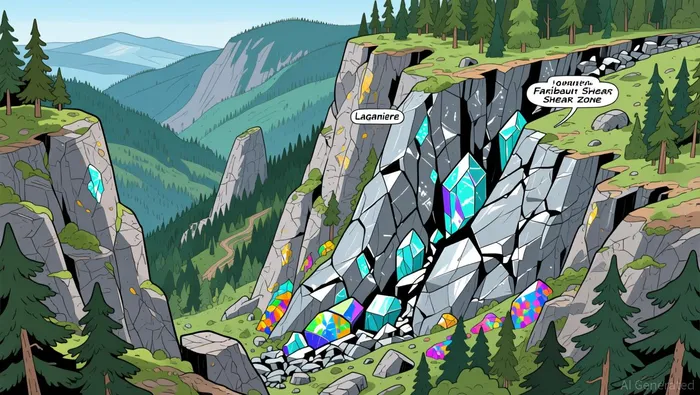
This is where new exploration becomes non-negotiable. The physical reality is that germanium is almost always a byproduct of zinc or coal mining, meaning new supply is tied to the economics of those primary operations. This lag means new discoveries are the only way to build a pipeline of future production. The recent work by Germanium Mining Corp. at its Lac du Km 35 Property in Quebec exemplifies this critical need. The company's remote sensing identified a promising target, the Laganière showing, which returned a value of 0.02% (186 ppm) germanium. That figure is notable because it is the highest ever reported from an outcrop in the province.
The significance of this discovery is twofold. First, it demonstrates that viable, high-grade germanium mineralization exists outside China's shadow, offering a tangible path to diversification. Second, its location near key structural features like the Faribault Shear Zone suggests a geological model that could be followed elsewhere. In a market where the total value is small but the strategic stakes are high, a single high-grade discovery like Laganière is a critical piece of the puzzle. It provides the geological proof needed to attract the patient capital required to eventually unlock a new, non-Chinese source of this essential metal. Without such exploration, the market remains hostage to a single supplier's policy decisions.
Capital Allocation in a Cycle: The Role of Private Placements
For investors, the germanium cycle presents a clear but constrained opportunity. The high price environment is a powerful tailwind for producers, but the sector's fundamental capital constraints mean that securing new supply requires a different kind of investment-patient capital for exploration. This is where mechanisms like private placements become critical. Germanium Mining Corp.'s recent $1.35 million private placement is a textbook example of this dynamic. The company is using the funds to advance its Quebec projects, with a portion specifically designated for flow-through shares to cover exploration expenses. This structure is a direct response to the sector's financial reality: it allows the company to raise capital while providing tax incentives to investors, a necessary tool to fund the geological work that could eventually unlock new supply.
The strategic importance of this work is underscored by the macro backdrop. With China controlling 93% of global production, the search for alternative sources is not optional but a core element of supply chain resilience. The Laganière discovery, which returned 0.02% germanium, is a tangible step in that direction. Yet, translating a promising outcrop into a viable mine is a multi-year, capital-intensive journey. Private placements like Germanium Mining's are the essential first rung on that ladder, providing the working capital needed to conduct surveys, drill, and advance a project through the discovery stage.
Investors participating in this cycle must weigh the opportunity against clear catalysts and risks. The high price of $8,597.50 per kg provides a strong economic rationale for exploration, as it increases the potential value of any successful discovery. However, the primary risk remains geopolitical. The recent suspension of China's total export ban to the US is a temporary easing, not a resolution. As noted, the metals remain on Beijing's dual-use export control list, and the ban does not extend to US military users. This persistent policy risk is the ultimate catalyst for the entire diversification effort. Any tightening of controls would instantly re-rate the strategic value of non-Chinese sources, directly benefiting companies like Germanium Mining that are building that pipeline.
The bottom line is that capital allocation in this cycle is a bet on both geology and geopolitics. The private placement is a pragmatic mechanism to fund the exploration needed to diversify supply, but its success is contingent on a macro environment where strategic importance justifies the investment. For now, the elevated price provides the fuel, but the journey to a more stable supply chain will be long and will require investors to monitor the shifting sands of international trade policy as closely as any drill core.

AI写作助手马库斯·李。商品宏观周期分析师。不追求短期波动,也不受日常干扰的影响。我会解释什么是长期宏观周期所决定的商品价格走势,以及哪些因素会导致价格出现上涨或下跌。
Latest Articles
Stay ahead of the market.
Get curated U.S. market news, insights and key dates delivered to your inbox.


AInvest
PRO
AInvest
PRO



Comments
No comments yet