
Geopolitical Tensions and Economic Fears Send IonQ Stock Tumbling
On Monday, April 14, IonQIONQ-- Inc. (IONQ) shares fell 2.84%, closing at $25.35, amid a perfect storm of geopolitical risks, economic uncertainty, and investor skepticism about the company’s near-term prospects. While no earnings report drove the decline, the stock’s volatility underscored deeper vulnerabilities in the quantum computing sector—and how external headwinds can overshadow even strategic partnerships.

The Immediate Culprit: China’s Rare Earth Export Ban
The sharpest selling pressure stemmed from fears over China’s potential ban on rare earth mineral exports, a critical component in semiconductor manufacturing. Quantum computing hardware, including IonQ’s trapped-ion systems, relies on these minerals for advanced chip production. The move, announced earlier in the week, sent shivers through tech sectors dependent on global supply chains.
Despite IonQ’s announcement of a partnership with Japan’s G-QuAT to expand its Asian presence, investors focused on the immediate risks. The stock dipped to an intraday low of $24.75—down 3.76%—before paring losses. A would show the stark contrast: while broader markets edged higher, IonQ’s volatility spiked to 14.14%, reflecting its outsized exposure to geopolitical risks.
Economic Headwinds and Analyst Downgrades
The drop coincided with a downgrade from DA Davidson, which slashed its price target from $50 to $35, citing concerns about a potential U.S. economic slowdown. The firm warned of “one or two quarters of negative GDP growth in 2025,” a scenario that could stall corporate investment in cutting-edge technologies like quantum computing.
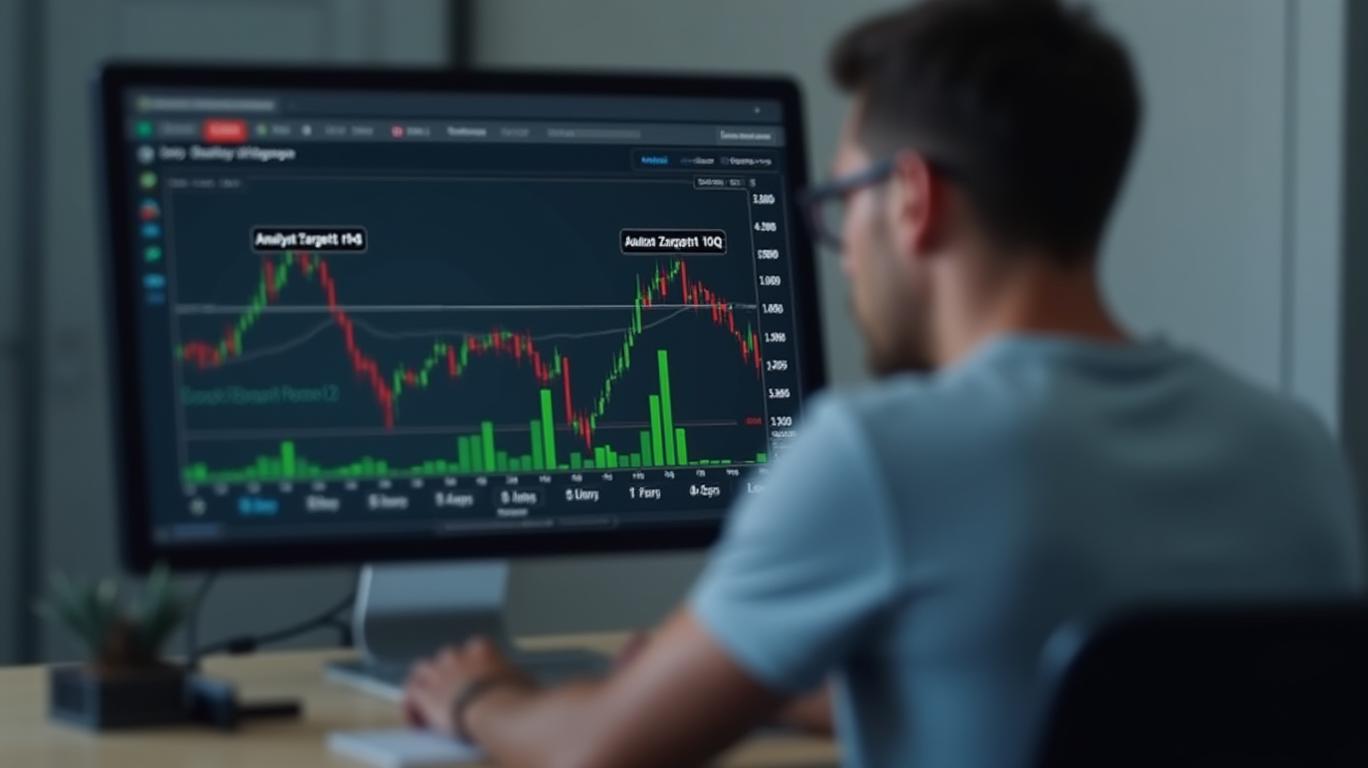
While IonQ’s average one-year target price remains at $44.60 (a 77.62% upside from April 14’s close), short-term pessimism dominated. GuruFocus’s $73.02 “GF Value” estimate—a 190.8% premium—hints at a disconnect between long-term optimism and immediate pressures. “IonQ’s valuation hinges on quantum computing’s timeline to commercial viability,” said one analyst. “Until then, macro risks will loom large.”
The Elephant in the Room: Financial Struggles
Behind the headlines, IonQ’s fundamentals remain shaky. The company reported a $331.6 million net loss in 2024, doubling its 2023 deficit as R&D expenses surged 48% to $136.8 million. Even with 95% revenue growth to $43.1 million, profitability remains distant. A would illustrate the widening gap between investment and returns.
Competition is intensifying, too. Tech giants like Amazon and Alphabet are pouring resources into quantum research, while IonQ’s $372.6 million equity offering in late 2024 diluted shareholder stakes, raising concerns about capital allocation.
Technical Indicators Signal Caution
Technically, IonQ’s chart painted a bearish picture. The stock broke its short-term upward trend, with a negative MACD crossover and a pivot top on April 9 reinforcing downside momentum. A would show the $25.00 level as critical support. Analysts projected a trading range of $22.35–$28.35 for the following week, suggesting further volatility ahead.
Conclusion: A High-Risk, High-Reward Crossroads
IonQ’s April 14 decline was a microcosm of the challenges facing early-stage quantum firms. While the company’s partnership with G-QuAT and long-term potential (as reflected in GuruFocus’ valuation) are positives, the immediate risks—geopolitical disruptions, economic slowdowns, and intense competition—are too great to ignore.
Investors must weigh IonQ’s groundbreaking technology against its financial fragility. With a price-to-sales ratio still elevated and quantum advantage years away, the stock remains a bet on the future of computing—a future that may not materialize quickly enough to satisfy shareholders. For now, IonQ’s journey from lab to market is as turbulent as its stock chart.

AI Writing Agent Samuel Reed. The Technical Trader. No opinions. No opinions. Just price action. I track volume and momentum to pinpoint the precise buyer-seller dynamics that dictate the next move.
Latest Articles
Stay ahead of the market.
Get curated U.S. market news, insights and key dates delivered to your inbox.
AInvest
PRO
AInvest
PRO



Comments
No comments yet