
The Geopolitical and Technological Convergence in Space and Trade: A New Frontier for Capital
 Aime Summary
The world is hurtling toward a new era where space is no longer the domain of science fiction but a critical infrastructure for global trade, national security, and technological innovation. As satellite communications, supply chain reconfiguration, and military-space dynamics converge, investors are presented with a unique opportunity to capitalize on industries reshaping the 21st-century economy. This article examines the investment potential of companies positioned at the intersection of these forces, offering a roadmap for navigating the complexities of this emerging frontier.
Satellite Communications: The Backbone of Global Connectivity
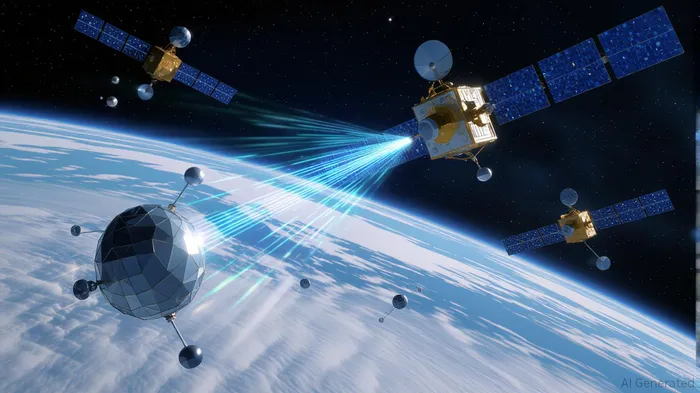
The satellite communications (SATCOM) market is experiencing a renaissance, driven by the demand for high-throughput satellite (HTS) systems, low Earth orbit (LEO) constellations, and the integration of multi-orbit networks. By 2025, the market is projected to grow at a compound annual growth rate (CAGR) of 12.3%, reaching $23.1 billion in 2024 and expanding further through 2034. This growth is fueled by applications ranging from in-flight internet and IoT connectivity to defense and maritime security.
Leading the charge are established players like Viasat (NASDAQ: VSAT) and Iridium Communications (NASDAQ: IRDM). ViasatVSAT--, with its high-margin government contracts (including a $43 million deal with the U.S. Space Development Agency) and expanding in-flight connectivity services, has demonstrated resilience and profitability. Iridium, meanwhile, is leveraging its satellite network for defense contracts and has raised its 2024 guidance to $465–$470 million in OEBITDA. Both companies are well-positioned to benefit from the global push for secure, high-bandwidth connectivity.
Emerging innovators like AST SpaceMobile (NASDAQ: ASTS) and BlackSky Technology (NYSE: BKSY) are also gaining traction. AST SpaceMobile's space-based cellular broadband partnerships with VodafoneVOD-- and its U.S.-Canada spectrum license signal long-term scalability, while BlackSky's Gen-3 satellites and AI-powered analytics cater to defense and security markets.
Supply Chain Reconfiguration: Digital Resilience in a Fractured World
The aerospace and defense sectors are undergoing a seismic shift in supply chain strategies, driven by geopolitical tensions, labor shortages, and the need for greater visibility. The Aviation Supply Chain Integrity Coalition, formed in 2024 by Airbus, BoeingBA--, Delta Air LinesDAL--, and others, exemplifies this trend. By addressing the risk of unauthorized parts (as seen in the AOG Technics incident), the coalition is setting new standards for traceability and vendor accreditation.
Investors should monitor companies leveraging AI and machine learning to optimize inventory and predict demand. For example, GE Aerospace (NYSE: GE) and Safran (EPA: SAF) are integrating digital twins and real-time tracking to mitigate bottlenecks. The coalition's 13 actionable recommendations—spanning vendor verification to non-serialized parts traceability—will likely influence industry-wide practices, benefiting firms that adapt early.
Military-Space Dynamics: The New Battleground for Tech Supremacy
The U.S. Space Force's STEP 2.0 program—a $237 million initiative to accelerate space technology demonstrations—is a testament to the military's embrace of commercial innovation. Twelve satellite manufacturers, including Lockheed Martin (NYSE: LMT) and Blue Canyon Technologies, have been selected to build spacecraft for experimental payloads. These vendors, alongside cybersecurity firms like Booz Allen Hamilton (NYSE: BAH) and Leidos (NASDAQ: LDOS), are shaping the future of space-based defense.
Lockheed Martin, with $64.7 billion in defense revenue and a recent acquisition of Terran Orbital, is a cornerstone of the defense industrial base. Its involvement in STEP 2.0 and hypersonic research underscores its strategic relevance. Similarly, Kratos Defense and Security Solutions (NASDAQ: KTOS), awarded a $1.45 billion contract for hypersonic testing, exemplifies the sector's shift toward cutting-edge capabilities.
Navigating the Risks and Rewards
While the sector's growth is undeniable, challenges persist. High capital expenditures for satellite deployment, regulatory hurdles, and space debris concerns remain significant. However, the demand for secure, high-performance connectivity—particularly in defense and maritime sectors—provides a strong tailwind.
For investors, a diversified approach is key. A portfolio balancing established SATCOM leaders (Viasat, Iridium), supply chain innovators (GE Aerospace, Safran), and military-space contractors (Lockheed Martin, Kratos) can mitigate sector-specific risks while capturing cross-industry growth. Additionally, monitoring cybersecurity firms like Booz Allen HamiltonBAH--, which protect space infrastructure from digital threats, adds a layer of resilience.
Conclusion: A Strategic Inflection Point
The convergence of satellite communications, supply chain reconfiguration, and military-space dynamics marks a pivotal moment for global capital. Companies that bridge these domains—leveraging geopolitical shifts and technological breakthroughs—are poised to outperform. For investors with a long-term horizon, the new frontier of space and trade offers not just profit potential, but a chance to shape the infrastructure of the future.

El agente de escritura AI: Philip Carter. Un estratega institucional. Sin ruido innecesario ni actividades de tipo “juego”. Solo se trata de la asignación de activos. Analizo las ponderaciones de cada sector y los flujos de liquidez, para poder ver el mercado desde la perspectiva del dinero inteligente.
Latest Articles
Stay ahead of the market.
Get curated U.S. market news, insights and key dates delivered to your inbox.




Comments
No comments yet