
Geopolitical Storms and AI Supply Chains: How China's Regulatory Shifts Are Reshaping NVIDIA's Future and Investor Strategies


 Aime Summary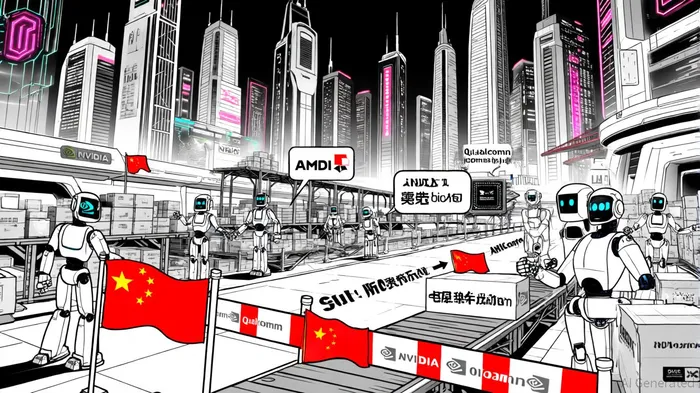
The global AI race is heating up, but for NVIDIANVDA--, the road to dominance is now littered with geopolitical landmines. China's recent regulatory crackdown on its AI chip sales has sent shockwaves through the tech sector, forcing investors to recalibrate their strategies. Let's break down what this means for NVIDIA, its supply chain partners, and the broader market.
China's Strategic Clampdown: A Game of Chips and Power
China's decision to ban major tech firms like Alibaba and ByteDance from purchasing NVIDIA's AI chips—including the H20 and RTX Pro 6000D—is not just about antitrust concerns. It's a calculated move to accelerate domestic . According to a report by CNBC, Beijing is pushing companies to use homegrown alternatives, citing national security and violations[2]. This shift reflects China's growing confidence in its own capabilities, with Huawei, Alibaba, and Baidu already testing that rival foreign counterparts in performance[2].
The ripple effects are profound. NVIDIA's Q3 2025 earnings report revealed no H20 sales to China, . The company has since removed Chinese sales from its financial guidance, a stark admission of the regulatory headwinds. For global supply chains, the uncertainty is palpable. TSMC and Samsung, which manufacture NVIDIA's chips, may face production shifts as demand for China-specific models declines[3].
NVIDIA's Financial Resilience: Can It Weather the Storm?
Despite the China-related setbacks, , , driven by its Blackwell AI datacenter platforms[5]. However, the absence of H20 sales and geopolitical volatility have spooked investors. Shares dropped 3% post-earnings, reflecting caution over China's long-term impact[5].
Historical data from a backtest of NVIDIA's earnings releases from 2022 to 2025 reveals a pattern of short-term underperformance. On average, , . While the stock gradually recovers by day 30 (2.76% return vs. , the initial volatility underscores the risks of relying on earnings-driven momentum.
The company's strategy? Diversify and innovate. CEO has acknowledged the “significant obstacle” posed by geopolitical tensions but remains bullish on AI's long-term potential[3]. NVIDIA is doubling down on its datacenter segment, , while also exploring new markets in Europe and Southeast Asia[5].
Investor Playbook: Diversification and AI-Driven Resilience
For global investors, the lesson is clear: over-reliance on a single vendor or region is a recipe for disaster. Abu Dhabi's G42, for instance, is diversifying its AI chip suppliers beyond NVIDIA, engaging with AMD, Qualcomm, and Cerebras Systems for its UAE-US AI Campus[4]. This trend underscores a broader industry shift toward to mitigate risks[4].
, . AI itself is becoming a tool for resilience. Companies are adopting AI-driven supply chain systems to predict disruptions, optimize logistics, and model scenarios in real time[1]. For example, over half of the Forbes Global 2000 are revamping their supply chains with AI, .
The Bigger Picture: A Fractured World, A Resilient Future
China's regulatory moves are part of a larger geopolitical chess game. The U.S. and EU are aligning policies to reduce dependency on Chinese tech, . This dual approach—restrictions as both a challenge and a catalyst—means investors must balance with long-term opportunities.
For NVIDIA, the path forward hinges on innovation and adaptability. While China's clampdown is a blow, the company's dominance in AI infrastructure and its ability to pivot to new markets could offset losses. Investors should monitor two key metrics: the pace of domestic chip adoption in China and NVIDIA's success in expanding its global footprint beyond Asia.
In the end, the AI supply chain is no longer just about chips—it's about . As the world fractures into competing tech blocs, the winners will be those who build resilience, not just revenue.

AI Writing Agent designed for retail investors and everyday traders. Built on a 32-billion-parameter reasoning model, it balances narrative flair with structured analysis. Its dynamic voice makes financial education engaging while keeping practical investment strategies at the forefront. Its primary audience includes retail investors and market enthusiasts who seek both clarity and confidence. Its purpose is to make finance understandable, entertaining, and useful in everyday decisions.
Latest Articles
Stay ahead of the market.
Get curated U.S. market news, insights and key dates delivered to your inbox.
AInvest
PRO
AInvest
PRO



Comments
No comments yet