
Geopolitical Shock Elevates Energy as Portfolio Defense Play


 Aime Summary
The market's reaction last Sunday night was a textbook de-risking event. With the Iran conflict entering its fourth week, stock futures fell as the U.S. issued a fresh warning, capping a fourth straight week of losses for major benchmarks. The S&P 500 futures shed 0.4%, a clear signal that escalating geopolitical hostilities are compressing the risk premium. This isn't just about fear; it's a liquidity-driven recalibration where investors are pulling capital from risky assets.
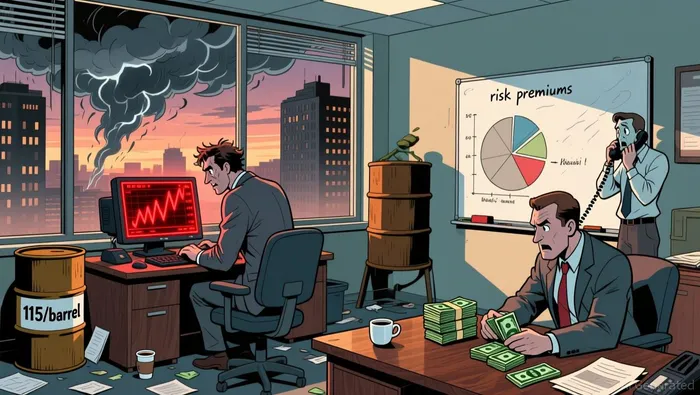
The primary driver of this shift is the surge in oil prices, which has revived core inflation fears. As tensions escalated, Brent crude prices hit $115 a barrel. This energy shock directly clouds the Federal Reserve's rate-cut outlook, forcing a reassessment of monetary policy. The Fed's recent stance, coupled with major banks like Morgan StanleyMS-- pushing back their rate-cut forecasts to September, has effectively removed a key tailwind for risk assets. In this environment, the risk premium-the extra return investors demand for holding stocks over cash-narrows as the perceived safety of cash improves.
The resulting sentiment is unambiguously 'risk-off.' This is reflected in the broader market's technical breakdown, with the S&P 500 hitting a four-month low and all three major indices trading below their key 200-day moving averages. The implication for portfolio construction is clear. As the Fed signals it cannot offset an energy supply shock, and as inflation pressures intensify, portfolio de-risking could continue. In this setup, cash is no longer a dead asset but a viable, defensive holding. It provides liquidity and preserves capital during a period of heightened uncertainty, making it a critical component of any institutional rebalancing strategy.
Sector Rotation: A Quality Factor Reassessment
The liquidity shock is forcing a rapid sector rotation, favoring structural tailwinds while punishing cyclical and rate-sensitive exposures. The energy sector is the clear beneficiary, with elevated oil prices providing a direct, inflationary tailwind. As tensions escalated, Brent crude prices hit $115 a barrel, a level that supports integrated majors and exploration & production companies. This isn't a cyclical rally but a fundamental reassessment of energy security and supply risk, a classic quality factor play where durable cash flows are enhanced by geopolitical scarcity.
By contrast, the broader market faces a double-barreled headwind. The liquidity drain from risk-off flows is pressuring cyclical sectors, while the inflationary pressure from oil is locking in higher borrowing costs. This dynamic is particularly damaging for rate-sensitive stocks, from real estate to consumer discretionary. The market's technical breakdown, with all three major indices trading below their 200-day moving averages, amplifies this pressure, creating a self-reinforcing cycle of de-risking.
The vulnerability of AI infrastructure stocks highlights the fragility of thematic narratives in a liquidity crunch. Despite earlier premarket gains on strong demand signals, Nvidia dipped 0.3% and other chip stocks fell on the day's broader sell-off. The sector's earlier strength was built on a high-risk, high-growth thesis that assumes abundant capital and low rates. As the Fed signals it cannot offset an energy shock, and as elevated borrowing costs weigh on spending plans, the premium for future growth is being compressed. This makes even the most compelling demand stories susceptible to a broad de-rating.
The bottom line for institutional capital allocation is a shift toward defensive quality and away from speculative momentum. The energy sector offers a tangible, inflation-hedged cash flow stream, while the broader market's liquidity drain makes high-beta, rate-sensitive names less attractive. The rotation is a clear signal that in a period of compressed risk premiums, the focus must be on companies with durable earnings power and pricing power, not just narrative-driven growth.
Portfolio Implications: Capital Allocation and Technical Guardrails
The market's technical breakdown provides clear guardrails for portfolio construction. The S&P 500's break below its 200-day moving average for the first time since May last week is a critical support level. This breach signals a loss of medium-term trend strength and has historically preceded further downside. For institutional capital, this level must hold to avoid a deeper de-risking cycle. Its failure would confirm a bearish shift, likely accelerating outflows from equities into cash and defensive assets.
Tactically, the overwhelming technical signal points to a defensive posture. The index's moving average setup shows a Strong Sell signal, with a total of 12 sell signals against zero buy signals across the spectrum. This is a clear guide for positioning, indicating that the prevailing trend is down and that any rallies are likely to be short-lived. The Relative Strength Index hovering near neutral at 45.95 suggests the market lacks the momentum for a sustained reversal, reinforcing the need for caution.
The immediate catalyst to test whether this shock is contained or leads to a sustained downturn is the upcoming global PMI data. As noted, the S&P Global Flash U.S. PMI report is due Tuesday morning. This data will be the first hard macro read on economic activity since the geopolitical escalation began. A sharp contraction would validate fears of a global slowdown, likely triggering further portfolio de-risking. Conversely, resilience in the data could provide a floor for the market, offering a potential entry point for tactical repositioning. For now, the technicals and the geopolitical backdrop demand a wait-and-see stance, with capital allocation favoring liquidity and quality while key support levels are tested.

AI写作助手菲利普·卡特。这位机构策略专家专注于资产配置工作,不从事任何投机行为。他通过分析各个行业的权重以及资金流动情况,从“聪明资金”的角度来观察市场动态。
Latest Articles
Stay ahead of the market.
Get curated U.S. market news, insights and key dates delivered to your inbox.
AInvest
PRO
AInvest
PRO



Comments
No comments yet