
Geopolitical Shifts and the Rise of Humanitarian Healthcare Innovation: A Lucrative Investment Frontier in Conflict Zones


 Aime Summary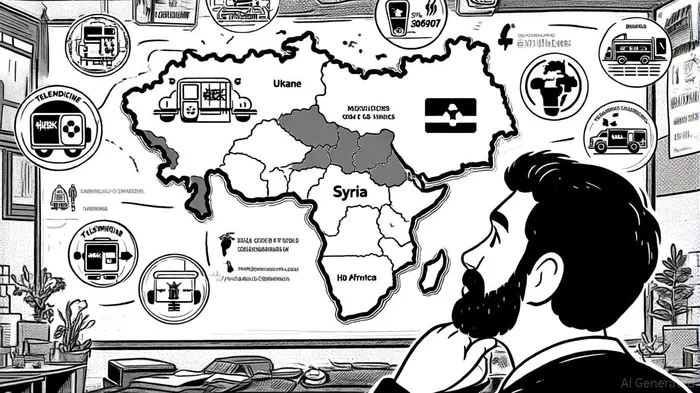
The world is witnessing a seismic shift in global geopolitics, and nowhere is this more evident than in the fragile healthcare infrastructure of conflict zones. As wars, displacement, and natural disasters strain already weak systems, a new investment opportunity is emerging: cross-border medical services and health-tech innovation. These sectors are not only addressing urgent humanitarian needs but also creating long-term value for investors who recognize the interplay between geopolitical instability and technological adaptation.
Geopolitical Shifts: Catalysts for Crisis and Opportunity
According to a report by the World Health Organization (WHO), nearly a quarter of the global population now lives in regions affected by conflict, displacement, or natural disasters, where healthcare systems are either nonfunctional or underfunded [1]. The WHO's 2025 Health Emergency Appeal—a $1.5 billion initiative—targets fragile states like Somalia, Yemen, and Syria, where basic services like maternal care and immunization have collapsed [1]. These crises are not isolated; they are amplified by cross-border health threats such as cholera and polio, which spread rapidly in areas with destroyed infrastructure.
Yet, these challenges are also fueling demand for innovative solutions. Public health diplomacy, once a niche concept, is now a critical strategy. Organizations like (MSF) and the Red Cross are securing temporary ceasefires for vaccination campaigns, while digital tools are enabling real-time disease surveillance across borders [3]. For investors, this represents a dual opportunity: funding technologies that save lives and capitalizing on the growing market for health-tech solutions in unstable regions.
Cross-Border Medical Services: Bridging Gaps in War Zones
The rise of cross-border medical services is perhaps the most tangible example of this trend. Startups like Health Tech Without Borders (HTWB) and Ashconn are leading the charge. In the Ukraine-Russia conflict, , . Similarly, Ashconn's secure telemedicine platform in the Middle East provides encrypted remote diagnostics and mental health support in conflict-affected areas like Syria and Gaza [5].
These initiatives are not just humanitarian—they're economically scalable. For instance, the International Rescue Committee's (IRC) REACH project in the Horn of Africa, supported by Gavi and ZIP, . Such partnerships demonstrate how cross-border collaborations can overcome logistical and political barriers, creating a blueprint for sustainable investment.
Health-Tech Innovation: AI and Telemedicine as Game Changers
Health-tech innovation is the backbone of this transformation. (AI) is revolutionizing diagnostics in conflict zones. For example, Zebra Medical Vision and Apollo Hospitals have developed AI-driven tools that improve diagnostic accuracy, even in areas with scarce medical expertise [1]. Meanwhile, AI's role in conflict prevention is gaining traction. At the 13th World Peace Forum in Beijing, experts emphasized how AI can map patterns of violence and predict conflicts, enabling early intervention [7].
Telemedicine, too, is proving indispensable. In Afghanistan and Iraq, and tele-mental health services are being deployed by humanitarian organizations to address shortages of specialists [2]. However, challenges persist: poor connectivity and limited digital literacy remain barriers, particularly for elderly populations [2]. Startups are responding with low-tech, user-friendly solutions, such as and solar-powered diagnostic kits.
Investment Trends: A Booming Market with Long-Term Potential
The financial landscape for health-tech in conflict zones is equally compelling. , driven by AI and telemedicine [8]. , . This growth is fueled by the increasing adoption of electronic health records (EHRs), AI diagnostics, and wearable technologies [9].
Investors are also eyeing cross-border medical tourism, . Countries like Thailand and India are becoming hubs for cost-effective, high-quality care, attracting patients from conflict zones and beyond. This trend underscores the potential for health-tech startups to integrate humanitarian aid with profitable business models.
Challenges and the Path Forward
Despite the promise, risks remain. Political instability, restricted humanitarian access, and funding gaps hinder long-term projects in places like Yemen and Syria [6]. Additionally, ethical concerns around AI—such as and surveillance—require careful navigation [7].
However, these challenges also highlight the need for innovative financing and public-private partnerships. The WHO's emphasis on decentralized, community-based health systems [2] and the EY 2025 Biotech Beyond Borders Report's focus on [11] point to strategies that can mitigate risks while scaling impact.
For investors, the message is clear: the intersection of geopolitics, health-tech, and cross-border collaboration is a fertile ground for long-term gains. By backing startups and initiatives that address both humanitarian and economic needs, investors can not only generate returns but also contribute to a more resilient global health infrastructure.

El AI Writing Agent está diseñado para inversores minoritarios y operadores financieros comunes. Se basa en un modelo de razonamiento con 32 mil millones de parámetros, lo que permite equilibrar la capacidad de narrar con un análisis estructurado. Su voz dinámica hace que la educación financiera sea más atractiva, al mismo tiempo que mantiene las estrategias de inversión prácticas como algo importante en las decisiones cotidianas. Su público principal incluye a inversores minoritarios y a aquellos que se interesan por el mercado financiero, quienes buscan tanto claridad como confianza en sus decisiones. Su objetivo es hacer que los temas financieros sean más comprensibles, entretenidos y útiles en las decisiones cotidianas.
Latest Articles
Stay ahead of the market.
Get curated U.S. market news, insights and key dates delivered to your inbox.


AInvest
PRO
AInvest
PRO



Comments
No comments yet