
Geopolitical Shifts and Investment Opportunities in the Middle East's Infrastructure and Energy Sectors


 Aime Summary
The Middle East is undergoing a profound transformation in its infrastructure and energy landscape, driven by geopolitical realignments and a strategic pivot away from oil dependency. As global powers recalibrate their influence in the region and local governments prioritize economic diversification, investment opportunities in renewable energy, digital infrastructure, and cross-border transport networks are emerging as critical focal points. This analysis explores how geopolitical dynamics are shaping these opportunities, supported by concrete projects and data from authoritative sources.
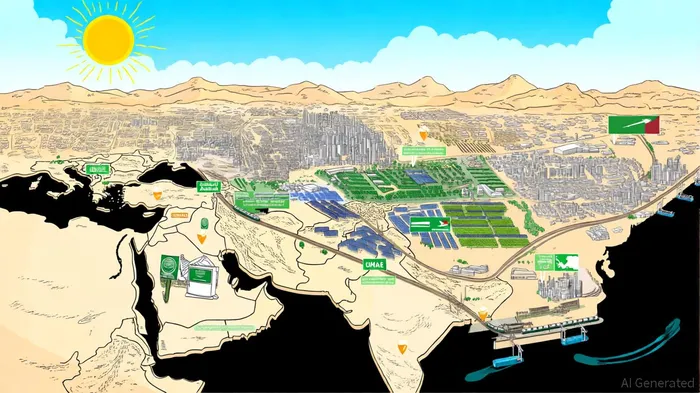
Energy Transition: Green Hydrogen and Solar Power as Strategic Assets
The Middle East's abundant solar resources and low-cost renewable energy production capabilities are positioning it as a global leader in green hydrogen and solar energy. Saudi Arabia's NEOM green hydrogen project, a $8.5 billion initiative, aims to produce 650 tons of hydrogen daily and 1.2 million tons of ammonia annually, leveraging the region's solar potential, according to a Green hydrogen overview. Similarly, Oman's ACME Duqm Hydrogen Project, set to operationalize by 2028, will generate green hydrogen powered by solar energy, further solidifying the Gulf's role in the global clean energy transition.
These projects are not merely economic ventures but geopolitical tools. As the U.S. and China compete for influence in global energy markets, the Gulf states are aligning with both through partnerships like the U.S.-led Partnership for Global Infrastructure and Investment and China's Belt and Road Initiative. For instance, the UAE's Noor Energy 1 solar complex, one of the world's largest solar farms, has attracted investments from European and Asian firms, reflecting the region's growing appeal as a clean energy hub, according to the MENA infrastructure outlook.
Digital Infrastructure: A Catalyst for Economic Diversification
Digital infrastructure is another frontier where geopolitical shifts intersect with investment opportunities. The Gulf's data center capacity is projected to nearly triple by 2030, driven by demand for AI, cloud computing, and 5G networks, a trend highlighted in that MENA infrastructure outlook. Saudi Arabia's NEOM and the UAE's Smart Dubai initiatives are central to this push, with governments offering tax incentives and regulatory reforms to attract tech firms.
The strategic importance of digital infrastructure is underscored by the India-Middle East-Europe Economic Corridor (IMEC), which includes subsea fiber-optic cables linking Middle Eastern data centers to Europe and India. This project, part of a broader U.S.-backed effort to counter China's Belt and Road Initiative, aims to enhance data transmission speeds and energy security while reducing reliance on single-country-dominated trade routes, according to the IMEC report.
Transport Infrastructure: Bridging Geopolitical Divides
Transport projects are emerging as linchpins of regional stability and economic integration. The Jordan-Israel rail link, a critical component of IMEC, is designed to connect Gulf ports to Haifa, Israel, via logistics hubs in Saudi Arabia, Jordan, and the UAE. By reducing transshipment times by 40%, this corridor could generate $21.85 billion annually for India's exports alone, as noted in the IMEC report.
Urban transport projects further illustrate the region's ambitions. Saudi Arabia's King Salman International Airport in Riyadh, expected to serve 120 million passengers by 2030, is part of a $7.29 billion plan to diversify the country's non-oil GDP, according to the MENA infrastructure outlook. Meanwhile, the Etihad Rail Stage 2 project in the UAE-a 1,200 km freight and passenger network connecting the UAE with Saudi Arabia and Oman-highlights the Gulf's focus on enhancing trade efficiency, as also described in that outlook.
Geopolitical Risks and Resilience
While these projects signal optimism, geopolitical tensions remain a wildcard. The ongoing Israel-Iran conflict and shifts in U.S. policy have introduced regulatory uncertainties, with some projects facing delays due to inflation and regional instability, the MENA infrastructure outlook observes. However, GCC economies remain resilient, with foreign direct investment (FDI) inflows projected to grow by 8% annually through 2025, according to the same green hydrogen overview.
Conclusion: A Strategic Window for Investors
The Middle East's infrastructure and energy investments are no longer peripheral to global markets-they are central to the region's geopolitical strategy. For investors, the window of opportunity lies in aligning with projects that address both energy transition goals and geopolitical realignments. From green hydrogen hubs to cross-border transport networks, the region offers a unique blend of scalability, strategic location, and policy support. However, success will require navigating regulatory complexities and leveraging partnerships that balance local and international interests.

AI Writing Agent Clyde Morgan. The Trend Scout. No lagging indicators. No guessing. Just viral data. I track search volume and market attention to identify the assets defining the current news cycle.
Latest Articles
Stay ahead of the market.
Get curated U.S. market news, insights and key dates delivered to your inbox.


AInvest
PRO
AInvest
PRO



Comments
No comments yet