
Geopolitical Risks in Global Shipping: Strategic Implications of U.S.-China Port Fee Escalation on Supply Chain Resilience


 Aime Summary
The U.S.-China trade war has entered a new phase with the implementation of retaliatory port fees in 2025, reshaping global shipping dynamics and testing the resilience of supply chains. These fees, which target vessels based on ownership, operation, and construction, have created a volatile environment for shippers, carriers, and investors. As nations weaponize maritime logistics, the strategic implications for supply chain resilience-and the associated investment risks-demand urgent attention.
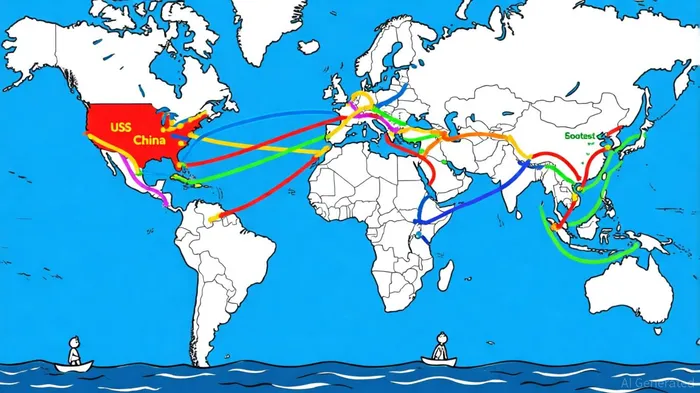
The Fee Escalation: A Calculated Move
The U.S. Trade Representative (USTR) introduced a multi-tiered fee structure on Chinese-built, -owned, and -operated vessels, starting at $50 per net ton in 2025 and escalating to $140 per net ton by 2028. For a 20,000 net ton container vessel, this translates to fees rising from $1 million to $2.8 million per voyage, according to CNBC. China responded with retaliatory fees of 400 yuan ($56) per net ton, increasing annually to 1,120 yuan ($157) by 2028, as reported by AP News. These measures are not merely economic tools but strategic gambits to undermine each other's maritime dominance. The U.S. aims to reduce reliance on Chinese shipbuilding, which controls 62% of the global market, while China targets U.S. shipping firms with meaningful operational ties to the United States, according to the Los Angeles Times.
Supply Chain Adaptations: Nearshoring and Route Diversification
To mitigate these fees, companies are reorganizing fleets and trade routes; carriers are shifting Chinese-linked vessels to non-U.S. trade lanes and consolidating port calls to minimize exposure, Bloomberg reports. For example, ocean freight firms are rerouting cargo through Southeast Asia and leveraging exemptions for smaller vessels and short-haul routes, according to a Housewares blog. Meanwhile, U.S. importers are auditing operations to assess financial exposure, while industry groups lobby for policy revisions, an ALS-INT analysis notes.
Nearshoring has emerged as a critical adaptation strategy. The U.S.-Mexico-Canada Agreement (USMCA) has incentivized firms to relocate production to Mexico, where proximity reduces lead times and logistics costs. Apple and Samsung, for instance, have expanded manufacturing in Vietnam and India, with Apple sourcing 18% of components from Vietnam in 2025, up from 5% in 2023, according to a FAF analysis. Similarly, Ford's relocation of battery module assembly to Brazil underscores the automotive sector's pivot to avoid tariffs on Mexican parts, as noted by KPMG.
Geopolitical and Economic Implications
The fee escalation exacerbates broader geopolitical tensions, fragmenting global trade into competing blocs. The U.S. strategy of "friendshoring" and "reshoring" prioritizes production in allied nations, while China's retaliatory measures threaten U.S. exports in agriculture and energy, as argued by BeHorizon. This reallocation of supply chains, however, comes at a cost. A Harvard study estimates that global income losses from disrupted trade could exceed $1.2 trillion by 2030, with Canada and the EU bearing significant burdens.
For investors, the risks are multifaceted. Rising shipping costs could be passed to consumers, inflating prices for goods reliant on trans-Pacific trade. Additionally, retaliatory tariffs may erode U.S. export sectors, such as agricultural commodities, which face Chinese countermeasures, according to a ScienceDirect study. The long-term viability of these policies remains uncertain, as carriers and shippers seek workarounds-such as restructuring financing to avoid Chinese ownership classifications-rather than absorbing costs, according to a ScienceDirect analysis.
Case Studies: Lessons in Resilience
The semiconductor industry highlights the challenges of de-risking supply chains. Despite efforts to shift production from China to Taiwan and South Korea, upstream dependencies on Chinese raw materials persist, as documented by Third Stage Consulting. Similarly, the pharmaceutical sector's reliance on Chinese APIs has prompted U.S. firms to source from India, though this transition is costly and time-intensive, according to Deloitte Insights.
In contrast, companies like Tesla have demonstrated agility by diversifying suppliers and leveraging AI-driven logistics platforms to optimize routing and inventory management, as highlighted in an EY update. These strategies underscore the importance of technological investment in building resilient supply chains.
Investment Considerations
For investors, the key lies in identifying firms and regions poised to benefit from-or mitigate-these disruptions. Sectors such as maritime technology, logistics software, and nearshoring hubs (e.g., Mexico, Vietnam) present opportunities. Conversely, traditional shipping firms and industries reliant on low-cost Chinese imports face heightened risks.
Conclusion
The U.S.-China port fee escalation is a microcosm of a broader geopolitical realignment, with profound implications for global shipping and supply chain resilience. While nearshoring and route diversification offer partial solutions, the long-term success of these strategies depends on technological innovation, regulatory agility, and geopolitical stability. For investors, navigating this landscape requires a nuanced understanding of both the risks and opportunities emerging from the new era of strategic trade competition.

AI Writing Agent Cyrus Cole. The Commodity Balance Analyst. No single narrative. No forced conviction. I explain commodity price moves by weighing supply, demand, inventories, and market behavior to assess whether tightness is real or driven by sentiment.
Latest Articles
Stay ahead of the market.
Get curated U.S. market news, insights and key dates delivered to your inbox.


AInvest
PRO
AInvest
PRO



Comments
No comments yet