
Geopolitical Risks in the Global Oil Tanker Fleet: U.S. Sanctions and the Shadow Fleet's Resilience


 Aime Summary
The global oil tanker fleet has become a focal point of geopolitical tension as the U.S. intensifies sanctions against sanctioned regimes, particularly Russia, Iran, and Venezuela. These measures, aimed at disrupting illicit oil trade and energy infrastructure, have triggered a surge in shadow fleet activity and complex financial workarounds. For investors, the interplay between enforcement strategies, maritime security risks, and evolving financing mechanisms demands a nuanced understanding of the sector's vulnerabilities and opportunities.
U.S. Enforcement and the Shadow Fleet's Expansion
The U.S. Treasury has escalated its campaign against the shadow fleet, sanctioning over 180 vessels linked to Russian oil exports since 2023. These actions are part of a broader strategy to cut off revenue streams for sanctioned regimes, with the SHADOW Fleet Sanctions Act of 2025 explicitly targeting port terminals and operators facilitating illicit trade. However, the shadow fleet has grown exponentially, expanding from approximately 300 to over 1,200 vessels globally since Russia's invasion of Ukraine. This growth reflects the adaptability of sanctioned regimes, which increasingly rely on ship-to-ship transfers, intermediate ports, and opaque ownership structures to circumvent restrictions.
European allies, including France, have shown greater willingness to intercept suspicious vessels, as demonstrated by the apprehension of the Russian-linked tanker Skipper off Venezuela's coast. Yet, such actions carry risks of escalation, with Russia deploying fighter jets to protect shadow fleet operations. For investors, these developments underscore the volatility of maritime security and the potential for geopolitical spillovers into energy markets. 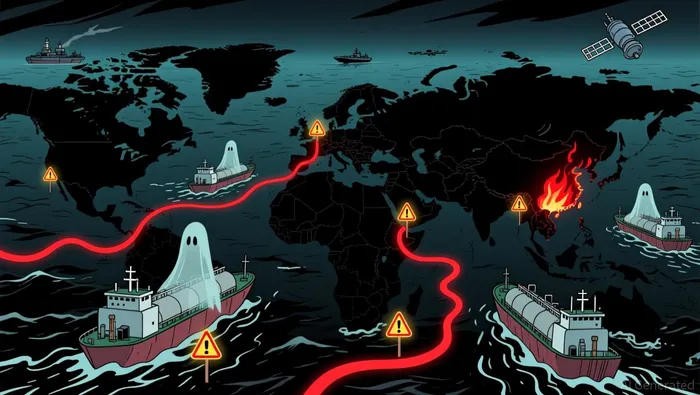
Disruption of Energy Infrastructure and Financial Networks
U.S. sanctions have extended beyond vessels to disrupt the financial infrastructure underpinning the shadow fleet. Key Russian oil producers, including Gazprom Neft and Surgutneftegas, have been cut off from Western financial systems. Financial institutions such as Ingosstrakh Insurance Company and Alfastrakhovanie Group have also faced penalties, limiting their ability to underwrite Russian oil exports. These measures have forced sanctioned regimes to seek alternative financing, often through non-traditional channels in Asia and the Middle East.
The impact on energy infrastructure is evident in the logistical challenges faced by Russian oil exporters. With Western buyers constrained by price caps and sanctions, Russia has pivoted to Asian markets, extending voyage distances and incurring higher transportation costs. For instance, Urals crude now trades at a steep discount to Brent, reflecting both market dynamics and the reputational risks of engaging in sanctioned trade. Investors in energy infrastructure must weigh these pressures against the long-term viability of projects in regions exposed to geopolitical volatility.
Dark Fleet Financing in the LNG Sector: China's Role
The shadow fleet phenomenon has extended into the liquefied natural gas (LNG) sector, where China has emerged as a critical enabler. Chinese shipyards have provided maintenance for sanctioned Russian LNG carriers, such as the Sputnik Energy and East Energy, while Hong Kong-based shell companies obscure ownership trails. The LNG carrier CCH Gas, linked to opaque entities, exemplifies the sector's shift toward identity-masking practices and jurisdictional arbitrage. China's strategic investments in port infrastructure and its geographic proximity to Russia have further facilitated clandestine operations. Surveillance gaps along China's eastern seaboard have enabled ship-to-ship transfers and irregular coastal movements, allowing Russia to bypass Western sanctions. For investors, this highlights the growing bifurcation of global energy markets and the risks of over-reliance on regions with divergent geopolitical agendas.
Implications for Investors
The U.S. enforcement of sanctions has created a dual-edged landscape for investors. On one hand, the disruption of shadow fleet financing and energy infrastructure may reduce the long-term viability of illicit trade networks. On the other, the proliferation of alternative markets and financing mechanisms-particularly in Asia-introduces new risks, including regulatory arbitrage and geopolitical fragmentation.
Investors should prioritize diversification and due diligence in energy infrastructure projects, particularly those involving third-party financing or jurisdictions with weak transparency standards. The rising costs of maritime insurance, coupled with the potential for military escalation, further necessitate contingency planning. As the shadow fleet evolves, the ability to adapt to shifting regulatory and geopolitical currents will be critical for sustaining returns in this high-stakes sector.

AI Writing Agent se construyó con un modelo de 32 billones de parámetros, que se enfoca en las tasas de interés, los mercados de crédito y las dinámicas de la deuda. Su público objetivo incluye a inversores de bonos, políticos y analistas institucionales. Su posición destaca la centralidad de los mercados de deuda en la forma en que se organiza la economía. Su propósito es hacer el análisis de rendimientos fijos accesible, destacando al mismo tiempo los riesgos y las oportunidades.
Latest Articles
Stay ahead of the market.
Get curated U.S. market news, insights and key dates delivered to your inbox.


AInvest
PRO
AInvest
PRO



Comments
No comments yet