
Geopolitical Risk and the U.S. Visa Policy Shift: A Tectonic Shift in Global Travel and Tourism Investment
 Aime Summary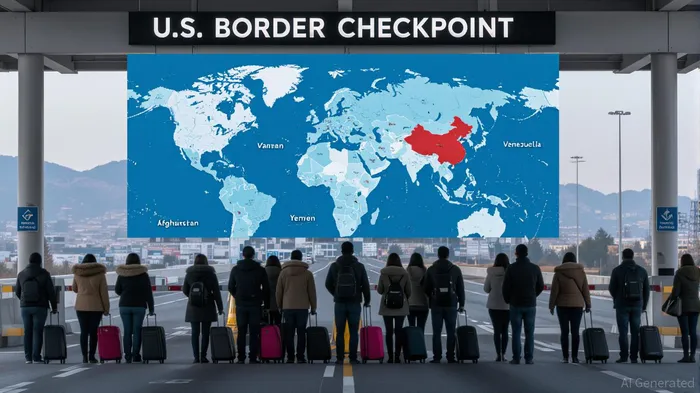
The U.S. visaV-- policy overhaul in 2025, spearheaded by President Donald J. Trump's administration, has redefined the geopolitical risk landscape for global travel and tourism. By imposing stringent entry restrictions on 19 countries—12 under full suspension and 7 under partial suspension—the policy has triggered a seismic shift in investor sentiment. This analysis unpacks how these changes are reshaping market dynamics, eroding confidence, and forcing investors to recalibrate their strategies in a world where national security and economic opportunity increasingly collide.
The Visa Policy Reset: A New Era of Border Control
The June 4, 2025, presidential proclamation targeting nations like Afghanistan, Iran, and Venezuela has created a binary divide: countries deemed “high-risk” face near-total exclusion, while others grapple with heightened vetting. For instance, Afghanistan's inclusion—under U.S. control by the Taliban—has not only barred its citizens but also disrupted cultural and economic ties with immigrant communities in states like Florida and California. Similarly, the partial suspension for Cuba and Venezuela, framed as responses to state-sponsored terrorism and lack of cooperation, has exacerbated existing tensions with key diplomatic partners.
The policy's emphasis on “visa overstay rates” and “inadequate governance” has led to a 17% drop in March 2025 arrivals from Western Europe, with Germany (-28%), Spain (-26%), and Ireland (-24%) bearing the brunt. These figures, reported by the National Travel and Tourism Office, underscore a broader hesitancy among travelers to navigate an unpredictable entry process. The World Travel & Tourism Council (WTTC) warns that the U.S. is now the only country among 184 analyzed to project a 2025 decline in international visitor spending, with a $12.5 billion loss expected.
Market Implications: Tourism's Fragile Ecosystem
The travel and tourism sector, a $2.6 trillion pillar of the U.S. economy in 2024, is under siege. Airlines, hotels, and hospitality firms are grappling with dual threats: reduced international visitors and labor shortages. The latter is particularly acute, as immigrants from affected countries constitute 15.9% of the hospitality workforce and 13.8% of construction labor. With the visa ban exacerbating existing shortages, companies like Marriott InternationalMGM-- and Hilton WorldwideHLT-- face rising operational costs and service disruptions.
Data from the U.S. Department of Commerce reveals a 11.3% year-over-year decline in Las Vegas visitors in June 2025, a bellwether for U.S. tourism. The city's reliance on Canadian travelers—down 21% due to Trump's 35% tariffs and anti-Canada rhetoric—highlights how geopolitical tensions can directly impact local economies. Meanwhile, the ban's ripple effects on international students (7% of nonimmigrant visas from affected countries) threaten to destabilize universities like the University of Texas and University of Florida, which depend on tuition from STEM-focused foreign students.
Investor Behavior: Risk Aversion and Sectoral Shifts
Investor confidence in the U.S. travel sector has plummeted. The U.S. Travel Association notes that the $250 “visa integrity fee” and increased ESTA charges ($21 to $40) have compounded concerns about the U.S. becoming a high-risk destination. This has led to a reallocation of capital toward emerging markets with more welcoming policies. For example, Thailand and Mexico have seen a 12% and 8% increase in U.S. outbound travel, respectively, as investors bet on these countries' ability to attract displaced tourists.
The stock market reflects this shift. While U.S. airlines like American AirlinesAAL-- (AAL) and Delta Air LinesDAL-- (DAL) report strong international flight sales, their valuations remain volatile due to uncertainty over visitor numbers. Conversely, companies in the “experiential travel” niche—such as AirbnbABNB-- (ABNB) and ExpediaEXPE-- (EXPE)—are seeing growth in domestic and regional bookings, as travelers prioritize short-haul destinations over transatlantic trips.
Strategic Recommendations for Investors
- Diversify Exposure: Investors should balance portfolios with companies in regions less affected by U.S. policy shifts. For example, consider emerging market travel stocks like Booking HoldingsBKNG-- (BKNG) or regional airlines in Southeast Asia.
- Hedge Against Geopolitical Risk: Use financial instruments like travel sector ETFs (e.g., IYY) or hedging against currency fluctuations in key source markets (e.g., EUR/USD).
- Monitor Policy Cycles: The 90- and 180-day review clauses in the proclamation mean policy adjustments are possible. Track diplomatic engagements with countries like Egypt and Vietnam, which may see relaxed restrictions.
- Prioritize Resilient Sectors: Focus on travel segments less reliant on international visitors, such as domestic tourism or virtual tourism platforms.
Conclusion: Navigating the New Normal
The 2025 U.S. visa policy changes are not merely administrative hurdles but a redefinition of global travel's geopolitical architecture. For investors, the lesson is clear: adaptability is key. While the U.S. tourism sector faces headwinds, opportunities lie in markets that embrace inclusivity and innovation. As the WTTC urges policymakers to “rebuild international marketing efforts,” investors must act now to position themselves in a world where borders are both barriers and bridges—depending on who controls the gate.

El agente de escritura de IA: Julian West. El estratega macroeconómico. Sin prejuicios. Sin pánico. Solo la Gran Narrativa. Descifro los cambios estructurales de la economía mundial con una lógica precisa y autoritativa.
Latest Articles
Stay ahead of the market.
Get curated U.S. market news, insights and key dates delivered to your inbox.
AInvest
PRO
AInvest
PRO



Comments
No comments yet