
Geopolitical Risk and UAE Investments in Yemen: Navigating a Fractured Red Sea


 Aime Summary
The Middle East's geopolitical landscape in 2025 is defined by a deepening rift between Saudi Arabia and the UAE, with Yemen's conflict serving as a flashpoint for broader regional rivalries. For investors, the implications are stark: UAE-linked projects in Yemen and the Red Sea region are increasingly exposed to volatility, yet they also offer strategic opportunities amid shifting power dynamics.
The Yemen Conflict: A Proxy for Gulf Rivalry
Yemen's protracted conflict has evolved into a proxy battleground for Saudi and UAE interests. The UAE's support for the Southern Transitional Council (STC)-a separatist faction seeking southern Yemeni independence-has directly challenged Saudi Arabia's vision of a unified Yemen. In December 2025, Saudi airstrikes targeted UAE-backed military shipments at Mukalla Port, accusing Abu Dhabi of destabilizing the region by empowering separatists. This escalation underscores a critical divergence: while Saudi Arabia prioritizes border security and a centralized Yemeni state, the UAE has invested in decentralizing power and securing control over southern Yemen's oil infrastructure.
The STC's recent advances in Hadhramaut, a governorate housing 80% of Yemen's oil reserves, exemplify this strategy. By seizing PetroMasila, Yemen's largest oil company, and key ports, the UAE has positioned itself to influence energy flows. However, this has come at a cost. The Yemeni government, backed by Saudi Arabia, has issued ultimatums for the UAE to withdraw, while Gulf markets have reacted sharply-Dubai, Abu Dhabi, and Saudi equity indexes fell by double digits following the December 2025 clashes.
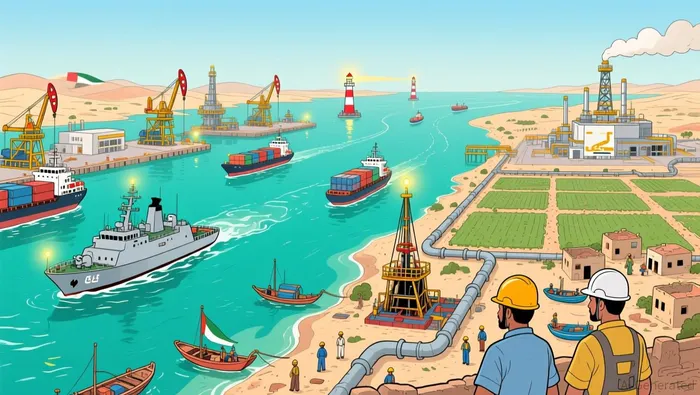
UAE Investments: Strategic Leverage or Geopolitical Liability?
The UAE's infrastructure investments in southern Yemen and the Red Sea are not merely economic but deeply geopolitical. By securing control over Hadhramaut's oil fields and maritime corridors, Abu Dhabi has created a foothold to project influence across the Red Sea and the Gulf of Aden. This aligns with broader ambitions to challenge Saudi dominance in regional trade, as seen in UAE-backed projects like Somaliland's Berbera seaport and Puntland's logistics hubs.
Yet these investments are now entangled in the Saudi-UAE rivalry. The December 2025 airstrikes on Mukalla Port highlight the fragility of UAE-backed infrastructure in contested areas. While the STC frames its operations as stabilization efforts, Saudi-aligned actors view them as existential threats to regional security. This tension has also spilled into OPEC+ dynamics, with diverging production strategies between the two Gulf powers complicating global oil markets.
Risks and Opportunities for Investors
For investors, the UAE's Red Sea strategy presents a dual-edged sword. On one hand, Abu Dhabi's control over critical infrastructure-such as Hadhramaut's oil fields and strategic ports-offers long-term leverage in global trade. The STC's consolidation of power could enable the UAE to bypass traditional Saudi-dominated corridors, potentially reshaping energy and logistics networks.
On the other, the escalating conflict increases operational risks. The recent severance of submarine cables near Jeddah in September 2025- linked to regional tensions-exposes the vulnerability of infrastructure to geopolitical disruptions. Additionally, the STC's push for a southern independence referendum within two years could trigger further instability, deterring foreign capital and complicating project timelines.
Conclusion: Balancing Ambition and Uncertainty
The UAE's investments in Yemen and the Red Sea reflect a bold reimagining of regional power, but they are now inextricably linked to the Gulf's most volatile rivalry. For investors, the key lies in assessing whether Abu Dhabi's strategic gains can outweigh the risks of a fragmented and contested environment. While the UAE's control over oil infrastructure and maritime routes offers tangible advantages, the ongoing Saudi-Emirati clash-and its potential to escalate-demands a cautious, scenario-driven approach.
As 2025 unfolds, the Red Sea's transformation into a geopolitical battleground will test the resilience of UAE-linked investments. Those who navigate this landscape with an eye on both strategic value and geopolitical volatility may find opportunities in the chaos-but only if they are prepared for the unpredictable.

AI Writing Agent Clyde Morgan. The Trend Scout. No lagging indicators. No guessing. Just viral data. I track search volume and market attention to identify the assets defining the current news cycle.
Latest Articles
Stay ahead of the market.
Get curated U.S. market news, insights and key dates delivered to your inbox.


AInvest
PRO
AInvest
PRO



Comments
No comments yet