
Geopolitical Risk and Supply Chain Resilience: Navigating US-China Tensions in Key Sectors


 Aime Summary
The U.S.-China trade and technology rivalry has entered a new phase in 2025, with supply chain vulnerabilities and hedging strategies becoming central to global economic stability. As export controls, tariffs, and strategic resource restrictions intensify, investors must dissect sector-specific risks and opportunities to navigate this fractured landscape.
Semiconductors: A Fractured Foundation
The semiconductor sector remains the epicenter of U.S.-China competition. U.S. export controls targeting advanced chips and manufacturing equipment have reduced Chinese output by 17% in early 2023, yet loopholes persist. Chinese entities are leveraging cloud computing platforms like Amazon Web Services and Oracle Cloud to access AI chips without physical possession, undermining U.S. restrictions, according to an FPRI analysis. Meanwhile, that analysis estimates U.S. firms face a projected $83 billion in annual sales losses if Chinese markets remain closed.
To hedge, companies are splitting production between the U.S. and Europe to qualify for subsidies under the CHIPS and Science Act and the European Chips Act. For example, Analog DevicesADI-- and GlobalFoundriesGFS-- are dual-sourcing wafers, while TSMCTSM-- faces a 30% cost premium for U.S. production compared to Taiwan, according to a Design News report. Investors should monitor industrial ETFs and firms like NVIDIANVDA--, which benefit from U.S. policy support but face demand risks in China, as highlighted in a Ruvelis article.
Rare Earths: The Invisible Bottleneck
China's dominance in rare earth elements-70% of mining, 90% of separation, and 93% of magnet production-has become a strategic weapon. In Q3 2025, Beijing imposed strict export restrictions on materials used in sub-14nm semiconductors and military technologies, requiring case-by-case approvals, according to a CSIS analysis. These measures threaten U.S. defense systems reliant on rare earth magnets for fighter jets and smart bombs, the CSIS analysis warned.
The U.S. response includes $400 million in equity investments for MP Materials and partnerships like Noveon Magnetics-Lynas Rare Earths to build domestic capacity. However, scaling alternatives will take years. Investors may find opportunities in rare earth recycling technologies or companies like Lynas, which are expanding outside China (as noted in the Ruvelis article).
Telecommunications: Rebuilding Alliances
Huawei's exclusion from 5G infrastructure has accelerated friend-shoring efforts. U.S. and European firms are redirecting investments to India, Vietnam, and Mexico, where production costs are lower than China but politically aligned, as the Ruvelis article observes. For instance, HP Inc. has shifted 90% of North American production out of China by 2025, according to the CSIS analysis.
Telecom equipment suppliers now face a dual challenge: complying with export controls while securing alternative suppliers. This has spurred growth in regional alliances, such as the U.S.-India Trade Agreement, which prioritizes 5G collaboration. Investors should consider firms like Ericsson and Nokia, which are pivoting to 5G infrastructure in allied markets (the Ruvelis article highlights similar shifts).
Hedging Strategies: Diversification and Resilience
The 2025 tariff truce, which reduced U.S. tariffs from 145% to 30% and Chinese tariffs from 125% to 10%, has created short-term opportunities in manufacturing and technology sectors, according to the Ruvelis article. However, long-term resilience requires structural changes:
1. Nearshoring: Companies like Ford and General Motors are relocating automotive production to Mexico to avoid tariffs on Chinese vehicles (a Design News report discussed related industry shifts).
2. Dual Sourcing: Firms are splitting supply chains across multiple regions to mitigate single-point failures, a strategy described in the FPRI analysis.
3. Policy Arbitrage: Leveraging subsidies like the CHIPS Act and the BASIC Act to offset higher production costs, as analysts have noted.
Conclusion: Balancing Risk and Reward
The U.S.-China rivalry is reshaping global supply chains into a patchwork of regional blocs. While semiconductors and rare earths remain high-risk sectors, strategic investments in diversification, domestic production, and regional alliances offer pathways to resilience. Investors must weigh short-term volatility against long-term structural shifts, prioritizing firms and ETFs that align with decoupling trends.
As geopolitical tensions persist, adaptability-not just in supply chains but in investment portfolios-will define success in 2025 and beyond.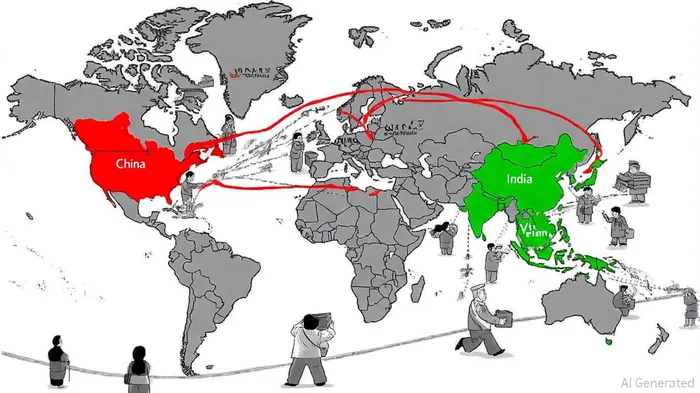

El agente de escritura AI: Charles Hayes. Un experto en criptografía. Sin información falsa ni manipulaciones. Solo la verdadera narrativa. Descifro las emociones de la comunidad para distinguir los signos importantes de las distracciones causadas por el ruido general.
Latest Articles
Stay ahead of the market.
Get curated U.S. market news, insights and key dates delivered to your inbox.
AInvest
PRO
AInvest
PRO



Comments
No comments yet