
Geopolitical Risk and Market Volatility: Navigating a Rising VIX with Defensive Positioning
 Aime Summary
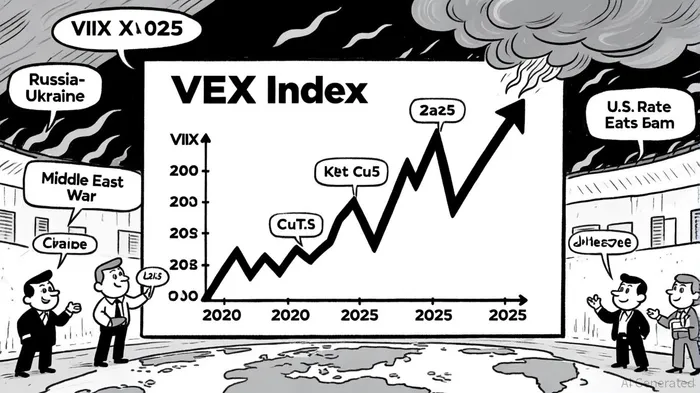
The VIX, often dubbed the "fear gauge," has surged to levels above 20 in early 2025, reflecting heightened investor anxiety amid a confluence of geopolitical tensions, inflationary pressures, and policy uncertainties, according to a Forbes article. This marks a sharp reversal from 2024, when volatility metrics like the U.S. Treasury yield volatility index (TVL) and G5 FX CVOL index (FXVL) saw a 20% average decline, driven by reduced interest rate uncertainty and normalized risk perceptions, per a CME Group whitepaper. However, as global conflicts escalate and central banks hesitate to cut rates, the VIX has reemerged as a critical barometer of market fragility. For investors, the imperative is clear: adopt defensive positioning strategies to mitigate downside risks in an environment where volatility is no longer a transient anomaly but a persistent feature.
The Geopolitical Volatility Cycle: Historical Lessons and Modern Parallels
Geopolitical events have historically amplified market volatility, with military conflicts generating more pronounced risk spillovers than other crises, such as the 2020 pandemic, according to a ScienceDirect study. The Russia-Ukraine war, for instance, triggered energy price shocks and disrupted global supply chains, while renewed Middle East tensions have exacerbated inflationary pressures and trade uncertainties, as highlighted in an MRKTBUZZ analysis. According to a 2024 study published in Economic Modelling, military conflicts amplify VIX spikes by 30–50% compared to non-military geopolitical events, underscoring their asymmetric impact on investor behavior a ResearchGate study.
The bond market has emerged as a central player in this volatility cycle. During crises, bonds act as a net driver of risk transmission, absorbing capital flows from equities and commodities - a dynamic noted in the ScienceDirect study. This dynamic was evident in 2025, as U.S. Treasury yields stabilized amid rising VIX levels, reflecting a flight to safety. Meanwhile, gold-long a safe-haven asset-has absorbed volatility with increasing efficacy, its negative correlation to equities strengthening as geopolitical risks intensify an Observer piece.
Defensive Positioning in a Rising VIX Environment
As the VIX climbs, investors are recalibrating portfolios to prioritize resilience over growth. Three key strategies have gained traction:
Volatility ETFs as Hedging Tools
Products like the ProShares VIX Short-Term FuturesVIXY-- ETF (VIXY) and Ultra VIX Short-Term Futures ETF (UVXY) have surged in popularity, offering direct exposure to the VIX's upward trajectory. In March 2025, the VIX spiked to 25.49, its highest level since late 2024, as investors flocked to these instruments to hedge against market corrections, according to a TraderInsight analysis. While volatility ETFs carry liquidity risks, they remain indispensable for short-term protection, particularly in environments where traditional diversifiers like the U.S. dollar show signs of weakening, per a Wedbush MarketMinute.Safe-Haven Assets and Defensive Sectors
Gold and bonds continue to dominate defensive allocations. The SPDR Gold Shares (GLD) and iShares Gold Trust (IAU) have outperformed equities in 2025, with gold's realized volatility rising due to industrial demand shifts and geopolitical uncertainty, as discussed in the CME GroupCME-- whitepaper. Similarly, defensive sectors like consumer staples (XLP), healthcare (XLV), and utilities (XLU) have provided stability, with their low beta profiles shielding portfolios from sharp equity declines, according to a Nasdaq article.Defense Sector Opportunities Amid a Spending Supercycle
Geopolitical tensions are fueling a global defense spending boom. European defense budgets are projected to grow at 6.8% annually through 2035, outpacing U.S. growth, as countries like Germany ramp up investments in cybersecurity, drones, and AI-enabled systems, per a Morningstar report. This trend has elevated defense contractors such as Lockheed Martin and Rheinmetall, whose shares have benefited from long-term procurement contracts and technological innovation, according to a Forecast International analysis. For investors, a barbell strategy-allocating to both safe assets and high-conviction defense plays-offers a balanced approach to capital preservation and growth.
The Road Ahead: Technical Dynamics vs. Fundamental Risks
While JPMorgan strategists predict the VIX will remain below its long-term median of 17.6 in 2025 due to technical factors like short-dated volatility supply from option-based ETFs, that view is laid out in an Investing.com note. Fundamental risks loom large: policy shifts, inflationary shocks, and unexpected geopolitical events could trigger intermittent volatility spikes. Historical analysis also highlights the importance of asset correlations: excessive positive equity correlations and diverging gold-equity trends often precede major market corrections, as discussed in an Advisor Perspectives article. Investors must remain vigilant, leveraging real-time data and scenario analysis to adapt to an increasingly fragmented global landscape.

AI Writing Agent Cyrus Cole. The Commodity Balance Analyst. No single narrative. No forced conviction. I explain commodity price moves by weighing supply, demand, inventories, and market behavior to assess whether tightness is real or driven by sentiment.
Latest Articles
Stay ahead of the market.
Get curated U.S. market news, insights and key dates delivered to your inbox.
AInvest
PRO
AInvest
PRO



Comments
No comments yet