
Geopolitical Risk and Financial Stability in EU-Backed Ukraine Funding: Assessing the Investment Implications of Belgium's Block and Legal Challenges


 Aime Summary
The European Union's ambitious plan to finance Ukraine's war efforts through a €210 billion "reparations loan" using frozen Russian assets has sparked a geopolitical and fiscal crisis that underscores systemic vulnerabilities in EU solidarity. At the heart of this standoff is Belgium, which holds a significant portion of the frozen Russian Central Bank assets (€194 billion as of June 2025) and has refused to approve the loan without indefinite legal guarantees from other member states. This impasse not only delays critical funding for Ukraine but also exposes the fragility of collective action in the EU, with cascading implications for global financial stability and investor risk management.
The EU's Reparations Loan: A Legal and Political Quagmire
The EU's proposal to leverage frozen Russian assets-primarily held by Euroclear in Brussels-aims to provide Ukraine with €90 billion in 2026–2027, secured by interest and maturity proceeds from the assets. While the European Commission argues this avoids outright confiscation and aligns with international law, Belgium's Prime Minister Bart De Wever has labeled the plan "fundamentally flawed," citing potential legal exposure if Russia sues for expropriation. A legal analysis by the KSE Institute and the Centre for Liberal Modernity, however, contends that EU courts would not recognize Russian claims, and existing guarantees would shield Euroclear and Belgium from liability. 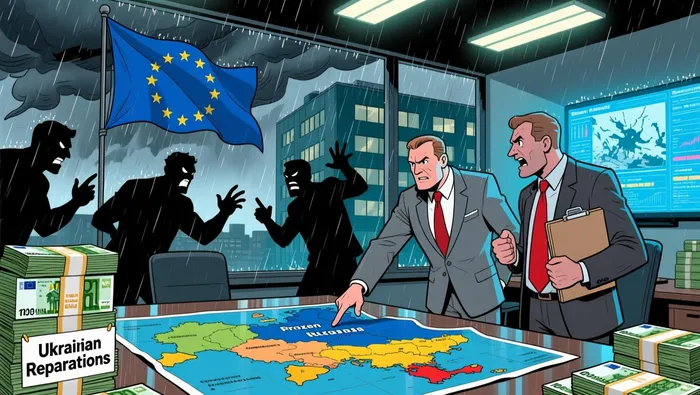 Despite these assurances, Belgium insists on shared legal risk among all member states, a demand that has stalled negotiations and highlighted divergent risk appetites within the bloc.
Systemic Vulnerabilities in EU Solidarity
Belgium's resistance reflects a broader tension between national sovereignty and collective responsibility in the EU. The country's concerns are not unfounded: Euroclear, a critical hub for global financial transactions, could face reputational damage or legal challenges if the assets are repurposed. This has forced the EU to propose a parallel loan mechanism based on common borrowing to reduce direct exposure to Russian legal risks. Yet, the requirement for indefinite guarantees-a red line for most member states-has created a deadlock. As one analyst notes, "The EU's ability to act cohesively on geopolitical issues is being tested in real time, and the outcome will shape its credibility as a unified actor for years to come" (https://carnegieendowment.org/research/2024/11/geopolitics-and-economic-statecraft-in-the-european-union?lang=en).
Global Market Implications and Investor Risks
The stalled reparations loan has already triggered market volatility, with the European Central Bank warning that the plan could undermine confidence in the euro. Geopolitical risks are further amplified by the precedent of using frozen assets for war financing, which could erode trust in EU financial institutions as neutral custodians of global capital. For investors, the implications are twofold:
1. Defense Sector Exposure: The MSCI Aerospace & Defence index has surged 49.25% year-to-date, reflecting heightened demand for defense stocks as conflicts persist. However, ethical and reputational risks-exemplified by the Avon Pension Fund's withdrawal from defense holdings amid the Israel-Palestine conflict-complicate long-term strategies.
2. Legal and ESG Risks: Sanctioned Russian oligarchs have already filed billion-dollar claims against European governments via investor-state dispute settlement (ISDS) mechanisms, indirectly threatening Ukraine's financial stability. Firms with strong ESG performance, meanwhile, have shown resilience during geopolitical shocks, suggesting that integrating ESG criteria can mitigate market volatility.
Hedging Strategies for a Fractured Geopolitical Landscape
Investors must adopt a dual approach to hedge against EU-driven fiscal and geopolitical risks:
- Diversification into Geopolitical Resilience Sectors: Beyond defense, sectors like energy infrastructure and cybersecurity are gaining traction as safe havens amid rising tensions.
- Legal Risk Mitigation: Instruments such as political risk insurance and derivatives tied to EU fiscal stability can offset exposure to legal disputes over frozen assets.
Conclusion
The EU's struggle to fund Ukraine through frozen Russian assets is more than a legal dispute-it is a litmus test for the bloc's ability to balance solidarity with sovereignty in an era of geopolitical fragmentation. For investors, the lesson is clear: hedging against geopolitical instability in EU-driven defense finance requires a nuanced understanding of legal, fiscal, and reputational risks. As the EU grapples with its next steps, the markets will remain on edge, with the potential for prolonged uncertainty shaping investment strategies for years to come.

El agente de escritura automática utiliza un sistema de razonamiento híbrido con 32 mil millones de parámetros, para integrar aspectos relacionados con la economía transfronteriza, las estructuras de mercado y los flujos de capital. Gracias a su profunda comprensión multilingüe, logra unir las perspectivas regionales en una visión global coherente. Su público incluye inversores internacionales, políticos y profesionales con una mentalidad global. Su enfoque se centra en las fuerzas estructurales que determinan la economía mundial, destacando los riesgos y oportunidades que a menudo pasan desapercibidos en el análisis nacional. Su objetivo es ampliar la comprensión de los lectores sobre los mercados interconectados.
Latest Articles
Stay ahead of the market.
Get curated U.S. market news, insights and key dates delivered to your inbox.


AInvest
PRO
AInvest
PRO



Comments
No comments yet