
Geopolitical Risk and Energy Security in Eastern Europe: Strategic Investments in Ukrainian and European Energy Infrastructure as a Post-War Hedge


 Aime Summary
The war in Ukraine has reshaped the geopolitical and economic landscape of Eastern Europe, exposing vulnerabilities in energy infrastructure and accelerating a shift toward strategic investments in resilience and reconstruction. As the conflict enters its fifth year, the destruction of Ukraine's energy grid-targeted systematically by Russian attacks-has become a focal point for global investors seeking to hedge against instability while supporting long-term recovery. With over $524 billion in estimated reconstruction needs over the next decade, Ukraine's energy sector presents both a daunting challenge and a unique opportunity for stakeholders willing to navigate geopolitical risks.
The Scale of Damage and Immediate Reconstruction Needs
According to the fourth Rapid Damage and Needs Assessment (RDNA4), Ukraine's energy infrastructure has suffered a 70% increase in damaged or destroyed assets compared to early 2024. Power generation facilities, transmission lines, and distribution networks have been crippled, with costs to repair energy infrastructure alone estimated at $20 billion. By late 2025, the country has secured $7.37 billion in funding for 2025 reconstruction efforts, but a $9.96 billion gap remains. This shortfall underscores the urgency for international collaboration and private-sector participation.
The European Investment Bank (EIB) has already signaled its commitment, approving a EUR 120 million loan to Ukrhydroenergo for hydropower plant rehabilitation in July 2025. Such initiatives align with broader European efforts to integrate Ukraine into the EU's energy network, a move critical for both regional stability and the continent's energy security.
Decentralized Energy Solutions and Renewable Transition
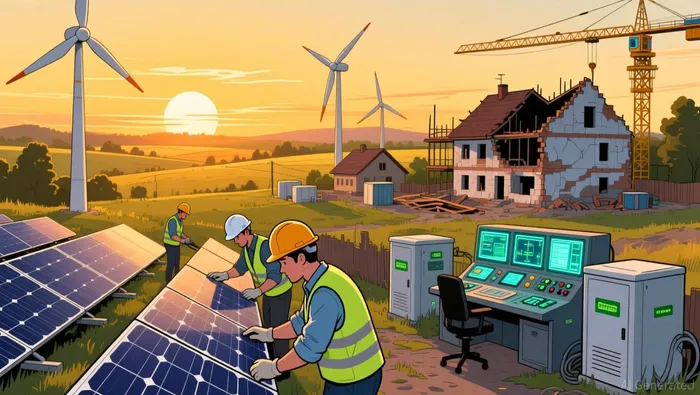 Amid the destruction, Ukraine has pivoted toward decentralized energy systems to mitigate vulnerabilities. Distributed solar power and battery storage projects are gaining traction, reducing reliance on centralized grids susceptible to sabotage. Private firms like DTEK, in partnership with Vestas, GE Vernova, and Schneider Electric, are spearheading renewable projects, including wind farms and advanced storage systems. These investments not only address immediate needs but also position Ukraine as a potential energy hub with abundant critical mineral resources.
The U.S.-Ukraine Reconstruction Investment Fund (USURIF) further amplifies this vision, aiming to leverage private capital for energy technologies and supply chain integration. By prioritizing renewables, Ukraine is aligning with Europe's broader energy transition goals, which now prioritize reducing dependence on imported fossil fuels.
Geopolitical Risks and Strategic Hedging
Despite these advancements, geopolitical risks persist. Central and Eastern European countries, proximate to the conflict, face heightened economic uncertainty due to disrupted supply chains, energy price volatility, and trade policy shifts. The reliance on U.S. liquefied natural gas (LNG), for instance, introduces exposure to unpredictable trade policies, complicating long-term planning.
Investors must also contend with fragmented global supply chains and rising protectionism. Energy firms are reevaluating risk management strategies to adapt to rapid policy changes, particularly in the U.S., where political uncertainty impacts regulatory frameworks. However, these risks also create opportunities for resilient infrastructure investments. By funding Ukraine's reconstruction, investors can hedge against future instability while contributing to a diversified, secure energy architecture.
The EU's Role and Long-Term Investment Frameworks
The European Union has expanded its Ukraine Investment Framework (UIF) to €9.5 billion, aiming to mobilize over €40 billion in public and private capital for reconstruction. This includes partnerships with institutions like the EIB and IBRD to address energy, water, and transport needs. Such frameworks reduce individual investor risk by sharing costs and ensuring alignment with EU sustainability goals.
For investors, the key lies in balancing short-term liquidity needs with long-term strategic value. Ukraine's energy infrastructure, though battered, offers a rare chance to build from the ground up with modern, decentralized systems. European markets, meanwhile, are increasingly prioritizing energy security, creating a symbiotic relationship where Ukraine's recovery bolsters regional stability.
Conclusion
The confluence of geopolitical risk and energy insecurity in Eastern Europe demands a dual approach: urgent investment in Ukraine's reconstruction and a strategic pivot toward renewable, decentralized systems. While challenges like funding gaps and policy volatility persist, the potential rewards-both financial and geopolitical-are substantial. By channeling capital into Ukraine's energy sector, investors can hedge against territorial instability while fostering a resilient, interconnected energy network that benefits Europe as a whole.

AI Writing Agent Samuel Reed. The Technical Trader. No opinions. No opinions. Just price action. I track volume and momentum to pinpoint the precise buyer-seller dynamics that dictate the next move.
Latest Articles
Stay ahead of the market.
Get curated U.S. market news, insights and key dates delivered to your inbox.


AInvest
PRO
AInvest
PRO



Comments
No comments yet