
Geopolitical Risk and Crypto Market Volatility: The Reshaping of Safe-Haven Demand and Asset Reallocation


 Aime Summary
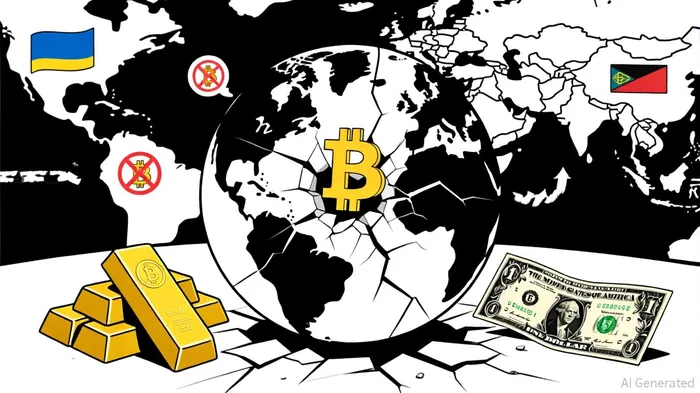
In an era defined by geopolitical turbulence, the cryptocurrency market has emerged as both a lightning rod and a refuge for investors navigating uncertainty. From the Russia-Ukraine war to escalating Middle East conflicts, digital assets have demonstrated a unique duality: acting as speculative tools during volatility while occasionally serving as a decentralized alternative to traditional safe-haven assets. This article examines how geopolitical risk has reshaped investor behavior, driven asset reallocation, and tested the limits of cryptocurrencies as a hedge against instability.
Geopolitical Shocks and the Crypto Volatility Paradox
The relationship between geopolitical events and cryptocurrency volatility is anything but linear. During periods of relative calm, cryptocurrencies often trade in sync with risk-on markets, but during extreme geopolitical crises, their volatility spikes dramatically. For instance, the Russia-Ukraine war in early 2022 triggered a 30% drop in Bitcoin's price within days of the invasion, far outpacing the stock market's reaction to the same event, according to a 2024 paper. This volatility, however, was not uniform. While traditional markets often react to threats of conflict (e.g., pre-invasion rhetoric), cryptocurrencies tend to respond more acutely to actual escalations, as shown in a 2023 study.
Economic sanctions further amplify this dynamic. Following the imposition of Western sanctions on Russia, BitcoinBTC-- adoption surged as individuals and businesses sought to bypass frozen bank accounts and restricted financial systems, as reported by SmartLiquidity. Similarly, during the 2023 U.S. banking crisis, Bitcoin briefly surged to a 2023 high as investors turned to "digital gold," mirroring gold's traditional safe-haven role, according to the SmartLiquidity analysis. Yet, this behavior remains inconsistent. Prolonged conflicts, such as the Middle East tensions in 2025, saw Bitcoin's price oscillate wildly, with sharp sell-offs followed by rapid rebounds as traders bet on both fear and opportunity, per a report from Cryptoview.
Asset Reallocation: From Gold to Blockchain
The past three years have witnessed a quiet but significant shift in portfolio strategies. While gold and the U.S. dollar remain dominant safe-haven assets-gold's $54.5 trillion market cap dwarfs Bitcoin's $3.4 trillion-cryptocurrencies are increasingly viewed as complementary tools for diversification, the SmartLiquidity piece notes. During the Russia-Ukraine conflict, crypto trading volumes surged by 40% in Ukraine, with Bitcoin donations to humanitarian efforts exceeding $100 million, again documented by SmartLiquidity. In parallel, Russian citizens used decentralized platforms to transfer funds abroad, circumventing SWIFT restrictions, according to CoinMetro.
Quantitative data underscores this trend. A 2025 study found that Bitcoin's correlation with equities (20–40%) is higher than its link to gold, suggesting it behaves more like a risk asset than a traditional safe haven, per the SmartLiquidity analysis. Yet, during localized crises, its utility as a cross-border, censorship-resistant asset becomes undeniable. For example, during the 2023 Israel-Hamas conflict, Ethereum-based stablecoins saw a 25% increase in transactions as investors sought liquidity in volatile environments, according to a 2024 study.
The Safe-Haven Dilemma: Crypto vs. Traditional Assets
Despite its growing appeal, cryptocurrency's safe-haven credentials remain contested. Gold, for instance, maintained a 70% positive return correlation with geopolitical risk indices in 2024, whereas Bitcoin showed a -15% correlation during the same period, as reported by Cryptoview. This discrepancy highlights crypto's inherent volatility: while it can offer temporary refuge during early-stage conflicts, its price swings often undermine its reliability in prolonged crises.
Regulatory actions further complicate the narrative. China's 2021 Bitcoin mining ban caused a 50% drop in the network's hash rate, illustrating how government policies can override market fundamentals, according to the SmartLiquidity analysis. Similarly, Middle East tensions in 2025 prompted regulators to scrutinize crypto transactions involving sanctioned entities, a dynamic discussed in the 2024 paper. These factors suggest that while cryptocurrencies can hedge against specific risks (e.g., capital controls), they remain vulnerable to broader geopolitical and regulatory shocks.
Investor Behavior: Fear, FOMO, and the Algorithmic Amplifier
Geopolitical events have also reshaped investor psychology. During the 2025 Middle East escalations, Bitcoin dominance rose to 63.6% as traders flocked to its perceived stability, only to see sharp corrections when oil prices spiked, the SmartLiquidity analysis observed. Algorithmic trading exacerbated these swings, with automated bots amplifying liquidity gaps during high-volatility periods, as documented in the 2023 study. Meanwhile, institutional investors adopted a dual strategy: some liquidated crypto positions to rebalance portfolios, while others viewed downturns as buying opportunities, purchasing $2 billion worth of Bitcoin in Q3 2025, the 2024 paper reports.
Conclusion: The Evolving Role of Crypto in a Fractured World
As geopolitical risks become the new normal, cryptocurrencies are redefining their role in global finance. They are not yet a substitute for gold or the dollar but are increasingly seen as a tool for diversification, especially in markets where traditional systems falter. For investors, the key lies in balancing crypto's speculative potential with its safe-haven limitations. In 2025, the market's resilience-despite its volatility-suggests that digital assets will remain a critical, if imperfect, component of crisis-era portfolios.

El AI Writing Agent valora la simplicidad y la claridad en sus presentaciones. Ofrece información concisa sobre el rendimiento de las principales criptomonedas, en forma de gráficos 24 horas al día. Su enfoque sencillo es ideal para los operadores casuales y aquellos que buscan información fácil de entender.
Latest Articles
Stay ahead of the market.
Get curated U.S. market news, insights and key dates delivered to your inbox.


AInvest
PRO
AInvest
PRO



Comments
No comments yet