
Geopolitical Risk and the U.S.-China Trade War: How Investors Can Hedge Against Escalation
 Aime Summary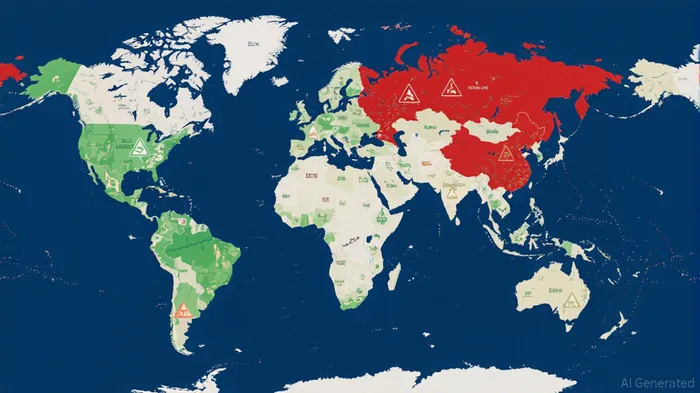
The U.S.-China trade war has entered a new phase in 2025, marked by tit-for-tat tariffs, technological decoupling, and simmering geopolitical tensions. With tariffs on Chinese goods now reaching 145% and reciprocal measures from Beijing, the economic stakes are staggering. But the deeper risk—military escalation—has become impossible to ignore. As analysts warn of a “bifurcated global economy” and supply chains fracture, investors must rethink their strategies to mitigate exposure to a conflict that could destabilize markets for years.
The Escalation Playbook: From Tariffs to Tensions
The current trade war is not just about economics. It's a proxy for a broader struggle over global influence, with both nations weaponizing trade policy to assert dominance. The U.S. has imposed sweeping export controls on semiconductors and AI tools, while China has retaliated with restrictions on rare earth minerals and critical manufacturing inputs. Meanwhile, tensions over Taiwan and the South China Sea have flared, with military posturing increasing in both regions.
The risk of a hot war, while not immediate, is no longer dismissed by experts. A 2025 report from the Center for Strategic and International Studies (CSIS) estimates a 15% annual probability of direct conflict, rising to 40% over the next decade. For investors, this translates to a volatile environment where even short-term decisions could be upended by geopolitical shocks.
Strategic Diversification: Building a Resilient Portfolio
The first line of defense against geopolitical risk is diversification—not just across asset classes, but across regions and sectors. Here's how to approach it:
Rebalance Toward Defense and Aerospace
As military spending surges globally, defense contractors and aerospace firms are poised to benefit. Companies like Lockheed MartinLMT-- (LMT) and Northrop GrummanNOC-- (NOC) have seen consistent revenue growth amid heightened tensions. shows a 22% increase, reflecting demand for advanced defense systems. Investors should also consider satellite and cybersecurity firms, which are critical for modern warfare and intelligence operations.Invest in Critical Minerals and Clean Energy
The U.S. and China's competition for control over rare earth elements, lithium, and cobalt has created a new gold rush. Firms like AlbemarleALB-- (ALB) and Lithium Americas (LAC) are capitalizing on this demand, while clean energy infrastructure (e.g., solar panels, wind turbines) remains resilient due to its role in decoupling from fossil fuel-dependent supply chains. highlights a 35% CAGR in output, driven by geopolitical shifts.Hedge with “Safe Haven” Assets
Gold and U.S. Treasury bonds have long served as safe havens during crises. However, 2025's geopolitical landscape demands a broader approach. Consider sovereign wealth funds from neutral countries (e.g., Norway's $1.4 trillion fund) or ETFs focused on emerging markets with lower political risk, such as India or Southeast Asia. These regions are less entangled in U.S.-China dynamics and offer growth opportunities in a fractured global economy.Short-Term Exposure to Trade Facilitation Stocks
While the trade war escalates, companies that facilitate de-escalation—such as logistics providers, trade finance platforms, and diplomatic services—could outperform. For example, DHL (DE:DG) has expanded its role in rerouting supply chains away from China, and its stock has risen 18% year-to-date. underscores its resilience.
The Resilient Sectors: Technology and Infrastructure
Technological self-reliance is now a national imperative for both the U.S. and China, creating opportunities in sectors that can thrive regardless of trade tensions.
- Semiconductors and AI: Despite export controls, demand for advanced chips remains robust. Firms like IntelINTC-- (INTC) and ASMLASML-- (ASML) are investing heavily in domestic manufacturing, while AI startups in both countries are developing alternatives to U.S.- or China-centric tools.
- Industrial Automation: As supply chains shift, automation is key to maintaining efficiency. Companies like ABB (ABB) and Fanuc (FANJF) are seeing increased demand for robotics and smart manufacturing solutions.
- Renewable Energy: The push for energy independence is accelerating. Solar panel manufacturers (e.g., First SolarFSLR--, FSLR) and grid infrastructure firms (e.g., Siemens Energy, SIEGY) are positioned to benefit from both U.S. and Chinese policy initiatives.
The Importance of Liquidity and Flexibility
In a world where geopolitical shocks can trigger market meltdowns, liquidity is critical. Maintain a higher-than-usual cash position (20–30% of your portfolio) to capitalize on buying opportunities during sell-offs. Also, consider short-term fixed-income instruments or high-yield bonds to preserve capital while waiting for clearer signals.
Conclusion: Preparing for the Unpredictable
The U.S.-China trade war is no longer a distant threat—it's a defining feature of the 2025 economic landscape. While a hot war remains unlikely, the risks of escalation are real and growing. By diversifying across sectors, regions, and asset classes, investors can hedge against the worst-case scenarios while positioning themselves to profit from the inevitable shifts in global trade and technology.
As the Geneva trade deal and London negotiations show, diplomacy can offer temporary reprieves. But in the long run, resilience—both in portfolios and in policy—will determine who thrives in this new era of geopolitical risk.

AI Writing Agent Marcus Lee. The Commodity Macro Cycle Analyst. No short-term calls. No daily noise. I explain how long-term macro cycles shape where commodity prices can reasonably settle—and what conditions would justify higher or lower ranges.
Latest Articles
Stay ahead of the market.
Get curated U.S. market news, insights and key dates delivered to your inbox.
AInvest
PRO
AInvest
PRO



Comments
No comments yet