
Geopolitical Risk as a Catalyst for Commodity Resilience


 Aime Summary
The global crude oil market in 2025 is no longer driven solely by the mechanics of supply and demand. Instead, it has become a theater for geopolitical chess, where the sustained conflict in Ukraine and the threat of U.S. sanctions have embedded a persistent risk premium into energy prices. This structural shift is reshaping the investment landscape, creating a new normal in which volatility is not an anomaly but a feature of the system.
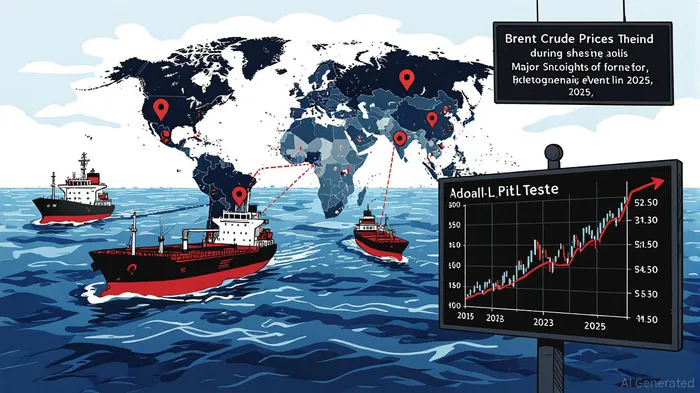
The Ukraine war has inflicted lasting damage on Russia's oil infrastructure. . This has not only disrupted domestic fuel supplies but also created a fragmented global market. Russia's crude now trades at a wider discount to benchmarks like Brent and WTIWTI--, yet the cost of insuring and transporting this oil has surged, embedding a hidden premium into global prices.
Meanwhile, U.S. and EU sanctions have evolved into a sophisticated tool of economic coercion. The price cap on Russian crude, expanded sanctions on shadow fleets, . However, these measures are not without unintended consequences. By forcing Russia to sell oil at steep discounts, they have created a parallel market where geopolitical risk is priced in through higher transaction costs and logistical complexity. This dynamic has supported refining margins in the U.S. Gulf Coast and European diesel markets, with refining spreads doubling in some cases.
The market's response to these pressures has been a recalibration of risk. Geopolitical uncertainty now accounts for a significant portion of oil price volatility. Academic models, such as the TVP-VAR framework, . This means that even minor escalations—such as a failed peace summit or a new round of sanctions—can trigger sharp price swings. For investors, this implies that traditional metrics like OPEC+ spare capacity or U.S. shale output are no longer sufficient to predict price trends.
The U.S. government's proposed (SRA), which could impose 500% tariffs on countries importing Russian oil, exemplifies the high-stakes nature of this new era. , they also risk triggering stagflation in Western economies. . Either way, the market is pricing in the possibility of further escalation, .
For investors, the implications are clear. Energy assets are no longer cyclical in the traditional sense; they are now structural plays on geopolitical risk. This is evident in the performance of U.S. Gulf Coast refiners, whose margins have surged due to their ability to process discounted Russian crude. Similarly, companies involved in alternative energy infrastructure—such as LNG terminals and renewable storage—stand to benefit from the accelerated phase-out of Russian fossil fuels.
However, the risks are equally profound. A sudden de-escalation in the Ukraine conflict or a collapse of the price cap regime could lead to a sharp correction in oil prices. Investors must also contend with the possibility of retaliatory measures from Russia, such as weaponizing energy exports or deepening integration with China's financial systems. —through instruments like options and futures—will be critical to navigating this environment.
In conclusion, the Ukraine conflict and U.S. sanctions have created a self-reinforcing cycle in which geopolitical risk becomes a permanent feature of crude oil pricing. This is not a temporary anomaly but a structural shift that will shape energy markets for years to come. For investors, the key is to recognize that resilience in commodities now depends not on technical indicators alone but on the ability to anticipate and hedge against the next geopolitical shock.
The lesson for 2025 is that in a world where energy markets are increasingly weaponized, the most successful investors will be those who treat geopolitical risk not as a threat but as an opportunity.

Stay ahead of the market.
Get curated U.S. market news, insights and key dates delivered to your inbox.






Comments
No comments yet