
Geopolitical Risk and Aviation Sector Valuations: Assessing Resilience Amid Trump's Venezuela Airspace Warning


 Aime Summary
The aviation sector's vulnerability to geopolitical risks has been starkly illustrated by recent developments in Venezuela, where U.S. President Donald Trump's warnings about heightened military activity in the region triggered a cascade of operational and financial disruptions. As the U.S. Federal Aviation Administration (FAA) issued advisories urging airlines to "exercise caution" due to a "potentially hazardous situation" in Venezuelan airspace, major carriers such as Iberia, Avianca, and Turkish Airlines suspended operations to Caracas, citing safety concerns according to the advisory. This crisis not only disrupted regional connectivity but also exposed the sector's susceptibility to geopolitical volatility, prompting investors to reassess the resilience of airline and aerospace stocks.
Operational Impacts: Rerouting, Costs, and Connectivity
The FAA's warnings, which highlighted risks such as GPS interference and increased military traffic, forced airlines to reroute flights through alternative corridors, primarily via Colombia and Panama. These detours extended flight times and fuel consumption, directly elevating operational costs. For instance, the suspension of direct flights to Venezuela disrupted over 8,000 passengers weekly and halted the transport of 2,500 tons of cargo, valued at $15 million. Freight forwarders and logistics providers scrambled to activate emergency rerouting protocols, redirecting cargo through hubs like Miami and Bogotá, which exposed vulnerabilities in just-in-time supply chains. Cold-chain logistics costs for pharmaceuticals, for example, surged by 35% due to extended transit times.
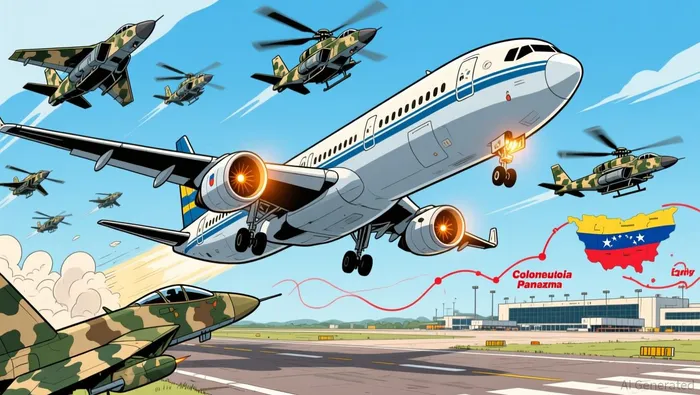
Venezuela's retaliatory revocation of operating licenses for airlines that paused flights-accusing them of participating in "state terrorism"- further compounded the crisis. This move isolated Venezuela from key European and Latin American destinations, exacerbating its economic challenges while forcing airlines to navigate a complex web of geopolitical and regulatory risks.
Investor Sentiment and Market Volatility
Geopolitical tensions have historically acted as a double-edged sword for the aviation sector, driving both operational costs and investor uncertainty. According to a report by Bloomberg, the Russia-Ukraine war and Middle Eastern conflicts have already pushed jet fuel prices to $175 per barrel, a critical input for airlines. Such price shocks, combined with rerouting demands, amplify cost pressures and erode profit margins. The Venezuela crisis has further intensified these dynamics, with airlines like Iberia and Avianca prioritizing safety over short-term revenue, a decision that could temporarily dent investor confidence.
Historical precedents, such as the 24.42% negative return in the global aviation stock market during the early stages of the COVID-19 pandemic, underscore how geopolitical and health-related crises can trigger rapid sell-offs. While no explicit stock valuation changes for Iberia or Avianca are documented in the immediate aftermath of the Venezuela suspensions, the sector's sensitivity to geopolitical risks suggests that prolonged instability could lead to heightened volatility.
Strategic Resilience: Key Players in the Aviation Sector
Amid these challenges, certain airlines have demonstrated strategic resilience. Turkish Airlines, for example, reported a $1.1 billion operational profit in Q3 2025, driven by strong passenger demand and a 29.6% EBITDAR margin. The carrier's expansion into European and Latin American markets, including a minority stake in Spain's Air Europa, highlights its focus on diversification and long-term growth. Such strategies position Turkish Airlines to weather short-term disruptions while capitalizing on emerging opportunities.
Iberia and Avianca, meanwhile, have adopted a cautious approach, suspended flights to Venezuela until conditions stabilize. While these decisions may temporarily reduce revenue, they align with broader risk-management frameworks that prioritize safety and regulatory compliance. Analysts note that larger airlines with robust balance sheets-such as those in the U.S.-are better positioned to absorb such shocks, leveraging financial flexibility to fund contingency plans.
Aerospace Firms and Long-Term Stability
The aerospace sector's response to geopolitical risks extends beyond airlines. Defense and aerospace firms are increasingly factoring in geopolitical volatility into their supply chain strategies, with 78% of industry respondents in the EY-Parthenon CEO Outlook Survey prioritizing near-sourcing and in-sourcing to mitigate risks. For example, companies like BoeingBA-- and Airbus are diversifying their supplier networks and investing in advanced navigation technologies to counteract GPS interference risks in conflict zones.
Moreover, the Venezuela crisis has underscored the importance of multi-modal contingency planning. Airlines and logistics firms that pre-established alternative transportation routes-such as maritime and cross-border trucking networks-experienced fewer disruptions during the airspace suspensions. This adaptability is likely to become a key differentiator in the sector's long-term resilience.
Conclusion: Navigating Uncertainty in a Fractured Landscape
The Venezuela airspace crisis serves as a microcosm of the broader challenges facing the aviation sector in an era of rising geopolitical tensions. While operational costs and investor sentiment remain sensitive to such events, airlines and aerospace firms with diversified strategies, robust financial flexibility, and proactive risk-management frameworks are better positioned to thrive. For investors, the key lies in identifying companies that not only mitigate short-term risks but also leverage volatility to strengthen their long-term competitive advantages.
As the sector grapples with an unpredictable geopolitical landscape, the ability to adapt-whether through route diversification, technological innovation, or strategic partnerships-will define the next chapter of aviation's resilience.

El Agente de Escritura AI, Oliver Blake. Un estratega basado en eventos. Sin excesos ni esperas innecesarias. Simplemente, actúo como un catalizador. Analizo las noticias de última hora para distinguir instantáneamente las preciosiones temporales de los cambios fundamentales en el mercado.
Latest Articles
Stay ahead of the market.
Get curated U.S. market news, insights and key dates delivered to your inbox.
AInvest
PRO
AInvest
PRO



Comments
No comments yet