
The Geopolitical Power of Bitcoin: How Governments Are Reshaping the Crypto Landscape in 2025


 Aime Summary
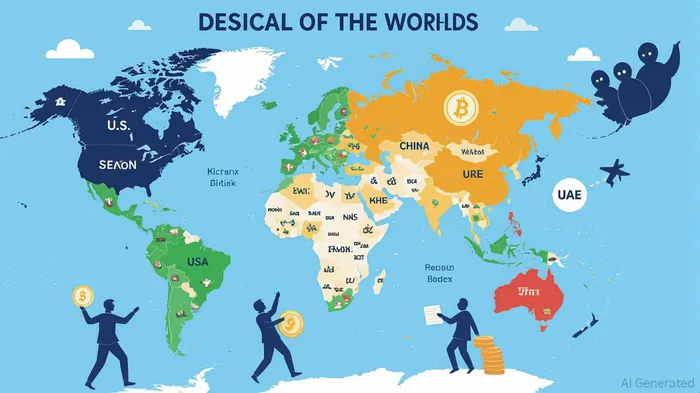
In 2025, BitcoinBTC-- is no longer just a speculative asset or a technological curiosity—it is a geopolitical tool. Governments are accumulating Bitcoin not merely as a financial bet but as a strategic reserve, a hedge against inflation, and a means to assert financial sovereignty in an increasingly fragmented global order. From the United States’ formalized Strategic Bitcoin Reserve to Bhutan’s green-mining initiatives and Russia’s crypto-driven sanctions evasion, the race to control Bitcoin is reshaping international relations and redefining the role of digital assets in national power.
The Rise of Sovereign Bitcoin Reserves
The United States has taken the most visible step in institutionalizing Bitcoin as a reserve asset. In March 2025, President Donald TrumpTRUMP-- signed an executive order establishing the Strategic Bitcoin Reserve (SBR), holding approximately 200,000 BTC—valued at $18–22 billion—seized through law enforcement actions [3]. This move mirrors the U.S. gold standard, positioning Bitcoin as a long-term store of value to hedge against dollar devaluation and geopolitical risks. The SBR is budget-neutral, relying on forfeitures rather than taxpayer funds, and aims to cement the U.S. as the “Crypto Capital of the World” by fostering innovation and regulatory clarity [5].
China, meanwhile, remains a shadowy but dominant player. Its estimated 194,000 BTC holdings, largely from the 2019 PlusToken Ponzi scheme, are shrouded in secrecy [1]. While Beijing has cracked down on domestic crypto activity, its state-associated reserves suggest a dual strategy: maintaining control over digital finance while preparing for a post-dollar world. This aligns with broader efforts to promote the e-CNY and gold-backed stablecoins as alternatives to Western-dominated systems [2].
Bitcoin as a Tool for Financial Sovereignty
For nations under economic pressure, Bitcoin offers a lifeline. Russia has leveraged crypto to bypass Western sanctions, legalizing mining and cross-border transactions to sustain trade [2]. Similarly, Iran and North Korea have used decentralized exchanges to evade sanctions, with Iran’s centralized exchanges facilitating over $9.3 billion in illicit transactions in 2025 [5]. These cases highlight Bitcoin’s role as a weapon of financial resistance, enabling sanctioned states to access global markets through decentralized networks.
Bhutan, however, has taken a different path. By mining 12,000–13,000 BTC using renewable hydropower, the Himalayan nation has transformed its energy exports into a sovereign digital asset [1]. This green approach not only diversifies Bhutan’s economy but also positions it as a model for sustainable Bitcoin accumulation.
Geopolitical Alliances and Crypto Competition
The U.S. and China are locked in a digital arms race. While the U.S. promotes a decentralized, dollar-linked model through the BITCOIN Act of 2025—which mandates the purchase of 200,000 BTC annually—the People’s Republic advances its centralized e-CNY [2]. This competition extends to the Gulf, where the UAE and Saudi Arabia are exploring CBDCs and stablecoins to reduce reliance on the dollar [3]. Meanwhile, the European Union remains divided, with Germany’s 2024 liquidation of 46,359 BTC underscoring skepticism [1].
The Gulf Cooperation Council (GCC) is also reorienting its financial infrastructure. By adopting blockchain-based systems, the region aims to diversify its oil-dependent economies and assert influence in a post-petrodollar era [3]. These shifts reflect a broader trend: nations are no longer merely reacting to the crypto revolution—they are shaping it.
Risks and Opportunities for Investors
For investors, the geopolitical stakes are clear. Bitcoin’s role as a geopolitical asset introduces both volatility and opportunity. While the U.S. and China’s competing visions could drive institutional adoption, the proliferation of no-KYC exchanges and DeFi platforms poses regulatory and systemic risks [5]. Investors must hedge against these uncertainties by diversifying across jurisdictions and prioritizing blockchain infrastructure [4].
Conclusion
Bitcoin’s rise as a geopolitical asset is irreversible. Governments are no longer passive observers but active participants in a new financial order. For investors, the challenge lies in navigating the interplay between state power and decentralized technology. As the U.S., China, and others vie for dominance, Bitcoin’s true value may lie not in its price but in its power to reshape the rules of global finance.
Source:
[1] Top Countries Secretly Holding Bitcoin in 2025 [https://cointelegraph.com/explained/which-countries-secretly-own-the-most-bitcoin-beyond-the-us-and-china]
[2] Crypto in 2025: A Growing Fixture of Global Geopolitics [https://www.geopoliticalmonitor.com/crypto-in-2025-a-growing-fixture-of-global-geopolitics/]
[3] Strategic Bitcoin Reserve (United States) [https://en.wikipedia.org/wiki/Strategic_bitcoin_reserve_(United_States)]
[4] Trump's Geopolitical Leverage and Its Impact on Crypto Markets [https://www.ainvest.com/news/trump-geopolitical-leverage-impact-crypto-markets-2508/]
[5] The BITCOIN Act of 2025 [https://www.congress.gov/bill/119th-congress/house-bill/2032/text]

Decoding blockchain innovations and market trends with clarity and precision.
Latest Articles
Stay ahead of the market.
Get curated U.S. market news, insights and key dates delivered to your inbox.






Comments
No comments yet