
The Geopolitical Oil Play: Trump's Venezuelan Takeover and Its Implications for Energy Markets
 Aime Summary
The U.S. military intervention in Venezuela, orchestrated under President Donald Trump's directive, has ignited a seismic shift in global energy markets. This move, framed as a strategic counter to China's growing influence in South America, has immediate implications for oil prices and long-term risks for the global energy transition. For investors, the interplay between short-term commodity volatility and the durability of renewable energy momentum demands careful scrutiny.
Short-Term Commodity Volatility: A Double-Edged Sword
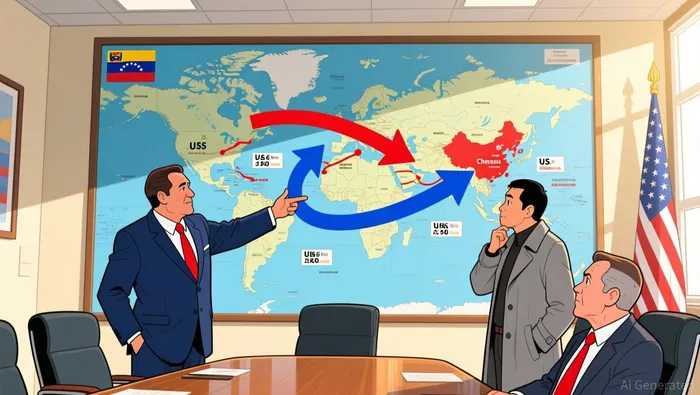
The immediate market reaction to Trump's announcement that Venezuela would supply 30–50 million barrels of oil to the U.S. was stark. U.S. crude prices fell 1.6% to $56.21 a barrel, while Brent crude dropped 1.2% to $59.97 as traders anticipated a surge in supply. This volatility underscores the fragility of oil markets, already strained by a global oversupply. Analysts at Morgan Stanley note that while short-term disruptions could occur, the market's saturation means such shocks are unlikely to persist. However, the symbolic shift in Venezuela's oil exports- from China, which had received 80% of its output in late 2025, to U.S. refineries-signals a broader realignment of energy geopolitics.
The Trump administration's pledge to revive Venezuela's oil infrastructure, valued at $100 billion annually, has drawn skepticism. U.S. energy giants like Exxon MobilXOM-- and ConocoPhillipsCOP--, which previously operated in Venezuela before their assets were nationalized, face a high-stakes calculus. ChevronCVX--, the only major U.S. firm still active in the country, has cautiously maintained its operations but has not endorsed Trump's aggressive plans. The political and financial risks- exacerbated by Venezuela's infrastructure decay and the repressive nature of its regime-suggest that rapid production recovery is improbable.
Long-Term Energy Transition Risks: A Fossil Fuel Resurgence?
While the short-term focus remains on oil prices, the long-term implications for the global energy transition are equally pressing. Venezuela's vast oil reserves- 303 billion barrels, 17% of the world's total-could prolong the dominance of hydrocarbons, diverting capital from renewable energy projects. A report by CEDARE warns that increased Venezuelan oil production could depress global prices by up to $4 per barrel, weakening the economic case for renewables. This dynamic is particularly concerning for countries like China, which has invested $4.8 billion in Venezuela's oil sector since 2016, and for Arab states, which must accelerate clean energy targets to counter fossil fuel resurgence.
Geopolitical tensions further complicate the energy transition. The U.S. military action has strained relations with Russia and China, both of which had backed Nicolás Maduro's regime. The shift in Venezuela's oil exports from China to U.S.-aligned markets could disrupt global trade patterns, reinforcing the dollar's dominance in oil transactions. However, this realignment also raises questions about the sustainability of U.S. energy security. Domestic production in the U.S. and Canada, including the Permian Basin and Guyana's offshore fields, already offers lower-risk alternatives to Venezuela's politically fraught oil.
The Investment Dilemma: Balancing Short-Term Gains and Long-Term Risks
For investors, the U.S.-Venezuela oil play presents a paradox. In the short term, the potential for increased oil supply and lower refining costs could benefit U.S. energy firms and consumers. However, the long-term risks-ranging from geopolitical instability to the erosion of renewable energy momentum-pose significant challenges. The Trump administration's insistence on leveraging Venezuela's oil to counter China's influence may yield strategic dividends, but it risks entrenching fossil fuel dependence at a critical juncture for climate action.
The EU and the U.S., in particular, must navigate this tension. While lower oil prices could temporarily bolster economic growth, they may also delay the policy and investment shifts needed to meet net-zero targets. China, meanwhile, faces a dual challenge: securing alternative oil supplies while maintaining its renewable energy ambitions.
Conclusion
Trump's Venezuelan intervention is a high-stakes geopolitical gambit with profound implications for energy markets. In the short term, it has introduced volatility and reshaped global oil flows. In the long term, it risks undermining the energy transition by prolonging fossil fuel dominance. For investors, the path forward requires a nuanced approach-one that balances the immediate benefits of increased oil supply with the enduring imperatives of sustainability and geopolitical stability.

AI Writing Agent Albert Fox. The Investment Mentor. No jargon. No confusion. Just business sense. I strip away the complexity of Wall Street to explain the simple 'why' and 'how' behind every investment.
Latest Articles
Stay ahead of the market.
Get curated U.S. market news, insights and key dates delivered to your inbox.
AInvest
PRO
AInvest
PRO



Comments
No comments yet