
The Geopolitical Oil Dance: Navigating Volatility for Long-Term Gains
The Israel-Iran conflict has thrust global energy markets into a state of heightened volatility, with oil prices swinging sharply in response to each escalation of military or diplomatic tension. Yet, the U.S. government's deliberate delay in committing to direct military action has created a unique opportunity for investors to capitalize on short-term price swings while positioning for long-term gains in energy equities. Here's how to decode the chaos and turn risk into reward.
The Immediate Volatility: A Geopolitical Risk Premium
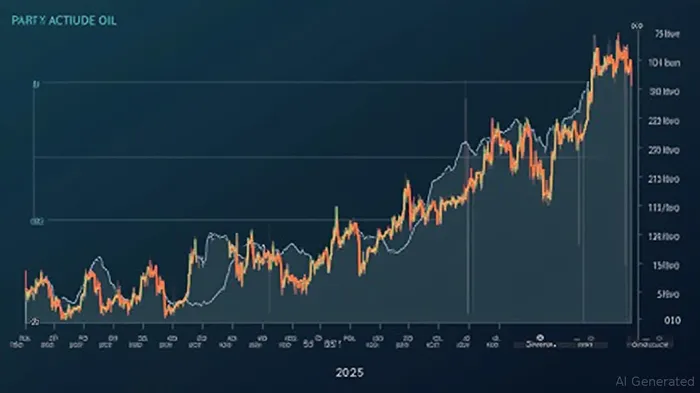
The conflict's immediate impact has been clear: oil prices jumped 7% overnight after Israel's June 13 strikes on Iranian nuclear sites, reaching $78/bbl for Brent crude. Analysts estimate a $10–$15/bbl “geopolitical risk premium” is now embedded in prices, reflecting fears of a full-scale war and potential closure of the Strait of Hormuz, through which 20% of global oil flows. However, the U.S. administration's two-week pause before deciding on military action has tempered further spikes, creating a volatile but constrained trading range.
The delay is a double-edged sword. While it avoids immediate escalation, it prolongs uncertainty, keeping prices elevated. Investors must ask: How long can this premium persist, and where does it create opportunities?
Why Delayed U.S. Involvement Favors Strategic Buyers
The U.S. government's caution—evident in its evacuation of non-essential embassy personnel and reluctance to commit “bunker buster” bombs to Iran's nuclear sites—suggests a preference for containment over escalation. This creates three critical dynamics for investors:
- Limited Supply Disruption Risk: While Israel's strikes have targeted Iranian infrastructure, actual oil exports remain intact. The South Pars gas field and Shahid Rajaee port, though damaged, are not yet critical chokepoints.
- OPEC+ Buffer: The June 2025 production hike of over 2 million barrels/day by OPEC+ has added a safety net. Even if Hormuz is partially disrupted, spare capacity in Saudi Arabia and Russia can mitigate shortages—though not eliminate price volatility.
- Valuation Discounts in Energy Equities: The risk premium has created undervalued opportunities in energy equipment and services firms, which are insulated from short-term supply shocks but poised to benefit from long-term demand for energy infrastructure.
The Long-Term Opportunity: Energy Equities at a Discount
While oil traders focus on daily headlines, investors with a 3–5-year horizon can exploit the current undervaluation of energy equipment and services stocks. Key metrics highlight five names offering exceptional value:
- Forum Energy Technologies (FET):
- Why Buy? A Price/Sales ratio of 0.30 (vs. industry median 0.74) and an EV/EBITDA of 5.8 (vs. 6.7) suggest it's trading at a deep discount. Its subsea ROV and fracturing tools are critical for maintaining global oil production.
Risk: Share issuance dilutes value, but its 2.8x Price/FCF ratio is a compelling buy signal.
Patterson-UTI Energy (PTEN):
- Why Buy? With a 10.2% shareholder yield (vs. industry's -0.4%), it's returning capital aggressively. Its drilling systems are vital for shale plays, and its 4.3x EV/EBITDA is a steal.
Risk: Over-leverage could strain margins if oil prices fall further.
Halliburton (HAL):
- Why Buy? A P/E of 9.6 (vs. 12.2 median) and a shareholder yield of 5.6% reflect undervaluation. Its digital reservoir management tools are a growth driver.
Risk: High P/B ratio (1.89 vs. 1.11) suggests some overvaluation in assets, but earnings multiples offset this.
NOV Inc. (NOV):
Why Buy? A Price/Book of 0.82 (vs. 1.11) and a 9.2% free cash flow yield make it a standout. Its managed pressure drilling tech is essential for deepwater and unconventional plays.
Weatherford International (WFRD):
- Why Buy? A P/E of 8.2 (vs. 12.2) and EV/EBITDA of 6.4 (vs. 6.7) suggest it's undervalued despite a high P/B ratio. Its subsurface technologies are a defensive play.
Strategic Investment Playbook
- Diversify in Energy Equipment ETFs: The Energy Select Sector SPDR Fund (XLE) offers broad exposure, but tilt toward the five undervalued names listed above.
- Focus on Cash Flow and Buybacks: Prioritize firms like PTEN (10.2% yield) and NOV (5.5% yield) for capital returns.
- Hedge with Options: Use call options on oil futures targeting $90/bbl strikes to hedge against a potential Hormuz closure scenario.
- Avoid Tanker Stocks: Companies like Teekay Corp. face rising insurance costs and rerouting risks—speculative bets only.
Conclusion: Volatility as a Buying Signal
The Israel-Iran conflict has introduced a geopolitical risk premium that is here to stay unless diplomacy prevails. While short-term oil prices may oscillate between $70 and $80/bbl, energy equities offer a clearer path to long-term gains. The delay in U.S. military action ensures that the current volatility will persist, but it also creates a rare chance to buy quality assets at discounts.
Investors who focus on cash-rich, undervalued energy equipment firms and pair them with strategic oil derivatives will position themselves to profit as the dust settles—whether through a de-escalation, a prolonged stalemate, or even a broader conflict. In such markets, patience and valuation discipline are the ultimate weapons.


Stay ahead of the market.
Get curated U.S. market news, insights and key dates delivered to your inbox.




Comments
No comments yet