
Geopolitical Noise and Market Resilience: Why Investors Should Stay the Course Despite the Drama
The geopolitical landscape has rarely been more turbulent. From Donald Trump's escalating tariffs on China to the ongoing fallout of the Ukraine war, markets have faced a barrage of risks that, by traditional logic, should unsettle investors. Yet equities have remained stubbornly resilient. This isn't a fluke—it's part of a decades-old pattern where markets shrug off geopolitical shocks, favoring long-term trends over short-term noise. Let's unpack why, and how investors can capitalize on this desensitization.
Historical Precedents: Geopolitical Storms, Calm Markets
Over the past 80 years, 36 major geopolitical events—from Germany's 1940 invasion of France to Russia's 2022 Ukraine invasion—have failed to derail long-term equity market gains. Despite triggering average three-month S&P 500 declines of 0.3% (vs. a 1.3% average for non-event periods), markets rebounded within six to twelve months, aligning with historical returns. Even the 2008 Russia-Georgia war or the 1990 Gulf War saw equities recover swiftly.
The outlier was the 1973 Arab oil embargo, which caused a 37% twelve-month S&P decline due to stagflation—a scenario avoided in 2022 thanks to U.S. shale oil's supply cushion. 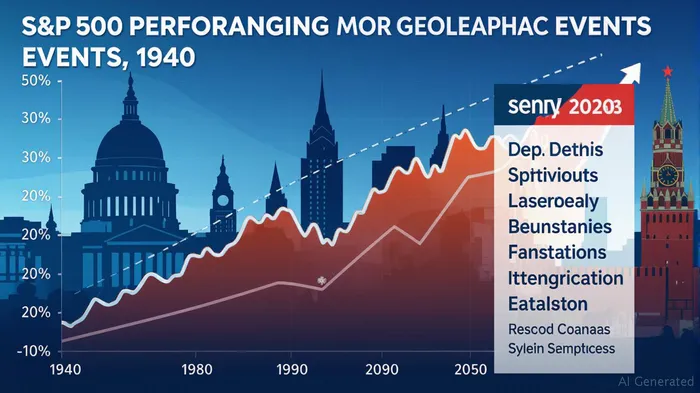 .
.
Why Markets Aren't Fazed in 2025
Today's geopolitical risks, while real, are not unprecedented. Take Trump's tariffs: the 2018–2025 escalation to 145% on Chinese goods caused sector-specific pain—German small caps underperformed the DAX by 23% due to energy cost spikes—but U.S. equities overall held firm. .
The key difference now? Markets have evolved to absorb shocks. Diversified portfolios, central bank liquidity, and corporate agility (e.g., reshoring, supply chain redundancy) buffer against disruptions. Even the 2025 “fentanyl tariff” on China, which triggered a 20% rate hike, saw equities stabilize within months as businesses adapted.
The Resilience Playbook: Sectors to Own, Risks to Hedge
1. Equity Exposure: Stick with Quality
Large-cap equities remain the core of resilient portfolios. The DAX's 49.7% EPS growth since 2022 (vs. German small caps' decline) underscores the advantage of scale and global diversification. .
2. Defensive Sectors: Utilities and Healthcare
Utilities (e.g., the Utilities Select Sector SPDR ETFXLU--, XLU) and healthcare stocks have historically outperformed during geopolitical turbulence. Their stable cash flows and low correlation to economic cycles make them ideal buffers.
3. Gold: The Tactical Hedge
Gold's 1.8% average four-week return during geopolitical spikes (per historical data) justifies a 5–10% allocation in portfolios. .
4. Avoid Overreacting to Tariff-Driven Sector Pain
Agribusiness and construction sectors face margin pressure from tariffs, but these are cyclical, not terminal. Investors should focus on companies with pricing power (e.g., Coca-ColaKO--, PepsiCo) or those pivoting to domestic markets (e.g., U.S. steel producers benefiting from reshoring incentives).
Expert Insights: Navigating the Gray Areas
Legal and policy uncertainty complicates the picture. The May 2025 court ruling against IEEPA-based tariffs could force retroactive refunds, shaking up supply chain costs. Advisors recommend:
- Diversify suppliers: Reduce reliance on single markets.
- Hedge currency risks: Use forward contracts to insulate against volatility.
- Scenario plan: Model tariff escalations or reversals to stress-test portfolios.
Final Takeaway: Stay Invested, but Stay Smart
Markets are no strangers to geopolitical fireworks. While short-term volatility is inevitable, history shows that long-term trends—driven by innovation, demographics, and liquidity—prevail. Investors should:
1. Maintain equity exposure, favoring large caps and global firms.
2. Layer in defensive assets (utilities, gold) to hedge against tail risks.
3. Avoid overrotation into “safe” sectors unless valuations are compelling.
As the saying goes, “Don't fight the Fed”—and don't fight the data. Geopolitical noise may dominate headlines, but portfolios thrive on fundamentals. Stay disciplined, and let the market's resilience work in your favor.
.
.

Delivering real-time insights and analysis on emerging financial trends and market movements.
Latest Articles
Stay ahead of the market.
Get curated U.S. market news, insights and key dates delivered to your inbox.


AInvest
PRO
AInvest
PRO



Comments
No comments yet