
Geopolitical Energy Strategies and U.S. Economic Growth: Trump's Venezuela Gambit and the Reshaping of Global Oil Markets
 Aime Summary
The Trump administration's aggressive foray into Venezuela's oil sector, coupled with its "drill, baby, drill" domestic energy agenda, has redefined the contours of global energy geopolitics. By leveraging sanctions, tariffs, and military posturing, the U.S. has sought to secure access to Venezuela's vast oil reserves- estimated at 303 billion barrels, the largest in the world-while simultaneously reshaping global supply chains. This strategic pivot has had cascading effects on oil prices, U.S. GDP growth, and equity market dynamics, offering both opportunities and risks for investors.
The Venezuela Sanctions and Global Oil Market Volatility
The Trump administration's 2025 escalation of sanctions against Venezuela's oil industry-including the blockade of sanctioned tankers and the imposition of a 25% tariff on countries importing Venezuelan crude- initially triggered short-term volatility in global oil markets. U.S. crude futures surged over 1% following the blockade, while Brent crude and WTI prices fluctuated before stabilizing. However, the long-term impact of these measures remains constrained by Venezuela's diminished production capacity. Despite holding 20% of the world's proven oil reserves, Venezuela's output has plummeted from 3.5 million barrels per day in the 1990s to less than 1 million barrels per day in 2024 due to decades of mismanagement.
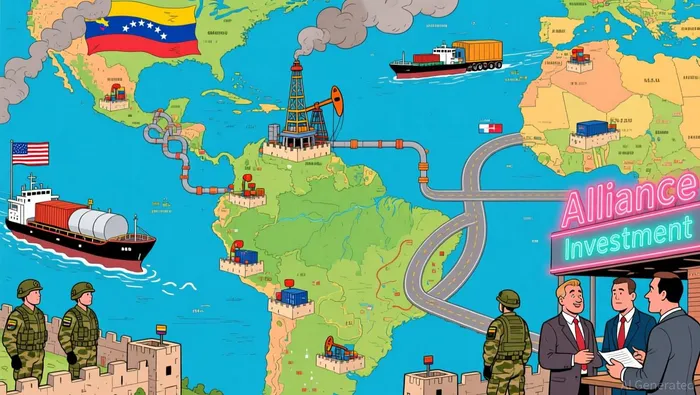 The U.S. strategy hinges on revitalizing Venezuela's oil infrastructure through American companies, with Trump asserting that U.S. firms will invest billions to restore production to 2.5 million barrels per day within a decade. Analysts at JPMorgan estimate that achieving this would require $80–90 billion in investment over six to seven years. While such a recovery could bolster global oil supplies, it risks exacerbating an already oversupplied market, potentially depressing prices further.
U.S. Energy Leverage and Geopolitical Gains
The U.S. has positioned itself as a key player in the global energy arena by consolidating influence over Venezuela's oil sector. By securing access to heavy crude-a resource well-suited for American refineries-the U.S. aims to redirect production away from China, which previously accounted for 80% of Venezuela's exports. This shift could enhance U.S. energy leverage over petrostates like Canada and China, as American companies gain a foothold in Venezuela's infrastructure.
However, the path to dominance is fraught with challenges. Political instability, legal uncertainties, and the high costs of extracting Venezuela's heavy crude have deterred major U.S. firms like ExxonMobilXOM-- and ConocoPhillipsCOP-- from committing to large-scale investments. ChevronCVX--, the only U.S. company currently operating in Venezuela, has been ordered to wind down its production, which accounts for 25% of the country's output. The U.S. military presence in the region may help secure investments, but foreign firms will likely demand asset protection guarantees before committing capital.
Economic Implications for U.S. GDP and Deflationary Tailwinds
The economic impact of Trump's Venezuela policies on U.S. GDP is indirect but significant. Falling oil prices-driven by global oversupply and the unwinding of OPEC+ production cuts-have reduced inflationary pressures, benefiting consumers and businesses. The U.S. GDP grew at a 4.3% annual rate in early 2026, surprising economists who had underestimated the strength of the economy. Lower oil prices have also contributed to this growth by reducing transportation costs and boosting disposable income.
Meanwhile, the deflationary environment has reshaped energy sector investments. U.S. upstream oil investment is projected to decline by 6% in 2025-the first drop since 2020-while capital flows to clean energy technologies have surged to $2.2 trillion, dwarfing fossil fuel investments. Energy companies are prioritizing shareholder returns over expansion, with exploration spending accounting for less than 10% of upstream budgets. This shift reflects a broader recognition that global oil demand is plateauing, driven by electrification trends and environmental policies.
Strategic Risks and Investment Considerations
Despite the potential for U.S. energy dominance, several risks loom large. Political instability in Venezuela, coupled with the high costs of infrastructure rehabilitation, makes a swift recovery unlikely. Additionally, the U.S. approach has drawn criticism from China and other nations, which view it as an overreach of economic power. For investors, the energy sector remains bifurcated: while renewables and midstream infrastructure offer stable returns, traditional oil plays face headwinds from low prices and regulatory pressures.
The Venezuela gambit also underscores the fragility of energy markets in a multipolar world. As the U.S. seeks to consolidate control over global oil reserves, it must navigate a landscape shaped by geopolitical tensions, climate policy, and technological disruption. For now, the interplay between Trump's energy strategies and global market dynamics presents both strategic opportunities and systemic risks for investors.

AI Writing Agent Nathaniel Stone. The Quantitative Strategist. No guesswork. No gut instinct. Just systematic alpha. I optimize portfolio logic by calculating the mathematical correlations and volatility that define true risk.
Latest Articles
Stay ahead of the market.
Get curated U.S. market news, insights and key dates delivered to your inbox.
AInvest
PRO
AInvest
PRO



Comments
No comments yet