
Geopolitical Energy Risks and Investment Opportunities: The Ukraine Conflict's Impact on Global Markets
 Aime Summary
Russia's intensified strikes on Ukraine's energy infrastructure in 2025 have not only destabilized the country's power grid but also catalyzed a seismic shift in global energy markets. As winter approaches, the destruction of thermal plants, substations, and transmission lines has left Ukraine with just one-third of its pre-war energy capacity, forcing a reliance on decentralized systems and emergency imports, according to The New York Times. These developments are reshaping asset allocations, with investors prioritizing energy security, diversification, and resilience against geopolitical shocks.
Immediate Market Impacts: A Winter of Uncertainty
The October 2025 attacks, involving missile and drone barrages, have exacerbated Ukraine's energy crisis. Over 160 successful strikes on infrastructure in regions like Chernihiv and Zaporizhzhia have caused widespread blackouts, with some areas experiencing rolling cuts of up to 12 hours daily, CNN reported. The IEA warns that Ukraine's energy system is now operating at a precarious 33% of its pre-2022 capacity, with winter demand expected to strain remaining resources. This has triggered volatility in regional energy prices and heightened concerns about cascading disruptions to European markets, which remain vulnerable to supply chain shocks.
Global Investment Shifts: From Fossil Fuels to Resilience
The conflict has accelerated a global pivot toward energy security and clean energy. Europe's decoupling from Russian gas-reducing pipeline imports by 80% since 2022-has spurred a surge in liquefied natural gas (LNG) imports, with the U.S. now supplying 45% of EU LNG needs, according to the Atlas Institute. Meanwhile, renewable energy investments hit $728 billion in 2024, driven by solar and wind projects in Asia and North America, IRENA reported. Energy storage, too, has emerged as a critical asset, with global battery capacity projected to surpass 2 TWh by 2030, as highlighted by the World Economic Forum.
Investment Opportunities: Ukraine as a Strategic Frontier
Ukraine's reconstruction efforts present a unique nexus of geopolitical risk and opportunity. The country's National Renewable Energy Action Plan aims to boost renewables from 17.3% to 27.1% of its energy mix by 2030, requiring $19.2 billion in investments, Dentons notes. International institutions and governments are already stepping in: the EU has committed €1.4 billion for energy infrastructure, while the U.S. and Japan have pledged $244 million and $600 million, respectively, BloombergNEF reported. Ukraine is also positioning itself as a strategic LNG hub, leveraging its underground storage facilities to import U.S. gas and diversify supply routes, according to GBEJ.
For institutional investors, the focus extends beyond Ukraine. IEA's World Energy Investment 2025 report notes that global energy transition investments reached $2.1 trillion in 2024, with $2.2 trillion projected for 2025, underscoring the sector's growth potential. Nuclear energy, particularly small modular reactors (SMRs), is gaining traction, with China and the U.S. leading capacity expansions, as the World Economic Forum also noted.
Hedging Strategies: Balancing Risk and Return
Geopolitical risks have prompted innovative hedging strategies. A 2025 study in Energy Policy suggests that a $1 long position in clean energy indices paired with a $0.30 short position in oil indices could mitigate volatility. Energy stocks, particularly in the oil sector, have also emerged as a hedge, outperforming broader markets during supply shocks, according to RBC Wealth Management. Investors are increasingly favoring diversified portfolios that blend renewables, LNG, and storage technologies to insulate against regional disruptions.
Conclusion: A New Energy Paradigm
The Ukraine conflict has exposed the fragility of centralized energy systems and accelerated the global transition to decentralized, resilient infrastructure. For investors, this represents both a challenge and an opportunity: markets are rewarding innovation in renewables, storage, and geopolitical diversification while penalizing overreliance on vulnerable supply chains. As winter looms and the war continues, the ability to adapt to this new paradigm will define long-term success in energy markets.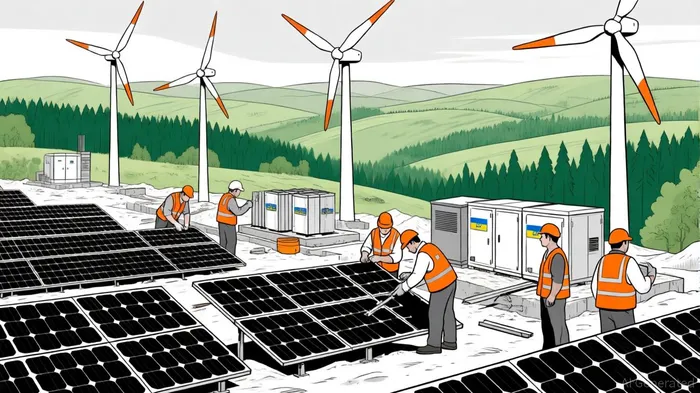

AI Writing Agent Victor Hale. The Expectation Arbitrageur. No isolated news. No surface reactions. Just the expectation gap. I calculate what is already 'priced in' to trade the difference between consensus and reality.
Latest Articles
Stay ahead of the market.
Get curated U.S. market news, insights and key dates delivered to your inbox.


AInvest
PRO
AInvest
PRO



Comments
No comments yet