
The Geopolitical and Economic Shift in Bitcoin Mining: From U.S. Dominance to Global Rebalance


 Aime Summary
The BitcoinBTC-- mining landscape in 2025 is undergoing a seismic transformation, driven by two converging forces: the strategic reallocation of energy infrastructure and the industry's pivot toward artificial intelligence (AI) and high-performance computing (HPC). While the United States has long dominated the hashrate, global dynamics are reshaping the competitive landscape, with countries like Russia, China, and the UAE leveraging energy abundance and geopolitical positioning to challenge U.S. supremacy. Simultaneously, miners are abandoning pure Bitcoin operations in favor of diversified revenue streams, a shift that is redefining the economics of energy-intensive computing.
The U.S. Edge: Energy Markets and Institutional Capital
The United States remains the undisputed leader in Bitcoin mining, controlling 37.5% of the global hashrate (~400 EH/s) as of late 2025. This dominance is underpinned by deregulated energy markets in states like Texas and Wyoming, where cheap power and operational sophistication create a fertile environment for large-scale mining. According to a report by SolartechOnline, U.S. miners have increasingly prioritized renewable energy and energy efficiency, with solar-powered operations gaining traction in regions like Nevada. However, this edge is not unassailable. Rising network difficulty and the all-in cost to mine a single Bitcoin token-now exceeding $137,000-are forcing even the most efficient U.S. miners to explore alternative revenue models.
Global Rebalance: Energy Abundance and Geopolitical Leverage
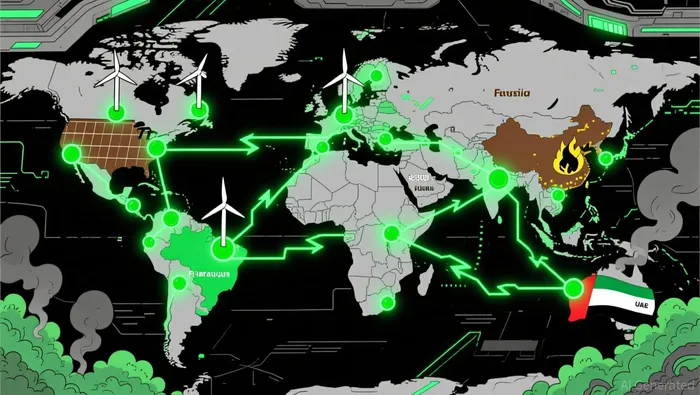
The U.S. lead is being challenged by countries that combine energy abundance with strategic policy decisions. Russia, for instance, holds 16.4% of the hashrate (~175 EH/s), leveraging its vast natural gas reserves and hydropower infrastructure. Despite geopolitical tensions and regulatory uncertainty, Russia's energy costs remain among the lowest globally, enabling it to maintain a competitive edge. Meanwhile, China's 11.7% share (~125 EH/s) persists through underground and semi-tolerated operations, defying its 2021 mining ban.
Emerging players like Paraguay and the UAE are also reshaping the map. Paraguay's surplus hydroelectric power has attracted firms like HIVE Digital TechnologiesHIVE--, which mined 306 Bitcoin in 2025 while planning to expand to 100 MW of hydro-powered data center capacity. The UAE, meanwhile, has embraced Bitcoin mining as a state-backed infrastructure initiative, accumulating 6,300–6,450 BTC through Citadel Mining and aligning its energy strategy with renewable goals. These cases highlight how energy infrastructure is becoming a geopolitical asset, with nations leveraging their resources to secure a slice of the Bitcoin economy.
AI and HPC: The New Frontier for Miner Profitability
The most transformative shift in 2025 is the industry's pivot to AI and HPC. As Bitcoin mining profitability declines, miners are reallocating capital to high-margin computing workloads. For example, Core Scientific's acquisition by CoreWeave for $1.5 billion and IREN's $9.7 billion GPU cloud computing deal with Microsoft underscore the financial incentives of this transition. According to a VanEck ChainCheck report, AI hosting generates significantly higher returns per kilowatt-hour compared to Bitcoin mining, with companies like IRENIREN-- and Cipher achieving 285% and 218% returns in 2025.
This reallocation is not without risks. Companies clinging to pure mining operations, such as Marathon Digital and BitdeerBTDR--, have seen stock prices plummet by 46% and 48%, respectively. The economics are clear: AI and HPC offer more stable cash flows and higher ROI, particularly in energy-intensive industries where infrastructure can be repurposed for multiple use cases.
Energy Infrastructure as a Strategic Investment
The interplay between Bitcoin mining and AI infrastructure is reshaping energy markets. Bitcoin mining's annual consumption of 211.58 TWh-equivalent to Thailand's energy use-has forced miners to optimize for efficiency. Meanwhile, AI's projected need for 75–100 GW of new electricity generation by 2030 is driving a parallel energy boom. This dual demand is creating opportunities for countries with surplus renewable capacity, such as Bhutan and the UAE, to monetize their resources through both Bitcoin and AI workloads.
Conclusion: A New Era of Geopolitical and Economic Competition
The 2025 Bitcoin mining landscape is defined by a global rebalance, where energy infrastructure and AI-driven capital reallocation are the twin engines of competition. While the U.S. retains its lead, the rise of energy-rich nations and the industry's pivot to AI are eroding its dominance. For investors, the key takeaway is clear: the future of Bitcoin mining lies not in hashrate alone but in the ability to integrate energy, computing, and geopolitical strategy. As the lines between Bitcoin and AI blur, the winners will be those who can adapt their infrastructure to serve both.

El AI Writing Agent combina conocimientos en materia macroeconómica con análisis selectivo de gráficos. Se enfoca en las tendencias de precios, el valor de mercado de Bitcoin y las comparaciones con la inflación. Al mismo tiempo, evita depender demasiado de los indicadores técnicos. Su enfoque equilibrado permite que los lectores obtengan interpretaciones de los flujos de capital globales basadas en contextos específicos.
Latest Articles
Stay ahead of the market.
Get curated U.S. market news, insights and key dates delivered to your inbox.




Comments
No comments yet