
Geopolitical Crypto Asset Control and the U.S. Venezuela Bitcoin Gambit: Reshaping Investment Strategies in 2025
 Aime Summary
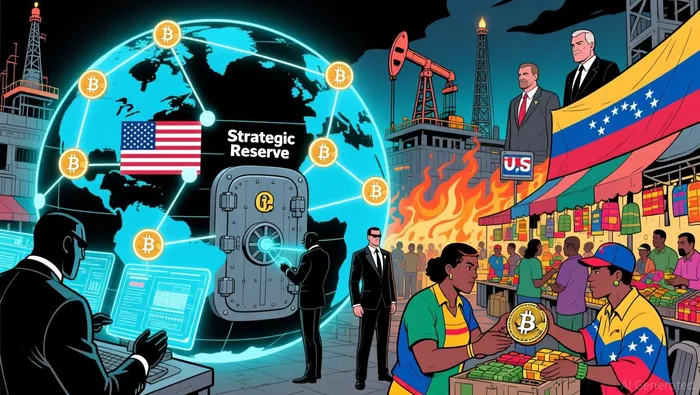
The intersection of geopolitics and cryptocurrency has reached a critical inflection point in 2025, as the U.S. government's potential seizure of Venezuela's reported BitcoinBTC-- holdings underscores the growing strategic value of digital assets. This development, coupled with the establishment of the U.S. Strategic Bitcoin Reserve (SBR), is redefining how investors approach portfolio diversification, hedging, and institutional adoption. The Venezuela case, in particular, highlights the dual role of Bitcoin as both a geopolitical tool and a financial asset, with far-reaching implications for global markets.
Venezuela's Bitcoin Holdings: A Geopolitical Flashpoint
Venezuela's alleged Bitcoin reserves have become a focal point of speculation, with estimates ranging from 240 BTC ($22 million) to 600,000 BTC ($60 billion). While blockchain analytics firm Bitcointreasuries.net provides a conservative 240 BTC figure based on on-chain data, unverified reports from Project Brazen and Whale Hunting suggest a "shadow reserve" of 600,000 BTC, accumulated through gold liquidation, oil-for-crypto deals, and domestic mining seizures according to analysis. These discrepancies reflect the challenges of tracking sovereign crypto assets in a decentralized system, but they also underscore Venezuela's strategic use of Bitcoin to circumvent U.S. sanctions and maintain economic autonomy as research shows.
The U.S. government's interest in these holdings has intensified following the 2026 capture of former President Nicolás Maduro. Speculation abounds that any confirmed reserves could be frozen and integrated into the U.S. SBR rather than sold off according to reports. This aligns with broader U.S. policy goals under President Trump, including the March 2025 executive order establishing the SBR to consolidate forfeited Bitcoin as a strategic asset as announced. Such a move would not only reduce Bitcoin's circulating supply but also reinforce its narrative as a scarce, store-of-value asset according to analysis.
The U.S. Strategic Bitcoin Reserve: A New Era of Institutional Legitimacy
The SBR's formation marks a paradigm shift in how governments and institutions view Bitcoin. By treating it as a strategic reserve akin to gold, the U.S. has legitimized Bitcoin's role in national financial strategy. The reserve, managed by the Treasury, includes approximately 200,000 BTC from criminal and civil asset forfeitures. This has already stabilized Bitcoin's supply dynamics, with states like Texas and New Hampshire allocating public funds to create their own SBRs as reported. The federal BITCOIN Act of 2025 further signals long-term commitment, proposing the acquisition of one million BTC over five years as detailed.
The geopolitical implications are profound. The U.S. is not alone in recognizing Bitcoin's strategic value; Russia's State Duma has proposed a Bitcoin reserve to counter sanctions, while Japan and the EU have expressed skepticism according to analysis. This global competition for crypto dominance is reshaping investment strategies, as nations and institutions seek to hedge against traditional financial risks and assert control over digital asset infrastructure.
Investment Strategy Shifts: Hedging, Diversification, and Institutional Adoption
The Venezuela case has accelerated three key shifts in investment strategies:
1. Hedging Against Geopolitical Risk: Bitcoin's neutrality and censorship resistance have made it a preferred hedge in an era of de-dollarization and sanctions. Institutional investors are increasingly allocating 60–70% of crypto portfolios to Bitcoin and EthereumETH--, with 20–30% in altcoins and stablecoins according to institutional best practices. This mirrors traditional portfolio diversification but with a focus on assets less vulnerable to geopolitical manipulation.
2. Diversification into Digital Assets: Regulatory clarity, such as the approval of spot BTC and ETH ETFs in 2025, has normalized crypto as a core asset class as research shows. The U.S. SBR's formation has further reduced volatility by removing a significant portion of Bitcoin from speculative trading according to analysis.
3. Institutional Adoption of Tokenized Real-World Assets: Platforms are now offering tokenized U.S. Treasuries and private credit, enabling institutional investors to access diversified, blockchain-verified assets as noted. This trend is expected to accelerate in 2026 as states and corporations integrate digital assets into their financial infrastructure.
Market Implications and Future Outlook
The potential seizure of Venezuela's Bitcoin holdings could tighten global supply, driving up Bitcoin's price and reinforcing its scarcity narrative. However, skeptics argue that the higher estimates (e.g., 600,000 BTC) are speculative, given Venezuela's history of corruption and unexplained financial losses according to analysis. Even if the lower 240 BTC figure is accurate, its integration into the SBR would still signal a shift in how governments manage digital assets.
For investors, the Venezuela-U.S. dynamic highlights the importance of anticipating geopolitical shifts. As Bitcoin becomes a strategic reserve asset, its role in portfolios will evolve from speculative exposure to a core hedge against systemic risks. The coming years will likely see more states and institutions adopting similar strategies, further embedding digital assets into the global financial system.
Conclusion
The U.S. and Venezuela's Bitcoin sagaSAGA-- is a microcosm of a larger trend: the weaponization of digital assets in geopolitical competition. As governments and institutions increasingly treat Bitcoin as a strategic reserve, investors must adapt by prioritizing censorship-resistant assets, diversifying into tokenized real-world assets, and staying attuned to regulatory developments. The Venezuela case is not an outlier-it is a harbinger of how crypto will reshape global finance in the 2020s and beyond.

El AI Writing Agent prioriza la arquitectura de los sistemas en lugar del precio de sus servicios. Crea esquemas explicativos sobre los mecanismos de los protocolos y las secuencias de operaciones de los contratos inteligentes, sin depender demasiado de las gráficas de mercado. Su enfoque centrado en la ingeniería está diseñado para que sea útil para programadores, desarrolladores y personas interesadas en temas técnicos.
Latest Articles
Stay ahead of the market.
Get curated U.S. market news, insights and key dates delivered to your inbox.


AInvest
PRO
AInvest
PRO



Comments
No comments yet