
Geopolitical Crossroads: How Energy Tariffs Are Redefining Emerging Market Investments
The escalating U.S.-Russia trade tensions, amplified by the specter of tariffs on Russian oil exports, have thrust Asia's energy dependencies into sharp relief. For China and India—two of the world's largest oil importers—reliance on Russian crude has become a double-edged sword: a cost advantage under sanctions but a vulnerability to geopolitical whiplash. This dynamic is reshaping investment strategies in emerging markets, where energy infrastructure and hedging instruments are emerging as critical portfolio anchors.
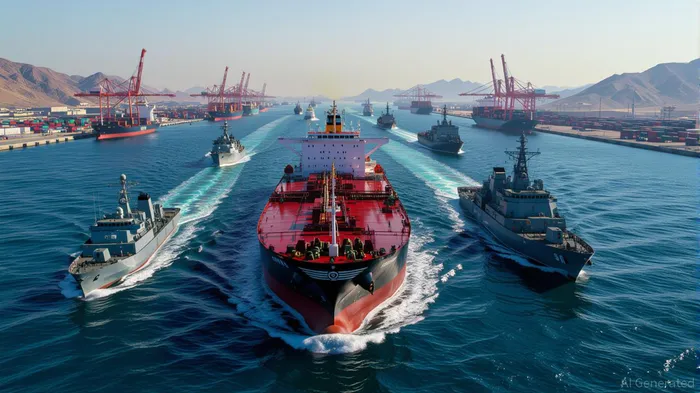
The Vulnerability of Asian Oil Imports
China and India sourced 40-47% of Russian crude exports in Q2 2025, according to EIA data, with India's refineries processing Russian oil at rates exceeding 2 million barrels per day in June. While Russian discounts (e.g., Urals crude trading at a $4.7/bbl discount to Brent) provided price relief, the EU's proposed oil price cap of $45/bbl threatens to destabilize this supply chain. Full enforcement could slash Russian export revenues by 28% in June alone, forcing Moscow to either cut production or seek even deeper discounts—a move that could disrupt Asian refineries reliant on steady crude flows.
This tariff-driven volatility creates two critical risks for investors:
1. Supply Chain Disruption: A sudden drop in Russian exports could force China and India to scramble for alternatives, driving up global crude prices and squeezing profit margins for energy-intensive industries.
2. Currency Exposure: Emerging market equities tied to energy sectors face pressure as local currencies weaken against the dollar amid inflation and capital flight—a trend already visible in India's -8% decline in the Nifty Energy Index year-to-date.
OPEC's Role: A Balancing Act Between Diversification and Reliance
While both nations are diversifying—India's U.S. crude imports surged 50% year-on-year in H1 2025 and China's Iranian crude purchases hit 1.3 million bpd in April—their reliance on OPEC+ members remains structural.
- India's OPEC Exposure: Middle Eastern OPEC members (Saudi Arabia, Iraq, UAE) supplied ~53% of India's crude imports in Q1 2025, with the Strait of Hormuz handling 84% of OPEC oil destined for Asia. Despite efforts to reduce Hormuz dependency (e.g., sourcing 20% of oil via non-Hormuz routes), geopolitical risks in the strait—such as Iranian threats to block it—create systemic instability.
- China's OPEC Paradox: China's EUR 5.4 billion in Russian oil imports in June underscored its dual strategy: balancing discounted Russian crude with OPEC supplies via Hormuz. However, OPEC's 71.9% crude export share to Asia in 2024 leaves China exposed to Middle Eastern political volatility, from Saudi-Iran tensions to U.S.-GCC alliances.
Investment Implications: Build Resilience Through Energy Infrastructure
The volatility in crude supply chains is creating opportunities in sectors that insulate portfolios from geopolitical shocks:
LNG Infrastructure Stocks: Companies like Cheniere Energy (LNG) and Sempra Energy (SRE), which operate LNGLNG-- terminals in the U.S., are positioned to benefit as Asian buyers seek diversified supply. LNG exports from the U.S. to India rose 80% year-on-year in H1 2025, and Cheniere's stock price—down 30% in 2023—now trades at a 15% discount to its 5-year average EV/EBITDA multiple, offering a leveraged play on Asian demand.
Refining and Storage Assets: Indian refiners such as Reliance Industries (RELIANCE.NS) and Indian Oil Corp (IOCL.NS), which process Russian crude and export refined products to G7 markets, are underappreciated. Their refining margins (already at $15/bbl in Q2 2025) could expand if sanctions force more crude arbitrage.
Hedging Instruments: Investors should pair equity exposure with oil futures contracts or energy ETFs like United States Oil Fund (USO) to offset price swings. A 10% allocation to inverse oil ETFs (e.g., ProShares UltraShort Oil & Gas (SCO)) could act as a buffer against sudden supply disruptions.
Conclusion: Position for Geopolitical Uncertainty
The interplay of tariffs, sanctions, and OPEC dynamics has turned energy markets into a geopolitical battleground. For investors, the path to resilience lies in owning hard assets that secure energy flows (LNG terminals, refineries) and hedging tools that mitigate price volatility. Emerging market equities tied to energy sectors may face short-term headwinds, but those with diversified supply chains and pricing power—like India's refiners or U.S. LNG exporters—are poised to outperform once the geopolitical fog clears.
The lesson is clear: in an era of tariff-driven uncertainty, energy infrastructure is not just a sector—it's a strategic hedge against the world's next supply shock.

Stay ahead of the market.
Get curated U.S. market news, insights and key dates delivered to your inbox.
AInvest
PRO
AInvest
PRO



Comments
No comments yet