
Geopolitical Crossroads: Bitcoin's Digital Gold Resilience vs. Ethereum's Smart-Contract Risks
The June 2025 U.S.-Iran nuclear strike incident has crystallized a pivotal truth in financial markets: geopolitical instability acts as both a catalyst and a filter for asset classes. While Bitcoin (BTC) and Ethereum (ETH) are often conflated as interchangeable crypto assets, their divergent performance during this crisis reveals a stark divide in their roles as safe-haven instruments. For investors, this episode underscores a critical lesson: Bitcoin's status as digital goldGBTC-- is being forged in the fires of real-world conflict, while Ethereum's value hinges on the resilience of its smart-contract ecosystem—a distinction that demands strategic portfolio allocation.
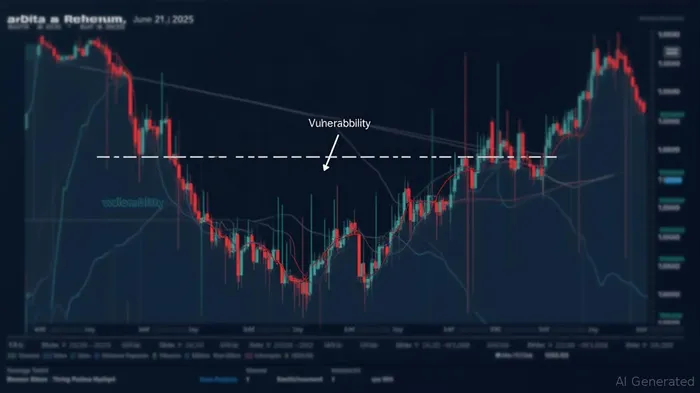
Bitcoin: The Digital Safe Haven in Action
When the U.S. launched bunker-busting MOP bombs at Iran's nuclear sites on June 21, Bitcoin initially dropped 3.2%—a steeper decline than Ethereum's 2.9%. Yet within hours, BTC rebounded to $61,200, while ETH remained subdued. This divergence highlights Bitcoin's unique positioning as an asymmetric risk hedge. Unlike traditional safe havens like gold, which require physical storage, Bitcoin's digital nature allows instant liquidity and global access. The 12% surge in Bitcoin transfers to cold storage during the crisis signals institutional buyers doubling down on capital preservation—a move absent in Ethereum's on-chain activity.
The data reveals Bitcoin's inverse relationship with equities during the crisis: as stocks sank 1.8%, Bitcoin rose 3.7%, cementing its role as a refuge in risk-off environments. Technical indicators like Bitcoin's RSI breaching 68 (overbought territory) on June 22 further suggest speculative inflows are treating BTC as a quasi-currency, not just a speculative asset.
Ethereum: Smart Contracts Face the Geopolitical Gauntlet
Ethereum's slower recovery—and its lingering below pre-crisis levels—exposes vulnerabilities unique to its platform-driven model. The sell-off reflects two realities:
1. Ecosystem fragility: Ethereum's value is tethered to the adoption of decentralized finance (DeFi) and NFT applications. During crises, these protocols face dual risks: reduced user activity (as investors prioritize liquidity) and counterparty risks from on-chain lending platforms.
2. Institutional hesitation: While Bitcoin saw $50 million inflows into crypto ETFs on June 22, Ethereum's Grayscale Trust (GBTC) bled $200 million—evidence that institutional capital views ETH as a beta trade tied to crypto's broader narrative, not a standalone safe haven.
The inverse correlation between Bitcoin and Ethereum during the crisis (BTC up 3.7%, ETH up only 0.9% by June 22 close) signals a market recalibration: investors are distinguishing between value storage and value creation. For Ethereum to regain parity, its smart contracts must prove their utility in volatile environments—a test that NFTs and DeFi yield farming alone may not pass.
Investment Strategy: Allocate Defensively, but Not Exclusively
The U.S.-Iran conflict offers a playbook for navigating crypto markets amid geopolitical uncertainty:
1. Core Positioning in Bitcoin: Allocate 50–70% of a crypto portfolio to Bitcoin as a digital gold proxy. Its demonstrated resilience during systemic events justifies its role as a hedge against both inflation and geopolitical shocks. Target entry points near $62,500 (June 21 lows) with stops below $60,000.
2. Selective Exposure to Ethereum: Deploy 15–25% to Ethereum only if paired with protocols demonstrating real-world utility. Focus on:
- DeFi protocols with fiat on-ramps (e.g., Aave's integration with traditional banks).
- NFTs tied to physical assets (e.g., land deeds or supply chain tokens).
- Enterprise blockchain projects (e.g., Polygon's healthcare partnerships).
Avoid pure speculation in meme coins or layer-2 tokens lacking tangible use cases.
Conclusion: The Crypto Divide Deepens
The U.S.-Iran crisis has accelerated a schism in crypto markets: Bitcoin is emerging as the digital equivalent of gold, while Ethereum's value remains contingent on its ability to deliver on blockchain's promise. For investors, this bifurcation demands discipline. Bitcoin's stability offers a bulwark against systemic risk, but Ethereum's potential lies in proving that smart contracts can thrive even as geopolitical storms rage. In the coming months, the true test will be whether Ethereum can weather volatility—or if it becomes collateral damage in a world where Bitcoin's safe-haven narrative only grows stronger.
The data tells the story: Bitcoin's 200-day moving average holds at $55,000, while Ethereum's struggles below $3,500. The path forward is clear—allocate prudently, but allocate with purpose.

Stay ahead of the market.
Get curated U.S. market news, insights and key dates delivered to your inbox.
AInvest
PRO
AInvest
PRO



Comments
No comments yet