
The Geopolitical Cost of Doing Business: Sony's Exit from Russia and Implications for Global Tech Exposure
 Aime Summary
In the wake of Russia's 2022 invasion of Ukraine, multinational corporations faced an impossible choice: uphold ethical stances and risk financial ruin, or compromise principles for short-term gains. Sony's complete withdrawal from Russia—marked by shuttered stores, blocked PlayStation accounts, and a 70% revenue drop in 2024—exemplifies the seismic shift in corporate risk management. For investors, this case underscores a broader truth: geopolitical volatility is no longer a peripheral concern but a core determinant of equity value.
The Financial Toll of a “Clean Break”
Sony's exit from Russia was swift and absolute. By March 2022, the company halted all hardware and software shipments, closed its PlayStation store, and suspended film distribution. While the immediate revenue loss was stark (an 82% drop in 2023), the long-term costs were even more punishing. Russian regulators forced foreign firms to sell assets at fire-sale prices—often 50% or more below market value. Sony's Moscow-based joint venture with DisneySCHL--, for instance, funneled £13.5 million in dividends to a London subsidiary in 2022-2023, a lifeline that couldn't offset the broader collapse of its Russian operations.
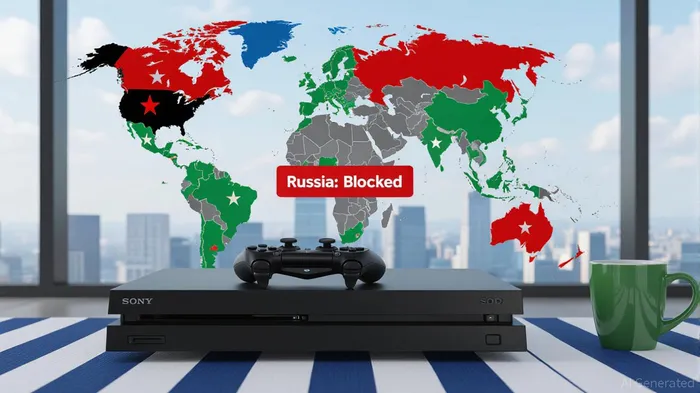
The PlayStation division became a battleground for compliance. By May 2025, SonySONY-- had cracked down on Russian users exploiting Ukrainian and Turkish PSN accounts, blocking thousands of profiles. This move, while necessary for sanctions compliance, further eroded a market that once accounted for 5% of global PlayStation sales. Meanwhile, restructuring costs—including 900 layoffs across studios and the closure of PlayStation London—added to the financial strain.
A Global Trend, A New Normal
Sony's experience mirrors a broader exodus. From ShellSHEL-- to Bosch, over 1,000 foreign firms have exited Russia, collectively writing down $107 billion in assets since 2022. The financial toll isn't just about lost revenue; it's about the erosion of trust. Russian consumers, once loyal to Western brands, now associate them with foreign sanctions. Meanwhile, Moscow's retaliatory policies—forcing asset sales at pennies on the dollar—have turned even orderly exits into financial disasters.
For tech and media companies, the risks are amplified. Unlike energy or retail, these sectors rely on intellectual property and digital ecosystems, which are uniquely vulnerable to geopolitical shocks. A blocked PlayStation account in Russia isn't just a lost sale—it's a signal to regulators in other markets that a company can be weaponized in geopolitical conflicts.
The Investor's Dilemma: Hedging Against the Unpredictable
The Sony case raises a critical question: How should investors assess geopolitical risk in global equities? Traditional metrics—revenue growth, profit margins, R&D spending—no longer suffice. Instead, investors must now evaluate a company's exposure to volatile regions, its ability to pivot supply chains, and its governance structures for crisis response.
1. Diversification Beyond Borders
Tech firms with cross-border exposure must avoid overconcentration in high-risk markets. Sony's reliance on Russia for PlayStation sales highlights the dangers of geographic overreach. Investors should favor companies with diversified revenue streams and localized production hubs. For example, firms that have shifted manufacturing to Vietnam or India—rather than relying on China or Russia—are better positioned to weather geopolitical shocks.
2. Scenario Planning and Stress Testing
The most resilient firms are those that treat geopolitical risk as a routine part of strategic planning. Sony's restructuring of Bungie and Firewalk Studios in 2024-2025, while painful, was a proactive response to anticipated market shifts. Investors should look for companies that publish detailed risk assessments and stress-test their balance sheets against worst-case scenarios.
3. Natural Hedging and Liquidity Buffers
Geopolitical volatility demands liquidity. Sony's ability to repatriate funds from its Russian joint venture (despite the broader collapse) provided a temporary buffer. Investors should prioritize firms with strong cash reserves and flexible capital structures. For example, companies with natural hedging—matching local revenue and expenses in volatile currencies—can mitigate sudden devaluations or sanctions.
4. Governance and Crisis Readiness
A company's response to geopolitical crises often hinges on its leadership. Sony's decision to exit Russia swiftly, despite short-term losses, was a testament to its board's prioritization of long-term reputation. Investors should scrutinize corporate governance structures, favoring firms with independent risk committees and transparent communication during crises.
The Road Ahead: Investing in Resilience
As geopolitical tensions persist, the cost of doing business in unstable regions will only rise. For tech and media companies, the lesson from Sony's exit is clear: adaptability is the new competitive advantage. Investors must shift from a “growth-at-all-costs” mindset to one that prioritizes resilience.
Consider the following strategies:
- Sector Rotation: Overweight firms in low-risk geographies (e.g., Southeast Asia, North America) and underweight those with heavy exposure to Russia, China, or the Middle East.
- ESG Alignment: Invest in companies with strong ESG frameworks, which often correlate with better geopolitical risk management.
- Derivative Hedging: Use currency and commodity derivatives to offset exposure in volatile markets.
Conclusion
Sony's exit from Russia is a cautionary tale and a case study in modern corporate risk management. For investors, it's a reminder that geopolitical volatility isn't a passing trend—it's a permanent feature of the global economy. The companies that thrive will be those that treat geopolitical risk as a strategic asset, not a liability. In this new era, the question isn't whether to hedge against geopolitical shocks, but how aggressively to do so.

Delivering real-time insights and analysis on emerging financial trends and market movements.
Latest Articles
Stay ahead of the market.
Get curated U.S. market news, insights and key dates delivered to your inbox.




Comments
No comments yet