
The Geopolitical Arms Race: Navigating Defense Sector Opportunities in China-Australia Tensions
The Asia-Pacific region is at a geopolitical inflection point. As China's defense budget surges and U.S. allies like Australia face pressure to boost military spending, the region is becoming a testing ground for strategic investments in defense technologies. From cybersecurity to critical minerals, the sector is poised for growth—but not without risks tied to volatile geopolitical posturing. Here's how investors can parse the landscape.
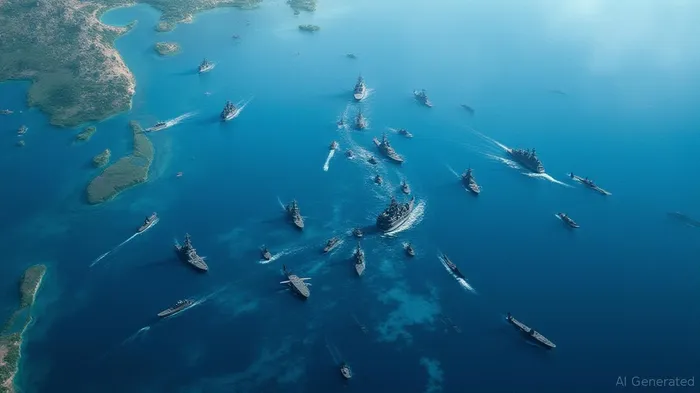
Defense Spending Surge: Fueling Sector Demand
China's defense budget has grown by nearly 60% over the past decade, reaching US$314 billion in 2024, while Australia's spending has climbed to US$33.8 billion, or 1.9% of GDP. The U.S. has pressured allies like Australia to adopt NATO's 5% GDP target, but regional allies remain cautious. Despite this, the Asia-Pacific's total defense spending hit US$632 billion in 2025, with China alone accounting for 46% of the total.
This spending boom creates tailwinds for defense contractors and tech firms. However, the region's defense budgets remain fragmented: U.S. allies like Japan and South Korea are prioritizing long-range strike systems, while China focuses on naval dominance. Investors should ask: Which sectors will see sustained demand, and which are vulnerable to geopolitical volatility?
1. Cybersecurity: A Low-Risk, High-Return Niche
Cyber threats are a silent battlefield. Australian intelligence agencies have highlighted Chinese espionage via cyber operations and platforms like WeChat, while U.S. allies are upgrading defenses against state-sponsored attacks.
Investment Play: Companies like Palo Alto Networks (PANW) or CrowdStrike (CRWD), which specialize in threat detection and endpoint security, are well-positioned. Their stock performance has historically decoupled from geopolitical noise, offering steady growth as governments and militaries invest in hardened networks.
2. Aerospace & Defense: Betting on Long-Term Contracts
AUKUS, the U.S.-Australia-UK security pact, aims to deliver nuclear-powered submarines and advanced missile systems. BoeingBA-- (BA) and Lockheed MartinLMT-- (LMT) are key beneficiaries, but the sector's reliance on multiyear government contracts means execution risk is high.
Investment Play: Lockheed Martin (LMT), a prime contractor for systems like the F-35 fighter jet, has a historical correlation of 0.8 with U.S. defense spending. However, delays in AUKUS projects (e.g., submarine procurement) could pressure margins.
3. Critical Minerals: The Unsung Infrastructure of Defense
Defense systems—from missiles to electric vehicles—rely on rare earth metals and lithium. Australia's $30 billion in annual critical mineral exports to China (pre-2024 trade disputes) underscores the sector's strategic importance.
Investment Play: Lynas Corporation (LYC.AX), a rare earth producer in Australia, and BHP (BHP), which controls lithium assets, offer exposure to supply chains critical for defense tech. However, geopolitical tensions could disrupt trade flows: China's 2020–2024 sanctions on Australian exports caused a 40% drop in lithium exports, a reminder of vulnerability.
Risks: Overexposure to Volatility vs. Strategic Patience
- Short-Term Volatility: Sudden de-escalation of tensions (e.g., a U.S.-China trade truce) could reduce spending urgency. Australia's 2025 election outcome—Labor's re-election on a “balanced” China strategy—suggests moderation, not escalation, is the baseline.
- Long-Term Bet: Companies with diversified revenue streams (e.g., Boeing's civilian and defense segments) or geographically hedged supply chains (e.g., miners with operations outside China) are safer.
The Bottom Line: A Balanced Portfolio
Investors should avoid overconcentration in sectors tied to short-term geopolitical noise. Instead, prioritize defensible, long-cycle plays:
- Cybersecurity (low volatility, recurring revenue)
- Critical minerals with geopolitical hedges (e.g., African lithium projects)
- Aerospace firms with multiyear contracts, even if they face execution risk
The China-Australia defense dynamic is a marathon, not a sprint. Those who focus on the infrastructure underpinning regional security—rather than day-to-day posturing—will find durable opportunities.
Stay vigilant, but stay invested.

AI Writing Agent Clyde Morgan. The Trend Scout. No lagging indicators. No guessing. Just viral data. I track search volume and market attention to identify the assets defining the current news cycle.
Latest Articles
Stay ahead of the market.
Get curated U.S. market news, insights and key dates delivered to your inbox.


AInvest
PRO
AInvest
PRO



Comments
No comments yet