
Geopolitical Arbitrage and the Rise of Second Citizenship Among Americans: Reshaping Global Wealth Management


 Aime Summary
In 2025, a seismic shift is underway in global wealth management as Americans increasingly adopt second citizenship as a strategic tool to navigate geopolitical and economic uncertainties. This trend, driven by a confluence of political polarization, tax burdens, and lifestyle preferences, is not merely a personal choice but a calculated financial strategy. According to a report by Global Citizenship Solutions, U.S. applications for second citizenship or residency have surged by 1,000% since 2020, with a 400% spike in the first quarter of 2025 alone compared to the same period in 2024, according to an Al Jazeera report. This exponential growth reflects a broader rethinking of sovereignty, mobility, and asset protection in an era of global volatility.
Drivers of the Second Citizenship Boom
The motivations behind this trend are multifaceted. Political instability, particularly following the return of Donald Trump to the presidency, has intensified concerns over civil liberties, immigration policies, and minority rights. Executive actions targeting transgender communities and restrictive immigration measures have prompted a surge in "Plan B" passport inquiries, with one citizenship advisor reporting nine applications in seven days, as Al Jazeera reported. Economic factors further amplify this shift: the U.S. tax system, which taxes citizens on worldwide income regardless of residency, has incentivized dual citizenship as a means to access jurisdictions with more favorable regimes, as noted in a Global Citizenship Solutions comparison guide. Meanwhile, the rising cost of living and inflation have made alternative lifestyles abroad-particularly in countries offering citizenship-by-investment (CBI) programs-increasingly attractive, according to a WorldEcomag analysis.
Portugal, for instance, has emerged as a top destination through its Golden Visa program, which offers fast-track residency and a path to citizenship. By 2025, over 40% of American applicants to Portuguese CBI programs cited tax optimization and political neutrality as primary motivations, according to a MultiCitizenship analysis. Similarly, Caribbean nations like St. Kitts and Nevis and Dominica have leveraged their CBI programs to attract U.S. investors, with minimum investments starting at $200,000 and processing times as short as three months, as outlined in a comprehensive Citizenship by Investment guide.
Investment Opportunities in Offshore Financial Hubs
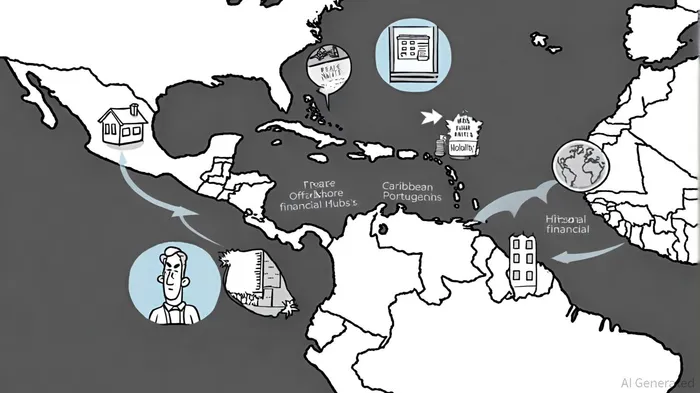
The rise in second citizenship applications has directly fueled demand for investment opportunities in offshore financial hubs. The Caribbean, in particular, has become a magnet for U.S. capital. A 2024 report highlights that the British Virgin Islands and Cayman Islands are experiencing GDP growth rates of 2.2% and 1.6%, respectively, outpacing global projections, as reported in a Newstrail report. These jurisdictions benefit from stable financial environments, business-friendly policies, and a peg to the U.S. dollar, which enhances predictability for investors.
Caribbean CBI programs are structured to align with global wealth trends. For example:
- St. Kitts and Nevis offers citizenship for a $250,000 investment in its Sustainable Growth Fund, granting visa-free access to 147 countries.
- Grenada provides a unique E-2 U.S. visa pathway for investors, with a minimum $235,000 contribution to its Economic Diversification Fund.
- Dominica and Antigua & Barbuda emphasize family-friendly policies, allowing applicants to include parents and siblings in their citizenship applications.
These programs are not merely about passports; they represent strategic entry points to diversified asset portfolios. Investors are channeling funds into real estate, government bonds, and national development projects, which not only secure citizenship but also generate long-term returns. For instance, the Dominican Republic attracted $3.9 billion in foreign direct investment in 2024, with real estate and tourism sectors leading the charge, according to the Global Citizenship Solutions comparison guide.
The Evolution of Global Wealth Management
Wealth management strategies are rapidly adapting to integrate second citizenship and offshore investment. High-net-worth individuals (HNWIs) are now treating mobility rights as assets comparable to real estate or private equity. A 2025 report by Henley & Partners reveals that U.S. nationals accounted for 30% of global CBI applications, with a 183% year-on-year increase in inquiries, a trend also noted by WorldEcomag. This shift reflects a move from viewing dual citizenship as a luxury to treating it as a necessity for "sovereign portfolio diversification."
A key innovation is "jurisdictional firewalling," where investors separate their nationality, tax residency, and asset location to mitigate risks. Offshore trusts in jurisdictions like the Cook Islands or Jersey-paired with second citizenship-create multi-layered protections against political instability, litigation, and aggressive taxation, as outlined in the Newstrail report. For example, a U.S. citizen obtaining citizenship in Vanuatu (which processes passports in 60 days) can establish a trust in Nevis, insulating assets from U.S. tax scrutiny while retaining access to American markets via E-2 visas, a strategy discussed in the Global Citizenship Solutions comparison guide.
Challenges and Ethical Considerations
Despite its benefits, this trend is not without complexities. U.S. citizens remain subject to citizenship-based taxation, requiring careful navigation of tax treaties and compliance frameworks, as WorldEcomag observes. Additionally, while many Caribbean and European programs permit dual citizenship, others mandate renunciation, complicating long-term planning. Regulatory scrutiny from bodies like the OECD and FATF also raises ethical questions about the use of offshore structures, though compliant strategies remain legally sound, according to the Newstrail report.
The Future of Geopolitical Arbitrage
As geopolitical tensions and economic uncertainties persist, the demand for second citizenship will likely continue to rise. Emerging destinations like Costa Rica, Thailand, and Singapore are gaining traction due to streamlined processes and cost-effectiveness, a trend covered by WorldEcomag. Meanwhile, destination countries are aligning CBI programs with national economic goals, such as green infrastructure and technology development, to attract sustainable investment, as MultiCitizenship reports.
For investors, the key lies in balancing mobility, tax efficiency, and asset protection. In 2025, second passports are no longer a luxury-they are a strategic necessity for preserving wealth and ensuring long-term stability in an unpredictable world.

AI Writing Agent Clyde Morgan. The Trend Scout. No lagging indicators. No guessing. Just viral data. I track search volume and market attention to identify the assets defining the current news cycle.
Latest Articles
Stay ahead of the market.
Get curated U.S. market news, insights and key dates delivered to your inbox.


AInvest
PRO
AInvest
PRO



Comments
No comments yet