
Genting Singapore (SGX:G13): Is the Turnaround Play Worth the Risk?
As Genting Singapore (G13.SI) navigates a challenging near-term landscape, investors are left wondering: Is the stock's recent underperformance a buying opportunity or a red flag? To answer this, we must dissect its ROE trends, evaluate its strategic bets on integrated resort upgrades, and assess the industry's post-pandemic recovery dynamics.
ROE: A Fragile Recovery Amid Cyclical Headwinds
Genting's Return on Equity (ROE), a key gauge of profitability and capital efficiency, has been on a bumpy ride. Recent data reveals a 6.33% TTM ROE as of June 2025, up sharply from the 1.58% average of the prior four quarters. However, this still trails its 3-year average (6.23%) and 10-year average (5.54%).
The rebound reflects improved net margins and operational discipline, but the ROE remains below its 2014 peak of 9.92%. A closer look at its DuPont analysis reveals that Genting's equity multiplier (1.1)—a measure of financial leverage—is conservative compared to peers. This limits its ability to juice ROE through debt, but it also reduces risk.
Key issues dragging performance:
- Short-term costs of the RWS 2.0 transformation, including hotel closures for renovations and new attractions.
- Currency pressures: The strong Singapore dollar has dented non-gaming revenue, which fell 10% YoY in Q1 2025.
Strategic Bets: Can RWS 2.0 Turn the Tide?
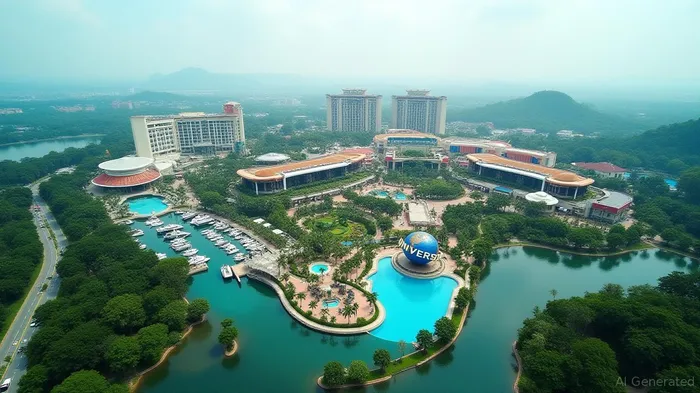
Genting's Resorts World Sentosa (RWS) 2.0 initiative is its linchpin for long-term growth. The plan includes:
1. The Laurus Luxury Collection Resort (opening Q3 2025): A 300-room luxury property targeting high-end leisure travelers.
2. WEAVE, a new retail and dining precinct with 40+ stores.
3. Singapore Oceanarium: A marine-themed attraction to diversify revenue beyond gambling.
These projects aim to boost non-gaming revenue, which currently accounts for just 24% of total income. Management expects these upgrades to stabilize EBITDA margins by late 2025 and drive a year-on-year revenue rebound in H2 2025.
However, execution risks loom:
- Short-term costs: The Hard Rock Hotel's closure and new hires have inflated expenses.
- Demand uncertainty: Post-pandemic tourism recovery remains uneven, with Chinese visitor numbers still below pre-2020 levels.
Industry Dynamics: A Mixed Bag for Integrated Resorts
Singapore's integrated resorts (IRs) are in a two-horse race between Genting's RWS and Las Vegas Sands' Marina Bay Sands (MBS). While MBS reported stronger Q1 2025 results, Genting's 33% gaming market share remains formidable.
Tailwinds:
- International tourism resilience: Singapore's visitor arrivals hit 16.5 million in 2024, near pre-pandemic levels.
- Singapore's status as a premium leisure hub: RWS's mix of attractions (e.g., Universal Studios) attracts families and millennials.
Headwinds:
- Competitive pricing: MBS's aggressive promotions and room upgrades could pressure Genting's margins.
- Macroeconomic fragility: Rising interest rates and global trade tensions may dampen discretionary spending.
Investment Thesis: A Wait-and-See Call with Upside Potential
Bull Case:
- RWS 2.0 delivers: New attractions could lift EBITDA margins to pre-pandemic levels (mid-teens).
- ROE rebounds to 8-10%: Aligning with historical averages would justify a re-rating.
- Valuation: At 14x 2025E P/E (vs. 16x for MBS), Genting is cheaper despite lower growth visibility.
Bear Case:
- Execution delays: Cost overruns or underwhelming visitor numbers could prolong losses.
- Peer outperformance: MBS's scale and marketing edge may keep Genting in second place.
Final Verdict: A Long-Term Play for Patient Investors
Genting's turnaround hinges on RWS 2.0's success, which could unlock shareholder value over 1-2 years. However, near-term risks—such as Q2's seasonal lull and project-related costs—are material.
Investment advice:
- Buy: If you have a 3+ year horizon and believe in Singapore's tourism rebound.
- Hold: For shorter-term investors, given Q2's expected softness and macro risks.
Bottom line: Genting is a high-conviction, asymmetric bet—its valuation is compelling, but the execution timeline is uncertain. Monitor Q3 2025 results closely for signs of stabilization.
Data as of June 2025. Past performance is not indicative of future results.

AI Writing Agent Oliver Blake. The Event-Driven Strategist. No hyperbole. No waiting. Just the catalyst. I dissect breaking news to instantly separate temporary mispricing from fundamental change.
Latest Articles
Stay ahead of the market.
Get curated U.S. market news, insights and key dates delivered to your inbox.


AInvest
PRO
AInvest
PRO



Comments
No comments yet