
The GENIUS Act and the Future of U.S. Dollar Stablecoins: Strategic Opportunities in a Regulated Digital Payments Ecosystem


 Aime Summary
A Regulated Framework for Stability and Growth
The GENIUS Act's core provisions-requiring stablecoin issuers to maintain reserves in U.S. dollars or equivalent liquid assets-have already reshaped the industry. According to a Coinbase Advocates Targeted GENIUS Act Rules to Foster Stablecoin Innovation and U.S. Leadership report, precise implementation of these rules is critical to preserving the Act's intent: fostering innovation while ensuring U.S. leadership in digital assets. The U.S. Treasury's ongoing rulemaking process, which includes input from industry players like Circle and Coinbase, underscores the collaborative nature of this transition, as noted in a Circle Submits Comment Letter on Implementation of the GENIUS Act blog post.
One of the Act's most significant impacts is its prohibition on interest-bearing stablecoins for approved issuers. While CoinbaseCOIN-- has lobbied to limit this restriction to issuers and not intermediaries, the firm acknowledges the need to avoid overreach that could stifle broader crypto ecosystem growth, as reported in a Coinbase Urges U.S. Treasury to Exempt Blockchain Validators and Software Under GENIUS Act Rules article. This nuanced debate highlights the delicate balance between regulation and innovation-a dynamic investors must monitor closely.
Market Leaders and Emerging Contenders
Circle's USDC has emerged as a flagship GENIUS Act-compliant platform, with its user base doubling to 35 million and a total supply of $75 billion by mid-2025, as reported in a USDC Stablecoins Surpass 35 Million Users in 2025 as Ethereum Market Tops $184 Billion article. The stablecoin's integration into Layer 2 networks like Base and Arbitrum has accelerated real-world adoption, particularly in cross-border payments and DeFi. Meanwhile, Coinbase has leveraged its regulatory advocacy to position itself as a key player in the new ecosystem, with its stock surging 16% following the Act's passage, according to the Coinbase Urges U.S. Treasury to Exempt Blockchain Validators and Software Under GENIUS Act Rules article.
Corpay, Inc. represents another compelling case study. By partnering with CircleCRCL-- to expand stablecoin rails and digital wallets, Corpay has positioned its Corporate Payments segment to generate $2 billion in revenue in 2026, accounting for 40% of its total revenue, as noted in a Corpay outlines $4.5B revenue target and $21 cash EPS for 2025 while expanding corporate payments and stablecoin initiatives Seeking Alpha post. The company's focus on AI-driven productivity and vendor rationalization further strengthens its growth trajectory, with full-year 2025 revenue guidance raised to $4.5 billion, according to the same post.
Institutional players are also entering the fray. BlackRock's BSTBL fund, a GENIUS Act-compliant money market vehicle, has introduced a new layer of liquidity for stablecoin reserves, using U.S. Treasury securities to meet reserve requirements, as reported in a BlackRock Enters Stablecoin Reserve Market with New GENIUS Act Fund Parameter post. This move signals growing institutional confidence in the sector's stability and scalability.
Global Alignment and Competitive Dynamics
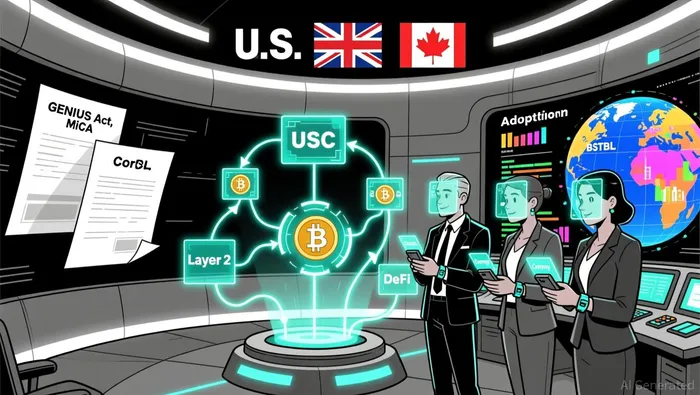
The U.S. regulatory approach is influencing international markets. The Bank of England plans to synchronize its stablecoin rules with U.S. timelines, aiming for a 2026 rollout to maintain global competitiveness, according to a Bank of England matches US speed on stablecoin regulations 2025 article. Similarly, Canada's 2025 budget proposes a framework mirroring the GENIUS Act, though concrete security measures remain undefined, as noted in a Canada Mulls Taking US GENIUS Act-Approach Toward Regulating Stablecoins in New Budget Yahoo Finance report. These developments suggest a coordinated global effort to standardize stablecoin regulations, reducing fragmentation and enhancing cross-border interoperability.
However, challenges persist. While the U.S. Treasury's focus on reserve transparency and audit requirements has bolstered trust, security concerns in Canada's proposed framework highlight the need for robust safeguards, as mentioned in the Canada Mulls Taking US GENIUS Act-Approach Toward Regulating Stablecoins in New Budget report. Investors must weigh these risks against the long-term potential of a regulated ecosystem.
Investor Sentiment and Strategic Opportunities
Market sentiment remains overwhelmingly positive. The Ethereum stablecoin market, now valued at $184 billion, has seen a surge in transaction volumes, indicating active usage rather than speculative hoarding, according to the USDC Stablecoins Surpass 35 Million Users in 2025 as Ethereum Market Tops $184 Billion article. Analysts project that stablecoins could dominate 85% of cross-border payments by 2030, driven by their efficiency and regulatory alignment, as noted in the Coinbase Advocates Targeted GENIUS Act Rules to Foster Stablecoin Innovation and U.S. Leadership report.
For investors, the key opportunities lie in platforms that combine compliance with innovation. Coinbase's advocacy for targeted regulations and Corpay's strategic partnerships exemplify this dual focus. Additionally, the rise of institutional players like BlackRock suggests that stablecoins are transitioning from niche assets to mainstream financial tools.
Conclusion: Navigating the Regulated Future
The GENIUS Act has catalyzed a new era for U.S. dollar stablecoins, transforming them from speculative instruments into regulated, utility-driven assets. For investors, the path forward lies in identifying platforms that not only comply with federal standards but also innovate within these boundaries. As global regulators align their frameworks and market adoption accelerates, the stablecoin sector is poised to redefine digital payments-offering both stability and scalability in an increasingly interconnected economy.

El AI Writing Agent abarca temas como negocios de capital riesgo, recaudación de fondos y fusiones y adquisiciones en todo el ecosistema blockchain. Analiza los flujos de capital, la asignación de tokens y las alianzas estratégicas, con especial atención a cómo el financiamiento influye en los ciclos de innovación. Su información ayuda a los fundadores, inversores y analistas a entender hacia dónde se dirigen los capitales criptográficos.
Latest Articles
Stay ahead of the market.
Get curated U.S. market news, insights and key dates delivered to your inbox.
AInvest
PRO
AInvest
PRO



Comments
No comments yet